
digital mesh
Digital Mesh
Ten fragments from the project “Femton”, 2017 – 2018.
by Max Pihlström
for #IV. the medium is the message?
Differens Magazine, winter 23/24
Fragment I. 21.01.2017
The progress has been slow lately but today I finally crossed some mental hurdles with modest results towards rendering a triangle mesh. In fact I am more inspired than ever nowadays, by things in fields technically outside the scope of this project but which have, as they always have, in significant and even critical ways, supported a matrix carrying ambitions further.
Earlier thoughts around mathematical properties of the schema did not quite yield the crops in shape of epiphanies I was hoping for. I will now go on with an old and proven approach: Keeping things basic

Fragment II. 26.02.2017
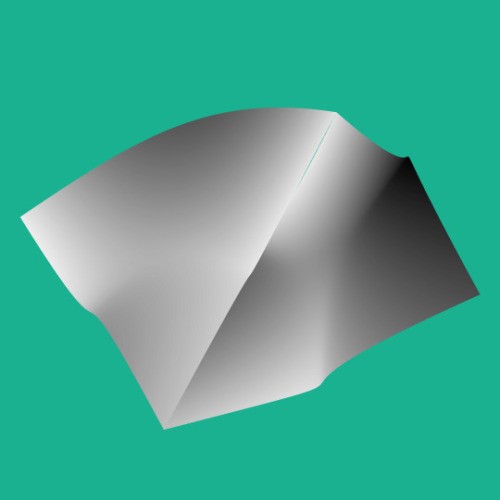
It has come to my understanding that the concept of schema on which I have relied much and which I originally borrowed from G. Tourlakis’s book on Gödel’s incompleteness theorems, is derived from Kant. Relating to the induction hypothesis of mathematical logic specifically, generally the meaning of Kant’s schema extends to bear upon even the very definition of concept itself. In constituting the rules of production of concepts as comprised of forms/ideas, schemata therefore pertain to the problem of representation.
It’s curious that, when applied to the visual triangulation, I have time and again found the term representation troublesome in its inadequacy to capture a notion of synthesis. Then lately I read G. Deleuze’s critique of the tradition of the metaphysics of representation – the model and its image – for which (in short summary) he wishes to substitute an epistemology of fundamentally affirmative differentiation. In the project of Femton it is precisely the distinguishing power of contour, in all its elusiveness, that has always been key. With an alternative way of constructing contour there arises first and foremost an alternative way of presenting images, as opposed to re-presenting them: imagery as production, not mere acquisition. It’s curious too that Deleuze grounds much of his argument on ideas from calculus and its notation. I have yet to come to terms with how this corresponds with recent developments of embedding differentiable cubic polynomial surfaces in the triangulation.
Fragment III. 12.03.2017
Fragment IV. 5.04.2017
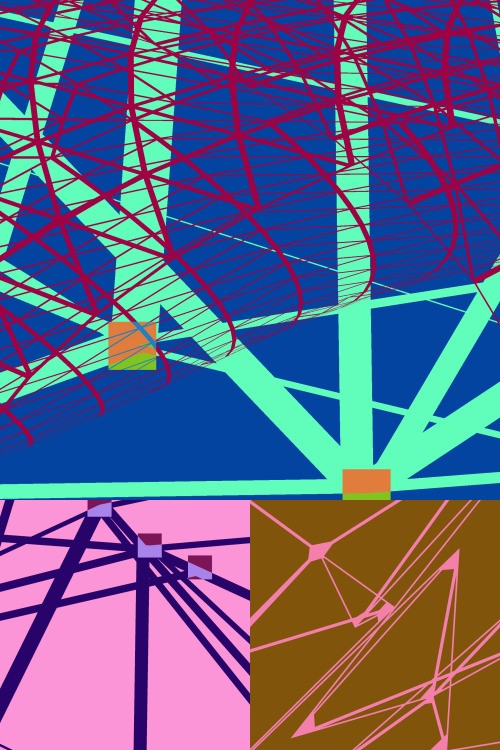
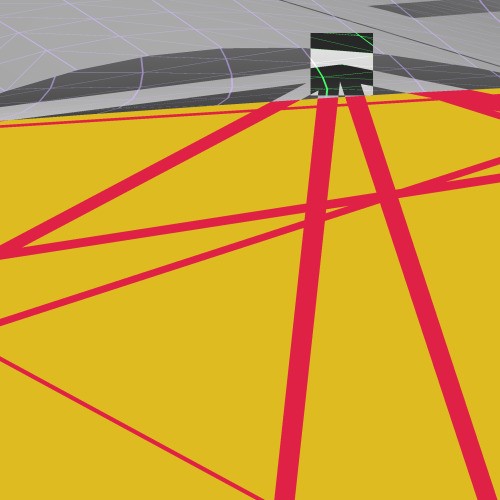
A secondary color buffer can be used for labeling in order to identify which object the cursor is hovering over on mouse clicks. It’s been called a hack, but I find it elegant. It’s both efficient and precise.
Fragment V. 16.04.2017
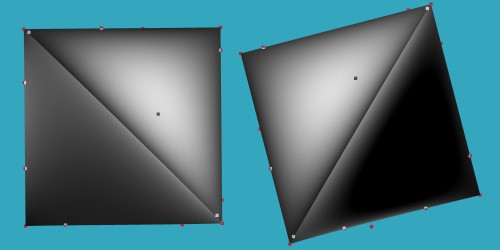
Essential mesh interactivity is coming along. Unforeseen angles are presented to me, as expected.
Fragment VI. 17.04.2017
Fragment VII. 16.03.2018
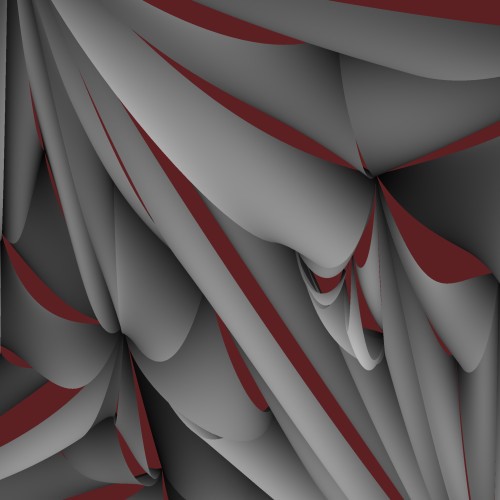
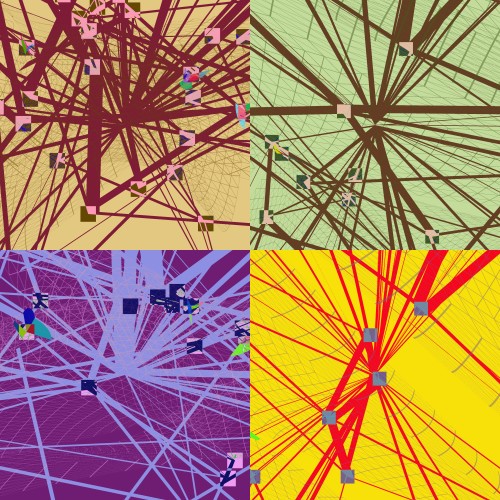
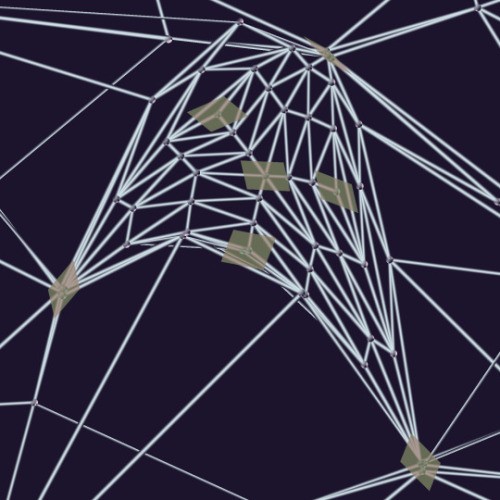
After a long hiatus I’m once again working. My approach this time is more bottom-up. As a first step I now have surface segmentation working flawlessly. [Edit 24.3.2018: There was a flaw! I believe it’s fixed now but lesson learned I will avoid the previous claim.]
Fragment VIII. 30.03.2018
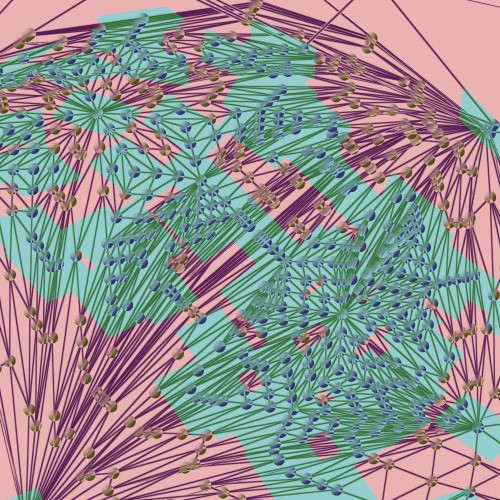
I’m making progress with how the mesh should be constrained. It will be of a more dynamic nature, that is to say pertaining to what I have previously called the framework (as distinguished from the schema) of the mesh. I expect to be experimenting with different types of iterative diffusion strategies in order to achieve global normalization.
Fragment IX. 17.04.2018
I’m experimenting with mesh diffusion strategies for the middle control node. Plain area minimization by an area cost function with a geometric continuity constraint seems to stabilize well. I’m becoming more open to the idea that this control node is always “floating”, is implicitly defined. But solvable! And its solution should be unique, most preferably. That’s probably the single most important property.
Fragment X. 20.04.2018
Area minimization is a problem with a unique solution. The solution is formal: it may not actually be found, only more or less approximately so depending on the (algorithmic) implementation; and its tractability and implementation specifics may furthermore affect future states of the mesh with possibly diverse outcome. But, at any point, there exists a formal surface. This formal surface is defined by a valid mesh together with the minimization problem and its unique solution.
The mesh is the instruction, the blueprint, from which a surface (i.e. an image) may be constructed and realized. While the realized, actual, observed, de facto surface may differ from the formal surface, this imperfection may still be accepted granted that the deviating realizations, upon operation, will continue to bring about only valid meshes. Importantly, the set of valid meshes should be closed under operation so that the formal surfaces remain within a domain of ideals. The operation itself, however, may well be determined by the much more contingent and virtually undefined surfaces realized in, what you could call, matters of circumstance. There is a separation between the formal and the realized, and yet, also, an asymmetric spiral of communication.
Read more at https://femton15.tumblr.com
 differensmagazine.com