
SANTA’S LITTLE HELPER
A conversation with Kris Lemsalu
Astrid Elander
Differens Magazine, autumn 24
With her extravagant sculptures and playful performances, Kris Lemsalu is restlessly charming the art world. In this issue, she is featured with her multilayered art, into which she molds all kinds of stuff; ceramics, clothes, furniture etc., creating objects and events that simultaneously provokes laughter and raises profound questions about life, death and, of course, beauty. Differens Magazines Astrid Elander got the opportunity to ask her about her working process, her thoughts on beauty and universality and her beauty advice.
Astrid Elander: Hey Kris, what are you doing?
Kris Lemsalu: Right now I’m making two sculptures. One is a traffic light called “Amber takes a long time”, it’s a work I’ve wanted to do for a year now. And like all my happy accidents I stumbled across a movie set or like a lot here in LA that sells old movie stuff, and there was this traffic light from the 50s and the only light that wasn’t broken was the amber, the yellow. It was almost mind-blowing because that’s the work I’ve been thinking about for so long, it just appeared at the right time.
It’s an appreciation of the in-between-zones in life, when your wave hasn’t really turned into that green light yet, but it’s the in-between space that also needs to be appreciated, it doesn’t go from red to green always, it has that time in between. It’s like a node or a bow… or like an airport. You’re not there yet, but it’s equal to the other parts. Like a totem for that in-between time. I feel like we are very much in between times, it’s not only personal, it’s also what I’m sensing in the world, so tapping into that feeling. It’s also about patience. When you’re trying to cross the road, you need patience, even if you’re in a hurry. It’s a good practice. It feels like I’m building a patience goddess or something.

Kris Lemsalu, Amber takes a long time, 2024.
A.E: You had this picture of the traffic light in your head already a year ago?
K.L: Yes, the title was there. I really liked the sentence, “Amber takes a long time”. I felt like I was on to something. It kind of penetrated my psyche. I’ve been working for so many years now, I know when I’m on to something. It’s like a cluster that starts to build up. With this piece, which is not so often, it started from the title and grew, like crystals. Like “oh, it’s a traffic light!” And then it defined itself.
A.E: We are making an issue of Differens about universalism and beauty. Do you think there is anything universally beautiful? And, in that case, what would that be?
K.L: For sure. Nature is universally beautiful. And we artists are like Santa’s little helpers trying to reach something just as beautiful. But the hierarchy is pretty strong. We will be defeated by nature every time. I don’t think we’re able to create something higher than nature. I also think a sincere connection and love is beautiful. Love that is not smeared or painted or dusty. I’m a people person, a person who creates communities and works with a lot of people, so I see a lot of beauty in that realm. You develop a connection and then energy is created from that connection, you start building something together, imagining or fantasising, creating your own world. That’s beauty to me.
A.E: And do you think there is anything universally ugly?
K.L: War is universally ugly, and all kinds of attributes and psychological or biological states and desires that lead up to such horrors.
A.E: How do you navigate aesthetically between parameters of beauty-ugliness in your work? For example: do you strive towards beauty? Do you wish to challenge normative ideas of beauty?
K.L: I don’t really analyse myself in that way because, you know, beauty is a very broad concept. I’m a little bit like a rebel, since I didn’t make up the concept of beauty and don’t really agree with it. I don’t agree with different seasonal trends of women’s bodies and so on. That’s why I’m on a road to build my own world. I don’t even mention I’m working with beauty. It’s more like I’m finding beauty in peace. And also in the details in my works, whatever material it might be. It might be porcelain or a sleeping bag, I’m trying to give them the same amount of care and attention. Even if one material is generally seen as ugly or cheap. They are all held in balance. I feel like that’s very visible. It makes sense altogether, even though there is no logical combination. Actually, the way I work is even more interesting than the works themselves. I’m breathing life into a piece. I also take in particular energies of the people I work with. I’m trying to achieve a peaceful existence, that’s beauty to me.
Still today, when I see some detail and I’m like “I can’t do that, it’s so ridiculous”, I know I’m in the right spot.
A.E: I wondered about that. You are using many different materials and genres, moving between installations, objects, ceramics, and performance. Still, you have a very consistent and personal aesthetic style, how did you find it?
K.L: I guess that’s the same kind of difficult question as “how did you find yourself?”. After I studied ceramics in Estonia, I moved to Vienna to study sculpture, and in the ceramic world there’s a lot of rules, and I felt like breaking free from that way of doing things. I allowed myself more and I was more playful. I remember when I did a little installation that felt so ridiculous. It was the work called wisdom and eggs, it’s a red boat with owls and chickens sitting in neon life vests. I had to overcome a fear of showing something that felt so absurd, and the feeling of overcoming this fear and then getting good feedback… understanding that there is support, people actually find it funny or find it deep or find meaning in it. That keeps the wheel turning. Still today, when I see some detail and I’m like “I can’t do that, it’s so ridiculous”, I know I’m in the right spot. Because I will get those people laughing about this exact thing. I communicate with my so-called people through my work. They are a little bit like a watchtower. Words are complicated. I find my language through my sculptures and installations.

Kris Lemsalu, Wisdom and eggs, 2011, photos by Katharina Reckendorfer and Josef Schauer-Schmidinger.
A.E: Do you receive inspiration from these communities as well?
K.L: Totally. That’s how my work is made. I understand the world and different cultures through people. And that’s somehow my main goal, to understand life a little more.
A.E: You’ve said before that you often get a clear image of a piece before you create it – like with the traffic light. But I also get the feeling that your works are very intuitively created with a high sensitivity to the material. Tell us more about your working process.
K.L: Ceramics are always a part of my works. Like the icing on the cake in a way. I also use a lot of textiles, a lot of my own clothes. It’s an extension of my home which is basically just a few clothes and some books — my home is basically what I wear. It’s like I’m taking out the interior. And this also blends into my work, when I feel like I’m ready to let go of something, I donate it to the work. For example, I’m doing another piece right now with this lion’s head where I’m using a lot of wicker, and I found this family across the street who does wicker chairs and baskets, and I’ve been hanging out there and I got some material from them that I used. It’s all kind of an organic flow, and if you have done this long enough you don’t question the flow. It makes sense and you breathe with it.
A.E: Sounds like your artistic practice is an extension of your life. Do you feel that your life is also an extension of your art?
K.L: Oh yeah, all the time. I’m not able to extract myself from my art at all. I dress like my artwork and my artwork dresses like me. I’ve done some praying figures, Crybaby 1 and Crybaby 2, which are good examples of where I’ve used my own clothes.
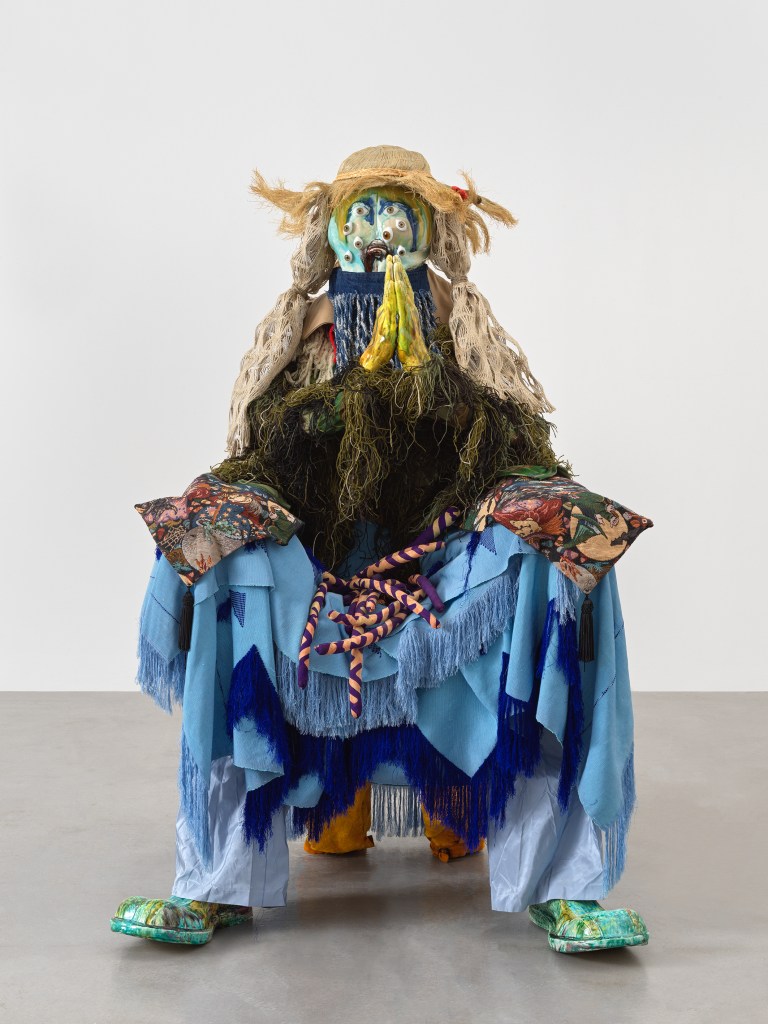
Kris Lemsalu, Сrybaby I, 2022 Eva Presenhuber group exhibition, photo Stefan Altenburger Photography.

Kris Lemsalu, Crybaby II, 2022 Eva Presenhuber group exhibition, photo Stefan Altenburger Photography.
A.E: Your work is often described as revolving around profound themes such as birth and death. But the reason we wanted to include you in this issue is because we perceive a recurring play with (multilayered) surfaces, disguise, make up… things that are connected to ideas of beauty. Do you agree? Why are you drawn to this?
K.L: I would go back to the idea of building your own universe, and defining your own rules in that universe. Layers are a great way to reveal and disguise. My makeup with these dark eyebrows is, for example, an extremely simple mask that allows me to go in and out, to be available and open and ready to communicate, or to hide. It’s a lot about play actually. I’m just curious to have a playful life and to find playmates in it. And I think that’s where this topic of beauty comes in, because when I work, I’m able to get into very elevated states of being. I like to make this similar to playing in a band, because mostly, music is much more direct and impactful than art. So I’m always trying to make a band. To capture that feeling of being in a jam session in the art work. That feeling of “oh my god we’re doing something elevated”.
I dress like my artwork and my artwork dresses like me.
A.E: You deconstruct bodies, gather hands, feet, tongues and arrange them in different formations, you use (your own) clothes, fabrics, animals and masks. Sometimes you create absurd figures, sometimes the formations appear as a part of the environment or some kind of decor or interior. Why this deconstruction and reconstruction of bodies?
K.L: Maybe I’m just offering a way to see things in life, because things don’t make sense. Absurdity and humor can be very helpful, it can release pressure and help to figure out ways to deal with things or life in general. It’s something I keep repeating in my work because I’m hoping that if you see it, you will get an experience that shifts your consciousness a tiny bit.
A.E: Why is that? Do you wish to question norms, or rather offer renewed perception of what we are? Like, why not three hands?
K.L: I don’t really know what’s normal and what’s not. I live in my own bubble, like most of us anyway. There are so many things occurring in nature that you can’t find an explanation for. And that’s the beauty of it. I guess I’m trying to imitate this, to give an additional view of how things could be, a second or third way of seeing.
A.E: You are also participating in your work as a performer, showing up in different costumes. For example, I spotted a picture from your latest exhibition “One foot in the gravy” (5/4-11/5 2024) at Margot Samel in New York where you were sitting in one of your installations, a rocking chair, with a huge tongue in your knee. Why this play with embodiment and disembodiment?
K.L: With this exhibition, I was trying to convey a particular feeling, a euphoric feeling that you get maybe when you recover from an illness or when somebody close to you dies. When the grief is over, you can get a very ecstatic feeling of being alive. An understanding and appreciation of life that doesn’t last long. A connection or a realisation. That’s such a crazy and precious moment. For the performance, I took this tongue in my knee. The tongue is a recurring symbol in my work. In Chinese medicine, you use the tongue to see what state your intestines are in, what’s happening in your life and in your body. It’s also a tool of communication. A tool of power. This goddess Kali, she always has her tongue out. It’s also erotic and it conveys everything in a way. Anyway, during the show, I was sitting there for two hours with the tongue in my knee while a song I made recently was playing, a cover of “put the lime in the coconut” by Harry Nilsson. I was sat facing a life altar that I had made. It was like I was viewing myself from afar, like I would be 100 years old and looking back on my life. I was sitting with it and communicating with the journey I’ve made so far, trying to convey that feeling of being alive and being happy about it. Because it comes down to this, it’s good to remind oneself of when petty things take over.
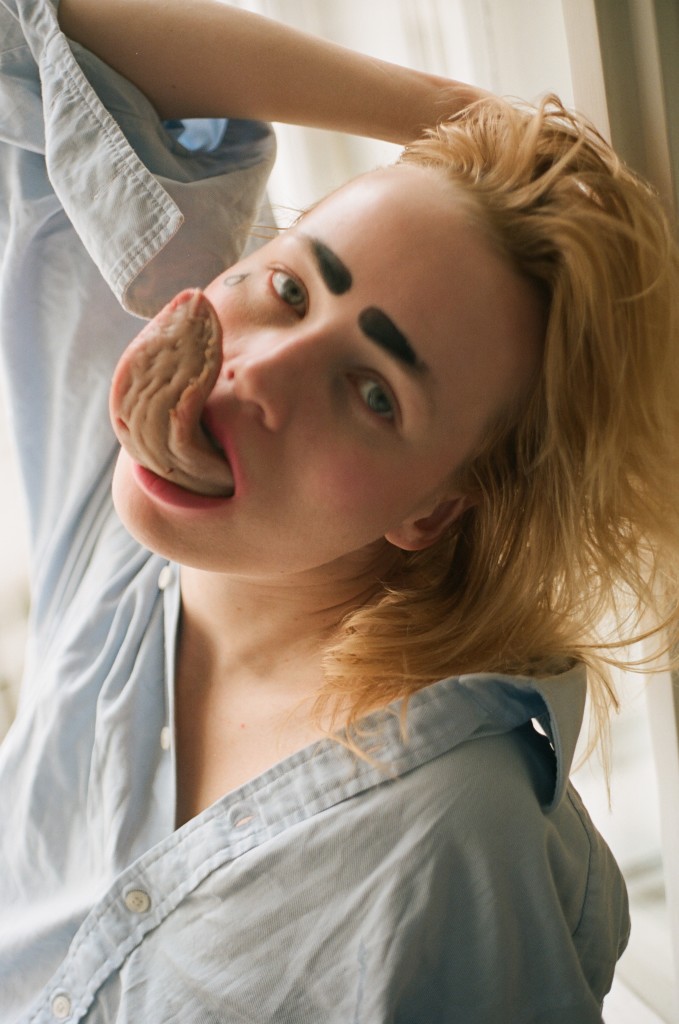
Kris Lemsalu, Photo by Nikolaus Weitzer.
A.E: Time is often discussed in connection to beauty – some say permanence is not one of beauty’s attributes, that beauty is something evanescent that sometimes appears, while others see beauty as an eternal idea, something that for example art can embody and fix. What do you think?
K.L: I just saw a plane flying by. And that was kind of a tiny, pretty moment. It’s good to look at the sky. I like to look at the sky, it’s where I find a lot of beauty. The formations of the clouds and the sun rising or going down, or just the colors of the sky. It extends your attention span. It’s a good practice. Like fire.
A.E: Do you have any beauty advice for our readers?
K.L: I guess it’s about finding your true self. And about acceptance of that self. And finding confidence to be the way you are. Then you become an ageless creature, like evergreen, you have ripened to become whatever creature you’re meant to be and that’s always beautiful. I love those kinds of people. Accepting yourself is always visibly beautiful. But it’s a road, it takes time. Also, sauna is rejuvenating, and walking. Walking can shake off your worries, if you walk long enough you can solve problems. Like skin shedding in snakes.
A.E: You are participating in the exhibition “On the absurd drama that is also life” (26.10 2024-23.2 2025) at Malmö Museum of Modern Art. What else are you looking forward to?
K.L: I’m looking forward to having a huge museum show so I can invite my friends and show my total universe because that would be quite amazing. I’m also starting to dream of a home. I like this idea of having a place to invite people to, because I’m always visiting other people. I’d like to change the dynamic.
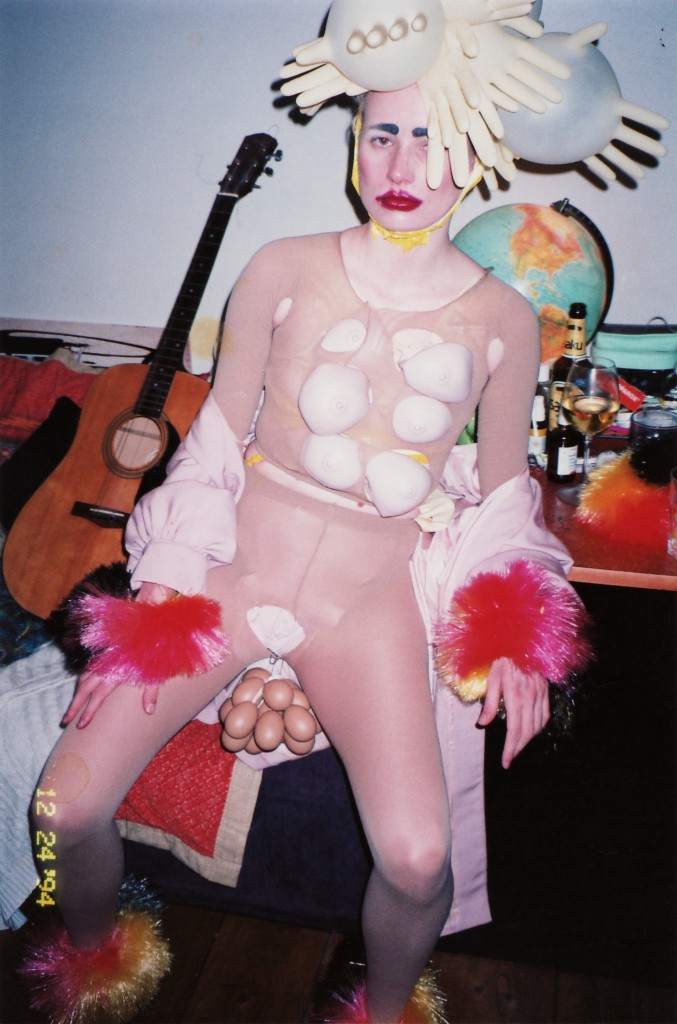
Kris Lemsalu’s portrait. Courtesy of the artist and Temnikova & Kasela Gallery. Photo by Johanna Ulfsak.
 differensmagazine.com