
Ugly Universalism
Europe’s Deadly Border Politics
Rosa Blens
Differens Magazine, autumn 24
The idea of universalism is a beautiful, unifying one. All human beings have the same value and the same rights. But although Western philosophy has a long history of universalist thinking, it seems that putting it into practice has never truly succeeded. When I think about universalism, I think about the people who have risked or lost their lives at Europe’s borders, those who are risking or losing their lives right now, and those who are yet to risk or lose theirs, trying to cross unruly terrain. How is it that the EU stands for human rights while Europe’s borders are so deadly that the Mediterranean has become a grave for so many?
The Puerto Rican Sociologist Ramon Grosfoguel, who uses the term ”European Provincialism”, has pointed out that universalism, in the first place, was never really intended to include everyone. By examining the history of its origins, Grosfoguel draws attention to a major contradiction in Western universalist theory. Western universalism is based on epistemic subjects who have freed themselves from all earthly limitations—including the body, their location within global power dynamics and their relationships. Being free from body, space, and time, is what makes them capable of arriving at universally valid insights. They claim for themselves a non-standpoint, an epistemic position that exists outside of this world, which is a position that was previously reserved for the Christian God.
When René Descartes wrote his famous cogito ergo sum (I think therefore I am), he was living in the 17th century Amsterdam. By that time, the Netherlands was the biggest colonial power with violently governed colonies in America, Africa, and Asia. When Immanuel Kant entered the conversation on universalist theory in the 18th century, the geopolitical situation had changed, with France, Germany and the UK replacing the Netherlands’ supremacy. It was no coincidence that the desks of the fathers of universalism were located at the centre of geopolitical power. As Grosfoguel points out, the subjects who theorised Western universalism had very specific locations, relationships and bodies. They were white, European, educated men located at the epicentre of global power. Or, as Grosfoguel writes: ”the political, economic, cultural, and social conditions of possibility for a subject who assumes the arrogance of speaking as though it were the eye of God is a subject whose geopolitical location is determined by its existence as coloniser/conqueror, that is, as Imperial Being.”
They claim for themselves a non-standpoint, an epistemic position that exists outside of this world, which is a position that was previously reserved for the Christian God.
Building universalist theory upon the ignorance of their own standpoint, Kant and Descartes unsurprisingly fail to take existing differences in locations, gender, sexuality, bodies, spirituality, race, class, ethnicity, or language among humans into account. As a result, people outside their own particular identity are simply excluded from subject status. What was an underlying assumption in Descartes’ works, comes to the surface in Kant’s writing. Transcendental reason in Kant’s ”Critique of Pure Reason” is not something everyone has access to. It belongs to those who he considers to be ”men”, which is male, white and European subjects. ”African, Indigenous Asian, and Southern European (Spanish, Italian, and Portuguese) men and all women (including Europeans) do not have the same access to ‘reason’”, writes Grosfoguel, referring to Kant’s anthropological work.
Why do people crossing European borders come to my mind when I think about universalism? I think about borders, because borders are places of radical differentiation. When we cross borders, it becomes more than obvious that we are not all equal. At Europe’s borders, we witness a radical paradox: the simultaneous existence of aeroplanes and other advanced transport technologies and the mass drowning of people in the Mediterranean Sea. Why is it that, in most cases, people in need of protection cannot take the safest route across the sea, which is by plane?
The ability to board an aircraft to cross the European border was restricted in the 1990s by the Schengen Agreement, which obliged airlines and shipping companies to bear all costs for passengers who are rejected at their destination due to missing documents. By forcing airlines to pay for all the costs incurred by a person without valid entry documents—according to European asylum policy this means accommodation, possible detention pending deportation, and the deportation itself—the responsibility for respecting human rights has been successfully transferred to the airlines.
In order to apply for asylum, non-European refugees must reach European soil first. Excluded from today’s technologically possible safe passages, these travellers are forced to take the path across weakly protected sections of the European borders, through forests, over mountains, or across the sea. Sociologist Estela Schindel studies border and mobility regimes. In her research on European borders, Schindel noted that not only are these travellers denied access to the safest way of crossing the sea, but high-tech surveillance systems, “security personnel” and illegal pushbacks also keep them away from the safer crossing points, pushing people into the most geographically rugged and dangerous terrain. As Schindel points out, this is no accident. “What in Western eyes may seem like open, borderless spaces—deserts, mountains, seas—become active agents in the practices of border enforcement and border crossing”, Schindel writes. Here, in the most inhumane geographical conditions, people die by drowning, thirst or freezing. These deaths are categorized as natural, a categorization that loses its validity when they are explained as the active incorporation of geographical circumstances into European border policies. These deaths are the result of being deliberately left to die.
These deaths are categorized as natural, a categorization that loses its validity when they are explained as the active incorporation of geographical circumstances into European border policies. These deaths are the result of being deliberately left to die.
Schindel suggests that these border policies should be understood as a forced expulsion of unwanted, non-European travellers into the realm of nature. As she shows, this expulsion is contingent on the European self-definition as superior to nature and therefore civilised. By forcing unwanted non-European travellers onto geographically rough terrain, they are placed in a position of extreme vulnerability to nature and its elements. At the same time, the politically engineered exclusion of refugees from technologically available, safe border crossings, for example by plane, forces them into a situation that Schindel describes as pre-technological. This, Schindel writes, ”reproduces a boundary between Europe as a modern, civilised, highly technologized realm, while at the same time pushing unwanted travellers, both symbolically and materially, into a zone of proximity with ‘nature’.” With the help of restrictive asylum politics, refugees are thus pushed into a position that is marked as uncivilised in the Eurocentric worldview, and that simultaneously keeps up the European narrative of superiority. This image is further reinforced by situations in which people’s paddles are taken from them by border guards, or rubber dinghies are capsized by motorised boats trying to rescue them—or at least pretending to.
The differentiation along the lines of civilised/uncivilised has a long colonial history in European anthropology. The Eurocentric image of all non-European cultures as “anthropological” cultures, which do not show a strong distinction between nature, culture and society—in contrast to the technologically equipped, civilised Europeans—has been used as an argument for colonisation. With the help of Schindel, we can see how this distinction is still active on Europe’s borders today. Drawing attention to the projections, ascriptions as well as material exclusions at work, she understands borders as places where subjectivities are produced. Due to the perceived and constructed proximity to nature, which has been considered deprived of subjectivity in Europe since the Renaissance, refugees tend to be excluded from subjecthood in a Eurocentric view.
It is clear that those who flee along dangerous paths are subjects, and are also not lacking technological means—smartphones, motorboats and GPS-devices are examples of this. However, paying attention to European patterns of interpretation might help to understand how the radically different situations of travellers with EU-citizenship or valid visas and those without is naturalised in a Eurocentric worldview. The perpetuation of racist, colonial and Eurocentric discourses that deny racialised individuals subject status here serves to maintain deadly border regimes and restrictive asylum regulations. By excluding people from the safe journey by plane, the Schengen Agreement has effectively overridden the right to asylum, which is part of the Universal Declaration of Human Rights. While those with EU-citizenship or the right visa cross European borders safely, non-European refugees, in the worst case, pay for the chance of a right to asylum with their lives. Through the alignment of images of non-European people at the mercy of the elements with the European distinction between civilised and uncivilised, the politically engineered exclusion is masked as natural. As a result we see how real, politically produced and radically racialised differences, which decide over life and death, are being ignored.
Those who can board a aeroplane and those who can not are in extremely different situations when crossing the European border. While the former are to be protected by surveillance systems at the airports, the latter are to be prevented from crossing the border by those systems, exposing them to death due to the geographical conditions. Moreover, people experiencing these differences physically, are excluded from subject status.
Moving beyond imagined, yet harmful categorisations like civilised/uncivilised means acknowledging and addressing the real inequalities imposed by current border regimes. Taking a look at those regimes reinforces the need for a new universalism that doesn’t fail to take differences among humans into account. Grosfoguel turns to Aimé Césaire in search of a decolonized vision of universalism:
”Provincialism? Absolutely not. I’m not going to confine myself to some narrow particularism. But nor do I intend to lose myself in a disembodied universalism. There are two ways to lose oneself: through walled in segregation in the particular, or through dissolution into the ‘universal’. My idea of the universal is that of a universal rich with all that is particular, rich with all particulars, the deepening and coexistence of particulars.”
By excluding people from the safe journey by plane, the Schengen Agreement has effectively overridden the right to asylum, which is part of the Universal Declaration of Human Rights. While those with EU-citizenship or the right visa cross European borders safely, non-European refugees, in the worst case, pay for the chance of a right to asylum with their lives.
In this light, a true universalism must be one that does not erase differences in race, gender, and class within the global power dynamics. Rather, it must be one that learns from them, building knowledge from the lived experience of all subjects.
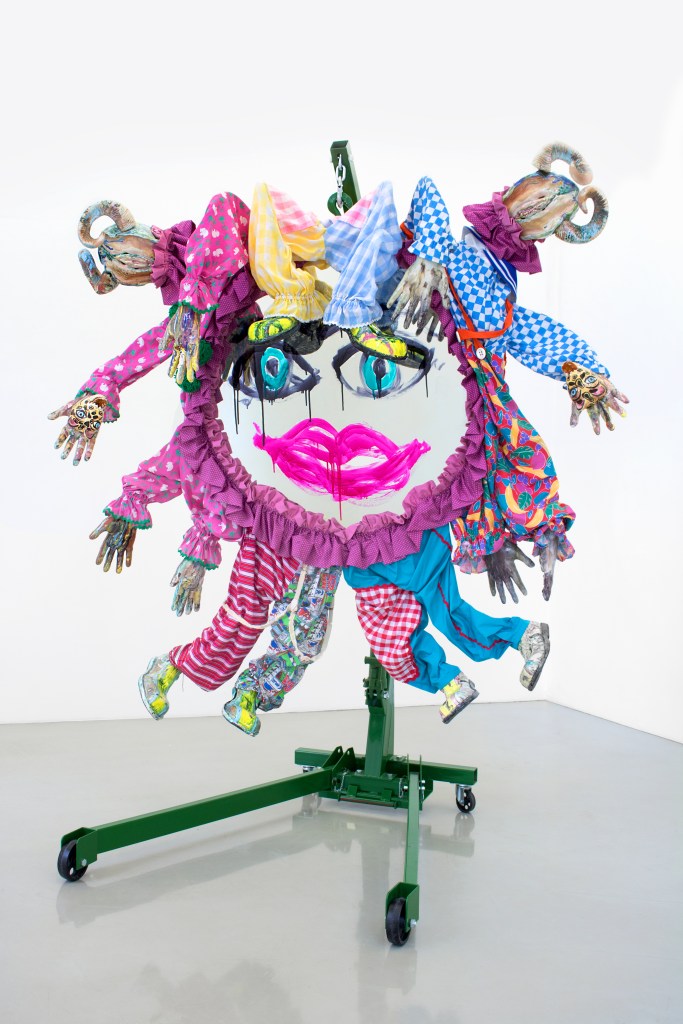
Kris Lemsalu, Lazy Flower, 2022, photo by Kati Göttfried.
Rosa Blens is a master’s student in cultural studies at the Humboldt University of Berlin.
REFERENCES:
Cesaire, Aimé. Discours sur le colonialisme. Paris: Éditions Réclame, 1950.
Grosfoguel, Ramón. Decolonizing Western Universalisms: Decolonial Pluriversalism from Aimé Césaire to the Zapatistas. TRANSMODERNITY: Journal of Peripheral Cultural Production of the Luso-Hispanic World. 1(3), 88-104. 2012.
Schindel, Estela. Das biopolitische Schisma: Materielle und symbolische Abgrenzungen entlang der EU-Grenzen. In: I. Gradinari, Y. Li & M. Naumann (Ed.), Europas Außengrenzen: Interrelationen von Raum, Geschlecht und »Rasse« (pp. 209-244). Bielefeld: Transcript Verlag, 2021.
 differensmagazine.com