
Playing With Fire
A Reflection on Love in the Works of Maya Eizin Öijer
Maya Eizin Öijer
for #vii. lovesick
spring 25

How do you get hold of the essence of love? Its intrusive and elusive nature, which at one moment seems to escape all words, as if words were too big and blunt, only to burst right through them in the next, making them seem all small and paltry.
One suggest might be to turn to the arts which instead of illuminating by delimiting, the way definitions do, tend to follow, mimic, or join in, like a dance partner or something.
In this issue of Differens Magazine for example, the editors have turned to the artist Maya Eizin Öijer. Her postmodernist aesthetic, the breaks in style and the mixing of motifs and materials, together with the recurring, pervasive even, dualism, seem to say something about the conditions of romantic love in our time. Characterized as much by ephemeral streams of images as by the indispensable forces that overturn life, her art simultaneously seems to ride on the surface and dig deep into the depths, back and forth between the interchangeable and the essential.
Eizin Öijer has been active since the 1980s, not to mention the 90’s. I wasn’t around visiting galleries back then, but I have a feeling that time has somehow caught up with her. A few years ago, her work was exhibited to much acclaim at Andréhn-Schiptjenko in Stockholm, partly to celebrate their 30-year collaboration.
The installation images are magnetic. The recurring zig-zag pattern that has been allowed to extend out of the paintings and spread to the walls can be interpreted precisely in terms of rejection and attraction, in other words; as an illustration of the predicament of love. The pattern seems to tell us that the deeper into the other you reach, the deeper you have to let the other in. Here, there is no space in between, no space to move back and forth; unreservedly, the spikes throw themselves into each other. Dependence is a razor-sharp tooth, love is as dangerous as nourishing, a lions’ jaw you just have to enter, without knowing whether you will ever be able to get out.
The sharp shapes in images like Eruption (2018) and Revenge I and II (2018), the red and black colours, make me think of the German electro-music group Kraftwerk. And if I keep my eyes long enough on the obtrusive compositions, I almost begin to expect sound to emanate. But the distinct and saturated colours could also, just like the contradictions abstracted in Eizin Öijer’s images, be attributed to the tradition of East Asian art. In addition to the Royal College of Art and Konstfack in Stockholm, Eizin Öijer was in fact educated at Tokyo University of Art. Along with Kraftwerk, her works bring to mind filmmaker Wong Kar-Wai’s ‘In the Mood for Love’, a classic of the nineties set in Hong Kong and depicting a love story that emerges in the shadow of infidelity. Here, as in the art of Eizin Öijer, passion is always accompanied by control.

And as in East Asian imagery there is also a recurring fragility, like the opium poppy in Nyx’s Opium Hourglass (2022). Delicate and thistle-like, and with stalks like electric wires, the symbol of Nyx, the goddess of the night within greek mythology, curl regularly over the surface. What first appears to be a graphic print — the mirrored formations suggest a common template — turns out to be an acrylic painting. If I look closely, I can see how the motive shifts, how the shapes of the leaves differ and how the stems move through the colour fields, taking the colour with them – or perhaps it is the background fields that cause the shifting colour of the flowers? As in love, it is not always clear who dictates the rules. Sooner or later you are forced to wake up from the infatuation, hungover, as it were, with the night clinging into the day after.

Red and black also recur in the silk screen, where Eizin Öijer has printed the motifs on glass plates. The left image in the triptych Venus-Vanitas (1992) shows a statue of Venus, the goddess of love, while the right shows a bunch of books lying on a table, together with some flowers and an hourglass and crowned by a skull – a classic vanitas motif, traditionally used to represent the transience of earthly life. The middle, then, is a thick red “V”, written in fraktur style and linking the eternal to the trivial like a beating heart.

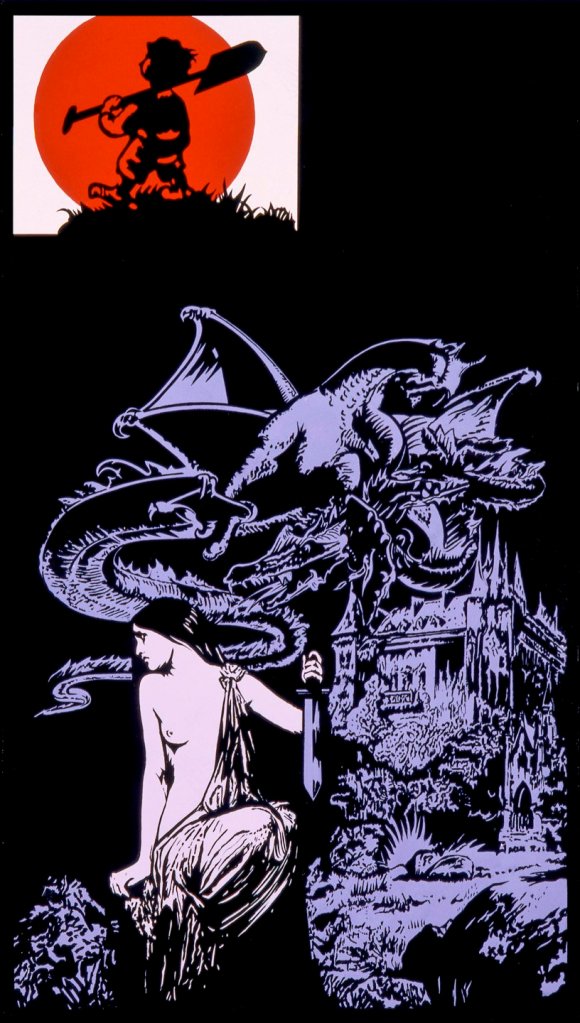
Eizin Öijer’s pictures have sometimes been said to have a coldness to them, and there is certainly an austerity in the contrasts and a rigour in the sharp lines. For Eizin Öijer, examining love is not a drowsy dabbing of the paintbrush into the paintbox, but the work of a fire juggler. As in the acrylic Underworld (1996), love is a fire-breathing dragon, the paint brush a sword, and the gravedigger is never far away.
 differensmagazine.com