The work ”Freelance working class balance baby boss call beep beep go go” serves as a paraphrase of the way some design houses incorporate and appropriate materials and symbols from precarious work.
Bio: Maiken Stæhr (she/her) is a visual artist trained at the Jutland Art Academy, Aarhus and Akademie Der Bildende Künste, Vienna. Through site-specific sculptural and performative approaches, her work investigates class markers and identifications in relation to gender, consumption and food culture. Her work focuses on feelings of alienation, meaninglessness, and absurdity in relation to what we consume, the bodies we inhabit, and the work we undertake. Maiken Stæhr lives in Copenhagen, Denmark and you can follow her work on www.pollyannacowgirl.eu.
With her extravagant sculptures and playful performances, Kris Lemsalu is restlessly charming the art world. In this issue, she is featured with her multilayered art, into which she molds all kinds of stuff; ceramics, clothes, furniture etc., creating objects and events that simultaneously provokes laughter and raises profound questions about life, death and, of course, beauty. Differens Magazines Astrid Elander got the opportunity to ask her about her working process, her thoughts on beauty and universality and her beauty advice.
Astrid Elander: Hey Kris, what are you doing?
Kris Lemsalu: Right now I’m making two sculptures. One is a traffic light called “Amber takes a long time”, it’s a work I’ve wanted to do for a year now. And like all my happy accidents I stumbled across a movie set or like a lot here in LA that sells old movie stuff, and there was this traffic light from the 50s and the only light that wasn’t broken was the amber, the yellow. It was almost mind-blowing because that’s the work I’ve been thinking about for so long, it just appeared at the right time. It’s an appreciation of the in-between-zones in life, when your wave hasn’t really turned into that green light yet, but it’s the in-between space that also needs to be appreciated, it doesn’t go from red to green always, it has that time in between. It’s like a node or a bow… or like an airport. You’re not there yet, but it’s equal to the other parts. Like a totem for that in-between time. I feel like we are very much in between times, it’s not only personal, it’s also what I’m sensing in the world, so tapping into that feeling. It’s also about patience. When you’re trying to cross the road, you need patience, even if you’re in a hurry. It’s a good practice. It feels like I’m building a patience goddess or something.
Kris Lemsalu, Amber takes a long time, 2024.
A.E: You had this picture of the traffic light in your head already a year ago?
K.L: Yes, the title was there. I really liked the sentence, “Amber takes a long time”. I felt like I was on to something. It kind of penetrated my psyche. I’ve been working for so many years now, I know when I’m on to something. It’s like a cluster that starts to build up. With this piece, which is not so often, it started from the title and grew, like crystals. Like “oh, it’s a traffic light!” And then it defined itself.
A.E: We are making an issue of Differens about universalism and beauty. Do you think there is anything universally beautiful? And, in that case, what would that be?
K.L: For sure. Nature is universally beautiful. And we artists are like Santa’s little helpers trying to reach something just as beautiful. But the hierarchy is pretty strong. We will be defeated by nature every time. I don’t think we’re able to create something higher than nature. I also think a sincere connection and love is beautiful. Love that is not smeared or painted or dusty. I’m a people person, a person who creates communities and works with a lot of people, so I see a lot of beauty in that realm. You develop a connection and then energy is created from that connection, you start building something together, imagining or fantasising, creating your own world. That’s beauty to me.
A.E: And do you think there is anything universally ugly?
K.L: War is universally ugly, and all kinds of attributes and psychological or biological states and desires that lead up to such horrors.
A.E: How do you navigate aesthetically between parameters of beauty-ugliness in your work? For example: do you strive towards beauty? Do you wish to challenge normative ideas of beauty?
K.L: I don’t really analyse myself in that way because, you know, beauty is a very broad concept. I’m a little bit like a rebel, since I didn’t make up the concept of beauty and don’t really agree with it. I don’t agree with different seasonal trends of women’s bodies and so on. That’s why I’m on a road to build my own world. I don’t even mention I’m working with beauty. It’s more like I’m finding beauty in peace. And also in the details in my works, whatever material it might be. It might be porcelain or a sleeping bag, I’m trying to give them the same amount of care and attention. Even if one material is generally seen as ugly or cheap. They are all held in balance. I feel like that’s very visible. It makes sense altogether, even though there is no logical combination. Actually, the way I work is even more interesting than the works themselves. I’m breathing life into a piece. I also take in particular energies of the people I work with. I’m trying to achieve a peaceful existence, that’s beauty to me.
Still today, when I see some detail and I’m like “I can’t do that, it’s so ridiculous”, I know I’m in the right spot.
A.E: I wondered about that. You are using many different materials and genres, moving between installations, objects, ceramics, and performance. Still, you have a very consistent and personal aesthetic style, how did you find it?
K.L: I guess that’s the same kind of difficult question as “how did you find yourself?”. After I studied ceramics in Estonia, I moved to Vienna to study sculpture, and in the ceramic world there’s a lot of rules, and I felt like breaking free from that way of doing things. I allowed myself more and I was more playful. I remember when I did a little installation that felt so ridiculous. It was the work called wisdom and eggs, it’s a red boat with owls and chickens sitting in neon life vests. I had to overcome a fear of showing something that felt so absurd, and the feeling of overcoming this fear and then getting good feedback… understanding that there is support, people actually find it funny or find it deep or find meaning in it. That keeps the wheel turning. Still today, when I see some detail and I’m like “I can’t do that, it’s so ridiculous”, I know I’m in the right spot. Because I will get those people laughing about this exact thing. I communicate with my so-called people through my work. They are a little bit like a watchtower. Words are complicated. I find my language through my sculptures and installations.
Kris Lemsalu, Wisdom and eggs, 2011, photos by Katharina Reckendorfer and Josef Schauer-Schmidinger.
A.E: Do you receive inspiration from these communities as well?
K.L: Totally. That’s how my work is made. I understand the world and different cultures through people. And that’s somehow my main goal, to understand life a little more.
A.E: You’ve said before that you often get a clear image of a piece before you create it – like with the traffic light. But I also get the feeling that your works are very intuitively created with a high sensitivity to the material. Tell us more about your working process.
K.L: Ceramics are always a part of my works. Like the icing on the cake in a way. I also use a lot of textiles, a lot of my own clothes. It’s an extension of my home which is basically just a few clothes and some books — my home is basically what I wear. It’s like I’m taking out the interior. And this also blends into my work, when I feel like I’m ready to let go of something, I donate it to the work. For example, I’m doing another piece right now with this lion’s head where I’m using a lot of wicker, and I found this family across the street who does wicker chairs and baskets, and I’ve been hanging out there and I got some material from them that I used. It’s all kind of an organic flow, and if you have done this long enough you don’t question the flow. It makes sense and you breathe with it.
A.E: Sounds like your artistic practice is an extension of your life. Do you feel that your life is also an extension of your art?
K.L: Oh yeah, all the time. I’m not able to extract myself from my art at all. I dress like my artwork and my artwork dresses like me. I’ve done some praying figures, Crybaby 1 and Crybaby 2, which are good examples of where I’ve used my own clothes.
Kris Lemsalu, Сrybaby I, 2022 Eva Presenhuber group exhibition, photo Stefan Altenburger Photography.
Kris Lemsalu, Crybaby II, 2022 Eva Presenhuber group exhibition, photo Stefan Altenburger Photography.
A.E: Your work is often described as revolving around profound themes such as birth and death. But the reason we wanted to include you in this issue is because we perceive a recurring play with (multilayered) surfaces, disguise, make up… things that are connected to ideas of beauty. Do you agree? Why are you drawn to this?
K.L: I would go back to the idea of building your own universe, and defining your own rules in that universe. Layers are a great way to reveal and disguise. My makeup with these dark eyebrows is, for example, an extremely simple mask that allows me to go in and out, to be available and open and ready to communicate, or to hide. It’s a lot about play actually. I’m just curious to have a playful life and to find playmates in it. And I think that’s where this topic of beauty comes in, because when I work, I’m able to get into very elevated states of being. I like to make this similar to playing in a band, because mostly, music is much more direct and impactful than art. So I’m always trying to make a band. To capture that feeling of being in a jam session in the art work. That feeling of “oh my god we’re doing something elevated”.
I dress like my artwork and my artwork dresses like me.
A.E: You deconstruct bodies, gather hands, feet, tongues and arrange them in different formations, you use (your own) clothes, fabrics, animals and masks. Sometimes you create absurd figures, sometimes the formations appear as a part of the environment or some kind of decor or interior. Why this deconstruction and reconstruction of bodies?
K.L: Maybe I’m just offering a way to see things in life, because things don’t make sense. Absurdity and humor can be very helpful, it can release pressure and help to figure out ways to deal with things or life in general. It’s something I keep repeating in my work because I’m hoping that if you see it, you will get an experience that shifts your consciousness a tiny bit.
A.E: Why is that? Do you wish to question norms, or rather offer renewed perception of what we are? Like, why not three hands?
K.L: I don’t really know what’s normal and what’s not. I live in my own bubble, like most of us anyway. There are so many things occurring in nature that you can’t find an explanation for. And that’s the beauty of it. I guess I’m trying to imitate this, to give an additional view of how things could be, a second or third way of seeing.
A.E: You are also participating in your work as a performer, showing up in different costumes. For example, I spotted a picture from your latest exhibition “One foot in the gravy” (5/4-11/5 2024) at Margot Samel in New York where you were sitting in one of your installations, a rocking chair, with a huge tongue in your knee. Why this play with embodiment and disembodiment?
K.L: With this exhibition, I was trying to convey a particular feeling, a euphoric feeling that you get maybe when you recover from an illness or when somebody close to you dies. When the grief is over, you can get a very ecstatic feeling of being alive. An understanding and appreciation of life that doesn’t last long. A connection or a realisation. That’s such a crazy and precious moment. For the performance, I took this tongue in my knee. The tongue is a recurring symbol in my work. In Chinese medicine, you use the tongue to see what state your intestines are in, what’s happening in your life and in your body. It’s also a tool of communication. A tool of power. This goddess Kali, she always has her tongue out. It’s also erotic and it conveys everything in a way. Anyway, during the show, I was sitting there for two hours with the tongue in my knee while a song I made recently was playing, a cover of “put the lime in the coconut” by Harry Nilsson. I was sat facing a life altar that I had made. It was like I was viewing myself from afar, like I would be 100 years old and looking back on my life. I was sitting with it and communicating with the journey I’ve made so far, trying to convey that feeling of being alive and being happy about it. Because it comes down to this, it’s good to remind oneself of when petty things take over.
Kris Lemsalu, Photo by Nikolaus Weitzer.
A.E: Time is often discussed in connection to beauty – some say permanence is not one of beauty’s attributes, that beauty is something evanescent that sometimes appears, while others see beauty as an eternal idea, something that for example art can embody and fix. What do you think?
K.L: I just saw a plane flying by. And that was kind of a tiny, pretty moment. It’s good to look at the sky. I like to look at the sky, it’s where I find a lot of beauty. The formations of the clouds and the sun rising or going down, or just the colors of the sky. It extends your attention span. It’s a good practice. Like fire.
A.E: Do you have any beauty advice for our readers?
K.L: I guess it’s about finding your true self. And about acceptance of that self. And finding confidence to be the way you are. Then you become an ageless creature, like evergreen, you have ripened to become whatever creature you’re meant to be and that’s always beautiful. I love those kinds of people. Accepting yourself is always visibly beautiful. But it’s a road, it takes time. Also, sauna is rejuvenating, and walking. Walking can shake off your worries, if you walk long enough you can solve problems. Like skin shedding in snakes.
A.E: You are participating in the exhibition “On the absurd drama that is also life” (26.10 2024-23.2 2025) at Malmö Museum of Modern Art. What else are you looking forward to?
K.L: I’m looking forward to having a huge museum show so I can invite my friends and show my total universe because that would be quite amazing. I’m also starting to dream of a home. I like this idea of having a place to invite people to, because I’m always visiting other people. I’d like to change the dynamic.
Kris Lemsalu’s portrait. Courtesy of the artist and Temnikova & Kasela Gallery. Photo by Johanna Ulfsak.
The idea of universalism is a beautiful, unifying one. All human beings have the same value and the same rights. But although Western philosophy has a long history of universalist thinking, it seems that putting it into practice has never truly succeeded. When I think about universalism, I think about the people who have risked or lost their lives at Europe’s borders, those who are risking or losing their lives right now, and those who are yet to risk or lose theirs, trying to cross unruly terrain. How is it that the EU stands for human rights while Europe’s borders are so deadly that the Mediterranean has become a grave for so many?
The Puerto Rican Sociologist Ramon Grosfoguel, who uses the term ”European Provincialism”, has pointed out that universalism, in the first place, was never really intended to include everyone. By examining the history of its origins, Grosfoguel draws attention to a major contradiction in Western universalist theory. Western universalism is based on epistemic subjects who have freed themselves from all earthly limitations—including the body, their location within global power dynamics and their relationships. Being free from body, space, and time, is what makes them capable of arriving at universally valid insights. They claim for themselves a non-standpoint, an epistemic position that exists outside of this world, which is a position that was previously reserved for the Christian God.
When René Descartes wrote his famous cogito ergo sum (I think therefore I am), he was living in the 17th century Amsterdam. By that time, the Netherlands was the biggest colonial power with violently governed colonies in America, Africa, and Asia. When Immanuel Kant entered the conversation on universalist theory in the 18th century, the geopolitical situation had changed, with France, Germany and the UK replacing the Netherlands’ supremacy. It was no coincidence that the desks of the fathers of universalism were located at the centre of geopolitical power. As Grosfoguel points out, the subjects who theorised Western universalism had very specific locations, relationships and bodies. They were white, European, educated men located at the epicentre of global power. Or, as Grosfoguel writes: ”the political, economic, cultural, and social conditions of possibility for a subject who assumes the arrogance of speaking as though it were the eye of God is a subject whose geopolitical location is determined by its existence as coloniser/conqueror, that is, as Imperial Being.”
They claim for themselves a non-standpoint, an epistemic position that exists outside of this world, which is a position that was previously reserved for the Christian God.
Building universalist theory upon the ignorance of their own standpoint, Kant and Descartes unsurprisingly fail to take existing differences in locations, gender, sexuality, bodies, spirituality, race, class, ethnicity, or language among humans into account. As a result, people outside their own particular identity are simply excluded from subject status. What was an underlying assumption in Descartes’ works, comes to the surface in Kant’s writing. Transcendental reason in Kant’s ”Critique of Pure Reason” is not something everyone has access to. It belongs to those who he considers to be ”men”, which is male, white and European subjects. ”African, Indigenous Asian, and Southern European (Spanish, Italian, and Portuguese) men and all women (including Europeans) do not have the same access to ‘reason’”, writes Grosfoguel, referring to Kant’s anthropological work.
Why do people crossing European borders come to my mind when I think about universalism? I think about borders, because borders are places of radical differentiation. When we cross borders, it becomes more than obvious that we are not all equal. At Europe’s borders, we witness a radical paradox: the simultaneous existence of aeroplanes and other advanced transport technologies and the mass drowning of people in the Mediterranean Sea. Why is it that, in most cases, people in need of protection cannot take the safest route across the sea, which is by plane?
The ability to board an aircraft to cross the European border was restricted in the 1990s by the Schengen Agreement, which obliged airlines and shipping companies to bear all costs for passengers who are rejected at their destination due to missing documents. By forcing airlines to pay for all the costs incurred by a person without valid entry documents—according to European asylum policy this means accommodation, possible detention pending deportation, and the deportation itself—the responsibility for respecting human rights has been successfully transferred to the airlines.
In order to apply for asylum, non-European refugees must reach European soil first. Excluded from today’s technologically possible safe passages, these travellers are forced to take the path across weakly protected sections of the European borders, through forests, over mountains, or across the sea. Sociologist Estela Schindel studies border and mobility regimes. In her research on European borders, Schindel noted that not only are these travellers denied access to the safest way of crossing the sea, but high-tech surveillance systems, “security personnel” and illegal pushbacks also keep them away from the safer crossing points, pushing people into the most geographically rugged and dangerous terrain. As Schindel points out, this is no accident. “What in Western eyes may seem like open, borderless spaces—deserts, mountains, seas—become active agents in the practices of border enforcement and border crossing”, Schindel writes. Here, in the most inhumane geographical conditions, people die by drowning, thirst or freezing. These deaths are categorized as natural, a categorization that loses its validity when they are explained as the active incorporation of geographical circumstances into European border policies. These deaths are the result of being deliberately left to die.
These deaths are categorized as natural, a categorization that loses its validity when they are explained as the active incorporation of geographical circumstances into European border policies. These deaths are the result of being deliberately left to die.
Schindel suggests that these border policies should be understood as a forced expulsion of unwanted, non-European travellers into the realm of nature. As she shows, this expulsion is contingent on the European self-definition as superior to nature and therefore civilised. By forcing unwanted non-European travellers onto geographically rough terrain, they are placed in a position of extreme vulnerability to nature and its elements. At the same time, the politically engineered exclusion of refugees from technologically available, safe border crossings, for example by plane, forces them into a situation that Schindel describes as pre-technological. This, Schindel writes, ”reproduces a boundary between Europe as a modern, civilised, highly technologized realm, while at the same time pushing unwanted travellers, both symbolically and materially, into a zone of proximity with ‘nature’.” With the help of restrictive asylum politics, refugees are thus pushed into a position that is marked as uncivilised in the Eurocentric worldview, and that simultaneously keeps up the European narrative of superiority. This image is further reinforced by situations in which people’s paddles are taken from them by border guards, or rubber dinghies are capsized by motorised boats trying to rescue them—or at least pretending to.
The differentiation along the lines of civilised/uncivilised has a long colonial history in European anthropology. The Eurocentric image of all non-European cultures as “anthropological” cultures, which do not show a strong distinction between nature, culture and society—in contrast to the technologically equipped, civilised Europeans—has been used as an argument for colonisation. With the help of Schindel, we can see how this distinction is still active on Europe’s borders today. Drawing attention to the projections, ascriptions as well as material exclusions at work, she understands borders as places where subjectivities are produced. Due to the perceived and constructed proximity to nature, which has been considered deprived of subjectivity in Europe since the Renaissance, refugees tend to be excluded from subjecthood in a Eurocentric view.
It is clear that those who flee along dangerous paths are subjects, and are also not lacking technological means—smartphones, motorboats and GPS-devices are examples of this. However, paying attention to European patterns of interpretation might help to understand how the radically different situations of travellers with EU-citizenship or valid visas and those without is naturalised in a Eurocentric worldview. The perpetuation of racist, colonial and Eurocentric discourses that deny racialised individuals subject status here serves to maintain deadly border regimes and restrictive asylum regulations. By excluding people from the safe journey by plane, the Schengen Agreement has effectively overridden the right to asylum, which is part of the Universal Declaration of Human Rights. While those with EU-citizenship or the right visa cross European borders safely, non-European refugees, in the worst case, pay for the chance of a right to asylum with their lives. Through the alignment of images of non-European people at the mercy of the elements with the European distinction between civilised and uncivilised, the politically engineered exclusion is masked as natural. As a result we see how real, politically produced and radically racialised differences, which decide over life and death, are being ignored.
Those who can board a aeroplane and those who can not are in extremely different situations when crossing the European border. While the former are to be protected by surveillance systems at the airports, the latter are to be prevented from crossing the border by those systems, exposing them to death due to the geographical conditions. Moreover, people experiencing these differences physically, are excluded from subject status.
Moving beyond imagined, yet harmful categorisations like civilised/uncivilised means acknowledging and addressing the real inequalities imposed by current border regimes. Taking a look at those regimes reinforces the need for a new universalism that doesn’t fail to take differences among humans into account. Grosfoguel turns to Aimé Césaire in search of a decolonized vision of universalism:
”Provincialism? Absolutely not. I’m not going to confine myself to some narrow particularism. But nor do I intend to lose myself in a disembodied universalism. There are two ways to lose oneself: through walled in segregation in the particular, or through dissolution into the ‘universal’. My idea of the universal is that of a universal rich with all that is particular, rich with all particulars, the deepening and coexistence of particulars.”
By excluding people from the safe journey by plane, the Schengen Agreement has effectively overridden the right to asylum, which is part of the Universal Declaration of Human Rights. While those with EU-citizenship or the right visa cross European borders safely, non-European refugees, in the worst case, pay for the chance of a right to asylum with their lives.
In this light, a true universalism must be one that does not erase differences in race, gender, and class within the global power dynamics. Rather, it must be one that learns from them, building knowledge from the lived experience of all subjects.
Kris Lemsalu, Lazy Flower, 2022, photo by Kati Göttfried.
Rosa Blens is a master’s student in cultural studies at the Humboldt University of Berlin.
REFERENCES:
Cesaire, Aimé. Discours sur le colonialisme. Paris: Éditions Réclame, 1950.
Grosfoguel, Ramón. Decolonizing Western Universalisms: Decolonial Pluriversalism from Aimé Césaire to the Zapatistas. TRANSMODERNITY: Journal of Peripheral Cultural Production of the Luso-Hispanic World. 1(3), 88-104. 2012.
Schindel, Estela. Das biopolitische Schisma: Materielle und symbolische Abgrenzungen entlang der EU-Grenzen. In: I. Gradinari, Y. Li & M. Naumann (Ed.), Europas Außengrenzen: Interrelationen von Raum, Geschlecht und »Rasse« (pp. 209-244). Bielefeld: Transcript Verlag, 2021.
Lätta moln/Small Clouds
En kort essä om hur livet och konsten flätas samman/A short Essay on how life and art intertwine
Jag har blivit besatt av en organisk form som egentligen kan vara vad som helst från en vattenpöl, ett moln, en tumör till ett blåmärke. Den går att förändra i det oändliga och jag ser den nu som min följeslagare. Mest har den fått ta plats på gardiner men nu ska jag berätta något annat om den. Jag har nämligen blivit bestulen på delar av min skönhet på grund av en organisk form.
För drygt sju år sedan hittade jag en klump, en organisk form, i mitt bröst som visade sig vara bröstcancer. Efter en lång cellgiftsbehandling som jag tappade håret av, opererades mitt ena bröst bort helt och hållet. För att ersätta det sattes en expanderprotes in, något man närmast kan likna en boj. Inte bara obekväm utan också estetiskt omöjlig att acceptera. Ingen, absolut ingen fick se mig naken under den tiden. Ett drygt år senare byttes expanderprotesen ut mot ett silikonimplantat som var betydligt bekvämare men endast lite finare. Det är fortfarande ett bröst som är vanligt. Hängigt, guppigt och ett som är gjutet, solid, främmande. När jag har sex och rider den andre så guppar ett bröst och ett är stilla. Jag kommer inte över hur fult det ser ut. Jag har undrat så många gånger hur man fortsätter leva med den typen av skev skönhet. Jag har fått omvärdera den högst subjektiva upplevelsen; att anse sig själv vara en snygg tjej. För mig kommer det aldrig kännas som att jag är en normativt snygg tjej igen på grund av att mina bröst, den kanske starkaste symbolen för kvinnlighet, är förstörda. Vill man vara en normativt snygg tjej? Ja, när man inte kan det så vill man det. När man blivit bestulen vill man bara ha tillbaka det som stulits från en.
Den organiska formen som återkommer i mina verk är en bearbetning av det obegripliga. Av att överhuvudtaget bli sjuk, men också av att sjukdomen berodde på en klump, en organisk form, som jag aldrig kommer att få se.
Small Clouds: A short essay on how life and art intertwine
I have become obsessed with an organic shape, a shape that looks like anything from a puddle, a cloud, a tumor to a bruise. It can change shape endlessly, and I now see it as my companion. Mostly, it has found its place on the curtains I sow, but I want to tell you something else about it. I have, in fact, had parts of my beauty stolen from me because of an organic shape.
Just over seven years ago, I found a lump, an organic form, in my breast, which turned out to be breast cancer. After a long chemotherapy treatment, which caused me to lose my hair, one of my breasts was completely removed. To replace it, an expander prosthesis was inserted, something you can liken to a buoy. Not only uncomfortable but also aesthetically impossible to accept. No one, absolutely no one, was allowed to see me naked during that time. A little over a year later, the expander prosthesis was replaced with a silicone implant that was much more comfortable, but only slightly prettier. I still have one breast that is natural. Saggy, bouncy, and one that is molded, solid, foreign. When I have sex and am riding the other person, one breast bounces, and one is still. I can’t get over how ugly it looks. I have wondered so many times how one continues to live with this kind of skewed beauty. I have had to reassess the highly subjective experience of considering myself a pretty girl. To me, it will never feel like I am a normatively pretty girl again because my breasts, perhaps the strongest symbol of femininity, are flawed. But, do you really want to be a normatively pretty girl? Yes, when you can’t be, you want to. When something has been stolen from you, you want it back.
The organic shape that reoccurs in my work is a way to process the incomprehensible. Of becoming ill in the first place, but also that the illness was due to a lump, an organic form, that I will never get to see.
Sandra Leandersson is a textile artist living in Stockholm. To see more of her work, please visit her instagram @sandraleandersson
The question of beauty and nature is one of the more normative and ideologically laden. But being in general an interest from conservative and reactionary viewpoints, it is also one of surprising perspectives. This text will focus on a perspective I first met in the continental feminist philosopher Elisabeth Grosz’ Becoming Undone. Darwinian Reflections on Life, Politics, and Art (2011), that I later found more expanded and scientifically thoroughgoing in the ornithologist Richard O. Prum’s The Evolution of Beauty. How Darwin’s Forgotten Theory of Mate Choice Shapes the Animal World – and Us (2017), and, in writing this article, in the evolutionary psychologist Geoffrey Miller’s The Mating Mind. How Sexual Choice Shaped the Evolution of Human Nature (2000). A perspective that for me presented a radically new and different view of nature and evolution – one in which desire, beauty, and the artistic plays an essential role. It all goes back to Darwin’s so-called ”second idea,” his theory of sexual selection. A theory that when first presented was fiercely contested for its radicality, for a hundred years forgotten, still today met with skepticism, and to the public little known compared to his theory of natural selection and the adaptationist formula ”survival of the fittest.” From these two theories, different views of nature have been extrapolated that can be expressed as the difference between mechanism, reductionism, and the supposedly rational on the one hand, creativity, abundance, and the allegedly irrational on the other. The latter has all to do with desire, beauty, and the artistic.
This article will begin with Darwin’s formulation of his theory of sexual selection and examine how sexual selection can account for beauty and artistry in some bird species. It will thereafter deal with the historical and contemporary reductionist critique of Darwin’s theory, before exploring how other aspects of species, relating to but sometimes moving beyond the question of beauty, can be explained from the perspective of sexual selection. We will here also encounter what can be seen as the opposite of beauty – violence – and explore in what way evolution can be seen as a struggle between the sexes over autonomy and reproductive choice, before ending up with our own species to see how a desire for pleasure and artistry (more than mere beauty) can account of many of the peculiarities of our species. I will end with some reflections on how the idea of beauty in nature put forth in this article can be understood in relation to Kant’s aesthetics.
Kris Lemsalu, Fine Sin, 2022 Peace at 295 Church, 2022, Margot Samel Gallery, photo by Dawn Blackman.
If Kant’s philosophy has been criticised for being sexless and supposedly gender neutral, this article will be far from it. We will be mostly concerned with birds – Kant’s favourite example in his aesthetics – but we will also venture not only into sexed reproductive strategies but also into the looks and particularities of penises and vaginas. And although this article will present ideas that could be characterised as ”progressive,” and according to two of the authors mentioned above even ”queer” or ”feminist,” evolutionary biology is a delicate field, and some words of caution might be in place. First, it should be underlined that these are some theories on evolution, beauty, sex, and nature, with both merits and flaws, and in no way intended to give some sort of exhaustive or final answer (and considering our species, culture, in all its possible varieties, is an essential part of our nature). If, to follow the early German Romantics, nature and the human being is to be seen as a work of art, then one should perhaps also apply the principle of the artwork’s inexhaustibility: no interpretation can exhaust it, and seemingly conflicting interpretations can each have their truth.
Secondly, the focus of sexual selection and sexual reproduction is a focus on males and females and their respective mate choices and reproductive strategies. It is therefore worth to emphasise nature’s sexual variety, including both hermaphrodites and species with more than two sexes, and, not least, same-sex sexual behaviour being found en masse – as of 2019 recorded in over 1500 species, a number that will most likely grow. If one wants to seek an evolutionary explanation to what has been termed a ”Darwinian paradox,” one could in fact look to mate choice favouring same-sex sexual behaviour (which is what Prum do) or find it in social evolutionary selection favouring group affinity. However, the search for an explanation might be made from a false premise. Given the widespread occurrence of same-sex sexual behaviour across various branches of the tree of life, it could be that indiscriminate sexual behaviour directed towards all sexes is the evolutionary basis, with exclusive different-sex sexual behaviour being an evolved trait in need of evolutionary explanation.
A last introductory point I would like to make concerns the merits of turning to the natural sciences. Here I agree with Grosz who argues that critical thinking, and specifically feminist philosophy in her case, has all to win in turning to nature and ”the relentless force of the real” and develop a ”new metaphysics.” Grosz, polemically, contrasts this with postmodern feminism, which has been preoccupied with representations of the real and, as a result, has neglected discussions about matter and nature. With new materialism and posthumanism, this is no longer the case. However, I think it is safe to say that posthumanism has been more interested in bacteria, fungi, and co-evolution than evolutionary biology and sexual selection. Though radical in many ways, one could argue that it is a ”safer” way to decentre the human and underline our embeddedness in nature than to look at our animal relatives. Yes, the human is entangled with bacteria and viruses, but we are also primates formed by, among other things, sexual selection. I would also argue that the shunning and critique of evolutionary biology on the basis of a reductionist and determinist – and as we will see anti-Darwinian – understanding of it, can also work as a confirmation of it since no alternative is presented. With this said, let us turn to one of the most powerful and interesting theories of an abundant and non-deterministic nature.
Sexual Selection and Beauty
Charles Darwin might seem an unexpected ally in thinking nature and beauty anew. But ever since the publication of The Descent of Man, and Selection in Relation to Sex in 1871, Darwin’s theory of sexual selection and the importance it accords to beauty, desire and what is mostly female mate choice has been fiercely suppressed among evolutionary biologists – in the name of a ”pure Darwinism” – and is largely unknown to the general public. Yet the theory of sexual selection was something that occupied his thinking more than the one of natural selection, and it was a radical theory entirely unique to Darwin.
Before entering the abundant world of sexual selection, I will briefly present its ”competitor”: natural selection. As we will see concerning sexual selection, birds make out a wonderful example and so also here. At the age of 22, Darwin set out for what would be a five year long and crucial expedition on the navy ship HMS Beagle. Passing the Galápagos Islands, Darwin collected several specimens of different finches – they would turn out to be important in the elaboration of his theory of natural selection. Darwin recognised the finches’ affinity to birds of the nearest mainland, though there were important differences: their beaks. It seemed, therefore, that the finches from the different islands had a common ancestor but that their beaks had evolved in different directions according to the environment of the islands. Later, this has been termed adaptive radiation: the beaks have evolved to allow the finches to eat different types of food, thus creating new species. The finches are therefore an excellent example of natural selection: you either eat or you die. Note that this evolutionary process is without any aspect of choice and that it leads to a functional result in the form of beaks adapted to eat different types of food. The birds of Galápagos now go by the name ”Darwin’s finches.”
”The sight of a feather in a peacock’s tail, whenever I gaze at it, makes me sick!” So wrote Darwin in a letter in 1860, the year after the publication of one of the most famous books in the history of science, On the Origin of Species by Means of Natural Selection, or the Preservation of Favoured Races in the Struggle for Life. Darwin’s unpleasant feelings in front of the peacock’s tail was not due to a peculiar taste in front of something generally regarded as an expression of beauty in nature; the problem was precisely how to account for the development of the peacock’s tail in relation to the theory of natural selection, often described as the ”survival of the fittest.” From the viewpoint of natural selection and survival, the peacock male’s elaborate tail seems instead unfit: the brilliance of the tail making it more visible to predators and its length a hinder to a quick escape.
So, if it does not have any survival value, why had it developed and what could be its advantage? The answer: its beauty. ”Many female progenitors of the peacock,” Darwin writes in The Descent of Man, and Selection in Relation to Sex, ”must during a long line of descent, have appreciated this superiority [in beauty]; for they have unconsciously, by the continued preference of the most beautiful males, rendered the peacock the most splendid of living birds.” Where the beak of the different Galápagos finches had evolved in adjustment to different types of food, the male peacock had developed its tail because female peacocks had chosen to reproduce with what they aesthetically desired, something that through evolution has led to the extraordinary appearance of the male peacock.
Darwin, however, does not merely describe this as a process of unconscious preference. More often, he explains it as a sophisticated judgement of taste. In the case of the Argus pheasant, whose elaborate feathers are only displayed during the mating dance, Darwin not only sees a ”good evidence that the most refined beauty may serve as a sexual charm, and for no other purpose” (my italics). He also describes the mating choice: ”Many,” Darwin writes, ”will declare that it is utterly incredible that a female bird should be able to appreciate fine shading and exquisite patterns. It is undoubtedly a marvellous fact that she should possess this almost human degree of taste.”
At the heart of the theory of sexual selection therefore stands desire and subjective judgements. An understanding of animals that is far from the idea that they are mere machines; animals are subjects with mental capacities that enable them to make judgments and choices. Furthermore, it is only by granting them these mental capacities and seeing their choices as subjective that we can understand nature and evolution. As Richard O. Prum puts it: if natural selection is described as a relentless and impersonal force that, as in the case of the ”Darwin’s finches,” produces functional design – a blind watchmaker with Richard Dawkins’ metaphor – in sexual selection, nature is not blind but has in its myriads of organisms developed its own eyes and ears and the mental capacities to make decisions based on this sensory information, producing ”unfunctional” design, that is beauty.
It is not only the visual beauty of birds that has been taken to what in some cases could be called, in Darwin’s words, ”a wonderful extreme.” There is of course bird song, an ”art,” as Darwin calls it, that have developed so elaborately out of the same desire for beauty and pleasure. The ornithologist and composer Olivier Messiaen – who had a great influence on 20th-century music, especially on the French serialists and Pierre Boulez – took a great interest in birdsong, culminating musically in his huge piano work Catalogue des oiseaux (”Catalogue of birds”). As Messiaen notes, the rivalry over territory – crucial for mating – is sometimes settledby song duels: ”if the predator wants to occupy a place that does not belong to him, the true owner sings, sings so well that the other one leaves […] [but] if the thief sings better, the owner gives him his place.”
An even more peculiar art is found among the bowerbirds. Here, beauty is expressed in elaborate and, across different species with their particular beauty norms, varied architectural and sculptural creations. There are two general types: the avenue bower and the maypole bower. In the former case the male build two walls of vertically placed sticks. In the latter, sticks are places around a support creating a pole that can rise several feet. The court, placed at some distance, is then decorated with hundreds of colourful objects of different sorts – shells, flowers, berries, even plastic items and coins – on which the male performs his courting, consisting of display and singing. It is furthermore one of the bower birds, the Tooth-billed bowerbird, that is Gilles Deleuze and Félix Guattari’s favourite example in their (post-humanistic) theory on the origin of art. The Tooth-billed bowerbird does not build a bower but only a ”stage,” consisting of leaves beneath the branch it sits upon and on which it performs its courtship consisting of advanced songs that include mimicry of other bird species. ”[U]n artiste complet,” ”une oeuvre d’art totale,” as they write. It is doubtful that Deleuze and Guattari knew of Darwin’s theory of sexual selection, but if they would, in it they could also have found an evolutionary theory in line with their idea of desire as productive rather than as feeling a lack: behind the ”complete artist” stands the female bowerbird’s desire for such courtship artistry.
As if these diverse forms of artistic expression were not enough, recent research suggests that the evolutionary development of wings – the defining feature of birds – may in fact have its cause in sexual selection. Long before wings for flying had evolved, feathers were enjoyed for their ability to be expressive. In what can be seen as a parallel to the discovery that the ancient Greek sculptures were in fact coloured, thus confounding later times idealisation of antiquity, a recent discovery is that most dinosaurs bore feathers. As with the coloured sculptures, feathered dinosaurs give quite a different feel – just imagine a colourfully feathered Tyrannosaurus Rex in the 1990s classic Jurassic Park. Prum was part of the research team that in 2010 developed the first representation of what this might have looked like in the case of the Anchiornis huxleyi. The hypothesis is that the development of more advanced forms of feathers has to do with their ability to be more expressive. As Prum writes about the fourth and final stage: “the planar vane of the feather might have evolved through aesthetic selection to create a two-dimensional canvas upon which to depict complex pigment patterns—including stripes, spots, dots, and spangles.” He concludes: “the potentially aesthetic innovation of planar feathers facilitated the evolution of flight and the avian dinosaur survival of the Cretaceous-Paleogene extinction. It’s harder to imagine a bigger possible impact for the role of beauty and desire in the history of life.”
What Darwin calls ”the taste for the beautiful” is however not the only principle of sexual selection in Darwin’s theory. There is also what he calls the ”law of battle”: the struggle between individuals of one sex, most often males, for getting the dominant position and the reproductive control over the individuals of the other sex. This process leads to the development of large body size and weapons of aggression, such as horns and antlers. The difference between these two principles of sexual selection can thus be boiled down to: ornaments or armaments. Another way to conceptualise the difference – and this I will come back to – is between autonomous choice and forced selection.
It might perhaps seem as if we are closer to the ”survival of the fittest” regarding the second form of sexual selection, that is the ”law of battle,” but it is still not about survival but about reproduction. To stretch the difference between survival and reproduction to the extreme, the only relation between them is that an animal must survive until it is sexually mature and able to reproduce; this is the only ”interest” in survival from the strict viewpoint of reproduction. It is also to be noted that reproduction is the bottom-line of evolution. An individual organism can be excellent in surviving, it will still sooner or later die, and if it has not reproduced, the excellent survival genes will die out as well. In reality, there is of course all sorts of possible overlaps between reproduction and survival, and sexually attractive traits may have their origin in them being also valuable for survival. This is what Ronald A. Fisher’s significant theory on runaway selection addresses: a trait that initially is preferred for some adaptive reason becomes unhinged and desired for its own sake. The ”runaway” aspect has to do with the fact that both the desire for the trait and the trait itself is inherited and it thus creates a positive feedback-loop that can drive ornaments to extremes, as in the case of the Peacock tail.
Kris Lemsalu, 2014, Aldonzo Lorenzo, Courtesy of the artist and Temnikova & Kasela Gallery.
Adaptationist and reductionist critique
Darwin’s theory of sexual selection was not well received, especially not the importanceDarwin accordedto female mate choice. In a review by the biologist St. George Mivart, the law of battle was accepted but Mivart argued that it should be seen as a branch of natural selection. Concerning the ”taste for the beautiful,” Alfred Russel Wallace, famous for discovering the principle of natural selection independently of Darwin, formulated the view that has since been the leading one: ”The only way in which we can account for the observed facts is by supposing that colour and ornament are strictly correlated with health, vigor, and general fitness to survive.” And as Wallace continued: ”In rejecting that phase of sexual selection depending on female choice, I insist on the greater efficacy of natural selection. This is pre-eminently the Darwinian doctrine, and I therefore claim […] the position of being the advocate of pure Darwinism.” To be a true Darwinian then meant to oppose one of Darwin’s two theories of evolution, and precisely the one that took up most of his interest, surely as Darwin knew it was the most controversial and radically new. Wallace’s reasons were also of a moral and prejudiced nature, not wanting to grant the ”brutes” of the animal kingdom the mental powers that Darwin’s theory of sexual selection accorded them. As Geoffrey Miller writes: ”This psychologizing of evolution was Darwin’s greatest heresy. It was one thing for a generalized Nature to replace God as the creative force. It was much more radical to replace an omniscient Creator with the pebble-sized brains of lower animals lusting after one another.”
With some few exceptions, the theory of sexual selection was then absent from evolutionary biology for a hundred years. And when scientists revived the theory of sexual selection in the 1970s, it was Wallace’s view that ornaments are correlated to fitness that returned, now expressed as ”good genes” and perhaps best known in the form of the ”handicap principle”. This principle, proposed by Amotz Zahavi in 1975, argues that ornamentation signals not beauty but burden, that is, a handicap. An individual communicates that it is able to survive in spiteof the handicap. In short, the greater the handicap, the better the genes. Zahavi’s idea and its later variants have proven very popular, despite having been contested for its logic, and despite decades of empirical research failing to prove it. Similarly, while Geoffrey Miller’s theory of the evolution of human nature is both mind-opening and convincing, he tends to view everything – from bird songs and extravagant plumage to marriage rituals and human beauty and art – as ultimately fitness indicators and expressions of good genes.
The reason for the popularity of the handicap principle is perhaps best understood in the reasoning of one of its principal developers, Alan Grafen, who favours its ”rhyme and reason” over the arbitrariness of aesthetic mate choice, an explanation he finds ”methodologically wicked.” To return to the opening paragraph of this article, I would therefore argue that it is a matter of worldview: the processes of nature must be rational and evolution strictly about adaptation. Richard Dawkins, the most famous evolutionary biologist of our time and an outspoken neo-Wallacean, endorses the handicap principle, and in the second edition of his reductionist classic The Selfish Gene (1976, 1989) he likens the female to a ”good diagnostic doctor” who chooses only the healthiest male as a mate. In one of the examples Dawkins is discussing – to which I will return – he adds that his theory of the diagnostic female doctor is ”less plausible than pleasing,” that is Dawkins finds his own reasoning implausible, but likes it because of its consistency with the doctrine of adaptation. Dawkins’ comment is, as Prum remarks, revealing for the whole research field on adaptive mate choice in its quest to find an adaptive explanation even when there is nothing to support it.
The resistance to Darwin’s theory of sexual selection thus has much to do with a predilection for rationality and reductionism, evident in Wallace’s expression ”pure Darwinism,” with adaptation as the single and global principle capable of explaining everything in nature. To accept the theory of sexual selection and the place of desire and beauty, is to accept an evolution that, in the words of Prum, is “far quirkier, stranger, more historically contingent, individualised, and less predictable and generalizable than adaptation can explain.” Grosz, for her part, describes sexual selection as ”the queering of natural selection”: ”that is, the rendering of any biological norms, ideals of fitness, strange, incalculable, excessive. Sexual selection, as an alternative principle to natural selection, expands the world of the living into the nonfunctional, the redundant, the artistic.” Sexual selection is, Grosz says with a nod to Gilles Deleuze, a ”difference machine.”
Kris Lemsalu, 2008 – 2022, photos by Katharina Reckendorfer, Josef Schauer-Schmidinger and Aadam Kaarma.
Mate Choice Expanded: Sociality, Female Autonomy, Sexual Pleasure, and the Creative Mind
To see how powerful the principle of sexual selection is in creating the richness and diversity of nature, we will move beyond mere beauty. Beauty may be the most striking example, but mate choice is ubiquitous – Darwin devotes considerable space to insects, fishes, reptiles, amphibians (leaving out plants however) – and can also be about favouring a particular behaviour, with enormous consequences for evolution and the development of new species. It can furthermore, to stick with pleasure but moving beyond aesthetic pleasure, be about the actual ”sex” in sexual selection, and it may be the major principle behind the development of our own essentially artistic species.
We will however stick with beauty and birds to make a bridge between aesthetic preferences and see how these can go hand in hand with the development of certain behaviours. If the peacock, the Argus pheasant, and the bowerbirds are prime examples of aesthetic evolution and beauty in nature, manakin birds are another. Although the 55 different species of manakin are also visually striking, their most characteristic feature is their advanced and varied courtship rituals that includes acrobatic flights, jumps, bowing, and wing vibration. Simply put: highly choreographed dances and show numbers. In certain manakin species, this has led to a radical change in male social behaviour as female manakins have developed a taste for coordinated group shows. The result? Male manakins are, in order to create the most impressive choreography, highly social, with daily social interactions and relationships with other males that can last for a decade or more. Adult females manakins, on the other hand, lead completely independent lives, their only social interaction being the few brief minutes a year when they visit the artistic shows, choose a mate, and copulate with him. In the Chiroxiphia genera, this entails that 90 percent of the males never get to reproduce, as the female chooses one of the alpha males in the group whose performance she prefers. Who then becomes the chosen male? Well, it is not about strength or domination. Studies on the long-tailed manakin show that the best indicator of a young male’s future reproductive success is his ability to establish social relationships, as this is what enables him to be the star in the best artistic group performance.
So how to understand this from the viewpoint of reproduction? In all the species discussed so far, the female chooses the paternity of the offspring out of her ”taste for the beautiful.” It is therefore – and this is one of Prum’s concerns – also a question of female autonomy. Sexual selection is, naturally, about sexual reproduction. This, however, does not require different sexes or sexual differences, though this is the case in most animals. On the most basic level, sexual difference is about the size of the gamete: the female sex evolved to make large packets, the egg, in which their DNA comes with nutrients, the male sex to make small almost naked package with their DNA, the sperm. The fundamental difference thus lies in the amount of energy contributed to the offspring. In mammals, this difference in ”parental investment” is further increased by pregnancy, milk production, and in most species care of the offspring. The crudest expression of this in relation to reproductive strategy is that males, especially when the investment is minimised to copulation, strive after quantity of females, and females after quality of males, which means that one male mates with several females and some males do not get to mate at all (with the Chiroxiphia genera of manakin birds being an extreme example). This is the reason why we see a general sex difference in the animal kingdom where males court and females choose, but also why there can be an evolutionary struggle between male control and female autonomy. Like Darwin, the great empiricist, we should however take note of species where the roles of the sexes are reversed, seen both regarding the law of combat, where females of some species are larger than the males ”for the sake of conquering other females and obtaining possession of the males,” and regarding the taste for the beautiful, where females are ”the more eager in courtship, the males remaining comparatively passive, but apparently selecting the more attractive females.” And there is of course species, such as ours, in which both sexes practice mate choice and courtship.
But there also exists a rather dark story of male coercion, or outright rape, versus female struggle for autonomous mate choice. This has been taken to extremes in the case of some species of waterfowl. Prum and colleagues have studied the anatomical evolution of the duck penises and vaginas which in some species show a kind of arms race between males and females ”in which each sex evolves successive behavioral, morphological, or even biochemical mechanisms to overcome the evolved efforts by the other sex to assert control or freedom of choice over reproduction.” Among the duck species, one finds the longest penises in relation to body size in the entire animal kingdom, and in the case of the mallard duck, the male has developed a long, corkscrew-shaped penis, while the female mallard duck has co-evolved a vagina with ”dead ends” and several clockwise spirals to reduce the chances of fertilisation when she has not chosen her partner freely but has been forced to copulation. But to call it a ”war of the sexes” is misleading, as Prum argues, because it is highly asymmetrical: ”Males evolve weapons of control, while females are merely coevolving defenses that create opportunity for choice. It’s not a fair fight, because only males are really at war.”
Is there then an evolutionary conflict between beauty and sexual violence? Returning to the bowerbirds, this seems in fact to be the case. In 1995, Gerald Borgia presented the risk reduction hypothesis, later experimentally verified. As the subtitle of his article ”Why Do Bowerbirds Build Bowers?” summarises it: ”Females prefer to visit courtship areas that provide easy avenues of escape, thereby protecting them from forced copulations.” The bowers thus works as protection that allows the females to safely exercise their aesthetic judgements, where research furthermore shows that females prefers to mate with the male with the most intense and aggressive courtship show. But enjoyed in safety and chosen freely. It can be understood as a case of, as Prum aptly calls his chapter on the bowerbirds, ”beauty from the beast.”
Forced copulation, an extreme form of the ”law of the battle,” should therefore be understood as a selfish male evolutionary strategy in conflict with the evolutionary interests of its female victims and the principle of mate choice and the ”taste for the beautiful.” It is, to use my distinction from above, a case of forced selection over autonomous mate choice. In some animals, this selfish male strategy to take forced control over reproduction and to spread the individual’s own genes is not only directed at females through forced copulation. In the case of many primates it gets even more sinister: infanticide. When a new male gains control of a group, he kills the lactating offspring of the group’s females to create reproductive opportunities for himself. In gorillas, it is estimated that around a third of infant mortality is due to reproductive motivated killings, and this is also well documented in chimpanzees.
With the bonobo – our closest relative along with the chimpanzee – things are notably different. Their societies have a matriarchal or at least co-dominant structure; infanticide is absent; and sex is never coerced, and serves far more purposes than just reproduction. Bonobos engage in sex to mediate conflicts, reduce social tensions, and reconcile—regardless of the individual’s sex, age, or social status. In one key respect, however, these different primates are similar: females take full responsibility for the offspring.
Turning to our own primate species, we share some important aspects with the bonobos: reproductively motivated infanticide is non-existent, forced sex exists but is far from being the norm, and sex is much more than just reproductive. However, humans differ from bonobos in two important ways: males invest in the care of the offspring and males also practice mate choice; the two are most likely interrelated. Following Prum – who, if it has not been clear, has a feminist viewpoint in his theorising on evolution and mate choice – he argues that our ancestral hominid females succeeded in what he calls an ‘aesthetic de-weaponization’ of males. This can be seen in the loss of elongated, razor-sharp canine teeth and the relatively small difference in body size between males and females. Once this was achieved, females used mate choice to expand their autonomy and drive a broader social transformation, turning males into fathers. To understand it in terms of autonomy might perhaps be to stretch it, but that male childcare was an aspect in mating success – that is, hominid males that practiced childcare were more often repeatedly chosen by females – is more than likely. Thus, not only did male care for the offspring increase the chances of the offspring to survive to a reproductive age, thereby spreading those genes, but it was also a reason of male mating success. And one thing is clear: male care of offspring is an essential part in the hominid evolution that led to homo sapiens.
That hominid males made substantial investments for the care of the offspring goes hand in hand with male mate choice, unknown among our primate relatives that never misses a fertile sexual opportunity. The perhaps most conspicuous ornament evolved out of the hominid male ”taste for the beautiful” is permanent breast, a unique human visual ornament that does not exist among any of the worlds other 5000 mammals. Natural selection obviously cannot account for this; breastfeeding among other mammals works great. And to just clear out some well-spread adaptationist ideas about human beauty: That the female body formin its individual differences would be related to fertility and ”reproductive value” – most well-known is the waist-to-hip ratio – is a theory not backed by any convincing data, despite massive research in search of it. The same applies to the theory regarding a correspondence between facial symmetry and good genes. And just to state it out clearly: beauty norms are diversified, plural and cultural. Returning to Darwin – a forceful opponent of slavery – sexual selection, grounded in arbitrary preferences for some physical traits, has led to the diverse appearances of the human ”races.” The reason for this diversity does not lie in adaptation or the survival of the fittest. Although human beauty does not display the same level of extravagance as that of the Argus pheasant, it remains an evolved trait enjoyed for its own sake.
Another human peculiarity is the place of sexual pleasure, an all-encompassing sensory experience rather than only visual. Both Prum and Miller argue that the striving for increased sexual pleasure has been a major driving force in human evolution, both on an anatomical and mental level, and primarily driven by female mate choice. The length of human copulation is unmatched, even the promiscuous bonobos only have an average of 13 seconds, and it can hardly be the result of natural selection. Instead, a preference for sexual pleasure has led to an evolutionary development, ”an aesthetic, coevolutionary lovefest” in the words of Prum. The best visible evidence for this is the human male penis: in its length, thickness, and flexibility it is without comparison among other primates. However, theories have been made to also explain this from a reductionist viewpoint. And here is the place to return to Dawkins’ idea of the female as a ”good diagnostic doctor,” because it precisely regards the penis. Together with the spider monkey, the human male penis is unlike all other primates’ as it lacks a bone, the baculum. The reason for this, Dawkins finds in the ability for the female to discern if the male has good genes. The lack of a bone is a handicap. Shortly, the greater the boneless boner the greater the genes: ”only genuinely healthy or strong males could present a really stiff erection.” Problem is that there is no truth in it. Not only is Dawkins’ idea a good example of how far the search of an adaptive explanation might go, but it is also, as Prum puts it, ”a masterwork of phallocentric evolutionary biology.” In general, adaptationist evolutionary biology does not only have difficulties with beauty but also sexual pleasure. Several theories have also been launched to explain the seemingly unnecessary female orgasm: as an evolutionary byproduct (the male orgasm is needed for fertilisation and the female has gotten it as by a happy accident), as increasing the chances of fertilisation (the so-called ”upsuck hypothesis”). None of them have gathered any empirical support and, as both Prum and Miller shows, they just do not make sense.
The true Darwinian answer is instead to see our sexual organs, and the foremost pleasure organ, the clitoris, not the least, as evolved through mate choice with a preference for sexual pleasure. Just as beauty can be an evolutionary driving force and valued for its own sake, so can sexual pleasure. The fact that our species has concealed ovulation goes hand in hand with this: as individual acts of sexual intercourse have a low probability of leading to fertilisation – in an average couple it takes about three months of regular sex – Prum suggest that we should better think of humans as having remating preferences, where sexual pleasure, or sexual ”compatibility” with a common expression, is precisely one major aspect of remate choice.
Sexual pleasure notwithstanding, the most characteristic feature of homo sapiens is the mind. But what if the mind actually has to do with pleasure, as in the ability to charm a potential mate through humour, imagination, storytelling, art, music, ornate language? This is what Geoffrey Miller convincingly argues for in the book The Mating Mind. How Sexual Choice Shaped the Evolution of Human Nature. The human mind would then be the equivalent to the peacock’s tail. This is not to say that looks are not important among humans, which would be a standpoint far from the reality we all live in. Looks are however only the first part of attraction, then comes charm, sociability, humour, intelligence, and so on, that is, the mind. The importance of the latter is even more evident regarding remating and pair bonding, where most actual reproduction happens, and it is thus here the real (reproductive) mate choice is made.
The crucial part is that the human mind stands out in its extravagancy, just like the peacock’s tail. To find an explanation to the rapid development of the mind and its abilities – with brain size tripling in the evolutionary mind-boggling speed of just two million years – has been a difficult scientific nut to crack for adaptationist science. In evolutionary theory, the best way to explain rapid development of something radically new, is the positive-feedback process that distinguishes runaway sexual selection. For an arbitrary reason – and sexual selection is always arbitrary – our ancestors developed a desire for a creative mind, just as the peacock female developed a desire for extravagant plumage.
With humanity dominating the world in a geological epoch we have named after us, the Anthropocene, it might be hard to imagine that the mind for the great majority of time since the modern homo sapiens first came into existence 100 000 years ago did not have any particular survival value. The major event that occurred around 12 000 years ago, which made the mind’s abilities useful from a survival perspective, was the advent agriculture and civilisation. Evolution, however, does not work with such foresight. From an adaptive perspective, every step leading to a complex innovation such as the human brain – which moreover accounts for 20% of the body’s energy consumption – needs some survival advantage. Traits that develop out of sexual selection do not, all they must do is to bring a reproductive advantage. So, rather than an adaptively developed problem-solver, the human mind should be viewed as a sexually selected amusement park, Miller argues. The mind is ornamental, abundant, and creative.
A phenomenon such as art is in this scenario therefore not a strange and unnecessary byproduct whose evolutionary and adaptive value is an enigma. On the contrary, it is an essential aspect of humanity and how our species came to evolve. It is a case of the ”taste for the beautiful,” only highly developed and complexified. To once more turn to Darwin: ”In man […] the sense of beauty is manifestly a far more complex feeling, and is associated with various intellectual ideas.”
Kris Lemsalu, Moo-Ma, 2021
Philosophical Aesthetics Revisited
In the arguably most famous book in the history of aesthetics, Immanuel Kant’s so called third Critique, the Critique of Judgement of 1790, natural beauty takes precedence. In the way nature is pleasing to our senses, Kant finds support for a purposiveness of nature beyond the mere deterministic nature depicted in the first Critique, thus connecting nature with the higher sphere of God, human freedom and morality, the topics of the second Critique. Natural beauty thus provides the sought-after connection that Kant describes in the introduction to the third Critique, bridging the gulf between the worlds of the previous Critiques, the phenomenal world of law-bound nature and the noumenal world of human freedom and morality. As Kant writes in §58:
”The beautiful forms displayed in the organic world all plead eloquently on the side of the realism of the aesthetic purposiveness of nature in support of the plausible assumption that beneath the production of the beautiful there must lie an antecedent idea in the producing cause—that is to say an end acting in the interest of our imagination. Flowers, blossoms, even the shapes of plants as a whole, the elegance of animal formations of all kinds, unnecessary for the discharge of any function on their part, but chosen as it were with an eye to our taste[.]”
With Darwin’s theory of sexual selection, however, the reason for the production of the beautiful in nature lies in the taste of animals themselves. Natural beauty is not ”chosen as it were with an eye to our taste,” thus pointing at a supersensible ground connecting the moral destiny [Bestimmung]of humanity with nature, it is grounded in the aesthetic judgment of animals. What Darwin does is to endow animals with subjectivity and mental capacities and, in Kant’s terminology, a ”judgement of taste.” But it is not only, to stick with Kant, an aesthetic reflective judgement, it is an aesthetic constitutive judgement as it, through mate choice – and in the timespan of evolution – forms and creates the natural world. Mate choice is of course not disinterested, a key aspect of aesthetic judgment in Kant, its end being reproduction and desire being essential. But contrary to Kant’s idea of nature’s purposiveness, the beauty of nature treated in this article does not have any higher purpose.
A key aspect of the beauty of nature covered in this article is furthermore its intimate link to desire, once more at odds with Kant’s conception of disinterestedness. But a desire for what precisely? As quoted earlier, Darwin proposes that ”the most refined beauty may serve as a sexual charm, and for no other purpose.” Compared to the reductionist viewpoint where beauty signals fitness or good genes, beauty according to Darwin serves no other purpose than to charm. In this way it is autonomous as it does not follow any other logics, rather it does not have any logic, apart from the standards of taste that has developed. And what more is, these standards are not fixed. In what I would like to see as an essential aspect of the theory of sexual selection, Darwin writes: ”There is also reason to suspect that they [animals] love novelty, for its own sake.” This love for the beautiful, pleasurable and the new – as with feathers, as with the creative brain – can later turn out to be useful for other purposes, but first and foremost they are relished on their own terms.
As we have seen, natural beauty can not only be explained from the theory of sexual selection and the desire for the new, but it is also key in understanding the abundance of nature at large. This is also how the Swedish Idealist and post-Kantian Benjamin Höijer understands it, as seen in one of his major works in philosophy of art of around 1807:
”This sexual [attraction and] sympathy, universal in nature and visible in an infinity of guises, could, in fact, when developed further to its species and possible random causes, shed much unexpected light – and explains individuality – just as this infinity and diversity of nature in its species, and universality in its individuals, is a consequence of individuality[.]”
Sexual desire – könsattraktion and könssympati in Höijer’s vocabulary– would thus be what explains nature in its abundance. It is universal as it can be seen in all nature’s ”subdivisions and subspecies in infinitum” and in an infinity of variation, including, as Höijer adds, between individuals of the same sex. Sexual desire is therefore the creative principle of organic life and of difference, variation, and multiplicity in nature, right down to the individual level; sexual desire being in itself individual and a result of ”possible random causes.” The capricious ”taste for the beautiful” being one of them. Beauty is therefore not only something we find when aesthetically contemplating nature, but a way in which nature works. Therein lies the universality of beauty.
Mats Dahllöv has a PhD in Aesthetics from Södertörn University, Stockholm, and is currently a postdoctoral researcher.
Notes
[i] See Julia D. Monk et al., ”An alternative hypothesis for the evolution of same-sex sexual behaviour in animals”, Nature Ecology & Evolution, vol. 3, December 2019, 1622–1631, https://doi.org/10.1038/s41559-019-1019-7. Superfluous to the discussion here, but I want to add that I have never understood the logics of claiming something to be ”natural” and other things ”unnatural”: if something exists in nature, including in our own species, it is by definition natural.
[ii] Elisabeth Grosz, Becoming Undone. Darwinian Reflections on Life, Politics, and Art (Durham: Duke University Press, 2011), 85.
[iii] Furthermore, to examine and to criticise how societal norms are reproduces in the natural sciences – something not least feminist and queer scholars have been good at – is one thing, to examine alternative theories of understanding nature in these sciences is something different.
[iv] As the title suggests, the book has two themes with the largest part devoted to sexual selection in animals. The first edition of The Descent of Man, and Selection in Relation to Sex was also published in two separate volumes.
[v] Darwin to Asa Gray, April 3, 1860, quoted in Richard O. Prum, The Evolution of Beauty. How Darwin’s Forgotten Theory of Mate Choice Shapes the Animal World – and Us (New York: Doubleday, 2017), 18.
[vi] The expression “survival of the fittest” was coined by Herbert Spencer in 1864 after reading On the Origin of Species, Darwin incorporated it in the fifth edition of the book.
[vii] Charles Darwin, The Descent of Man, and Selection in Relation to Sex, 2nd edition (New York: D. Appelton and Company, 1889), 434.
[viii] Darwin, The Descent of Man, 400.
[ix] Darwin, The Descent of Man, 400.
[x] Richard Dawkins, The Blind Watchmaker. Why the Evidence of Evolution Reveals a Universe without Design (Harlow: Longman, 1986).
[xi] Prum is even talking about a certain ”decadence,” by which he refers to the process where a species by way of sexual selection develops to a point where they could actually go extinct.
[xii] For a hilarious clip that crosscuts different bird chants, Messiaen’s vocal imitation of them, and the performance of his piano composition, see https://www.youtube.com/watch?v=9QdgUJss9BU
[xiii] Claude Samuel, Entretiens avec Olivier Messiaen (Paris: Belfond, 1967), 96: ”si le prédateur veut occuper indûment un endroit qui ne lui appartient pas, le véritable propriétaire chante, chante si bien que l’autre s’en va […] [mais] si le voleur chante mieux, le propriétaire lui cède la place.”
[xiv] Gilles Deleuze and Félix Guattari, Qu’est-ce que la philosophie? (Paris: Minuit, 1991), 174f. The Tooth-billed bowerbird, or Scenopoetes dentirostris, also figures in Mille plateaux.
[xv] In his major opus Différence et répétition, Deleuze hails Darwin’s theory of natural selection as inaugurating the thought of individual difference: ”The leitmotiv of The Origin of Species is: we do not know what individual difference is capable of!” Deleuze thereafter, falsely, credits the German evolutionary biologist August Weisman for his essential contribution in showing how individual differences find a natural cause in sexual reproduction. Deleuze quotation from an 1892 French translation of Weisman on the principle of sexual reproduction is nevertheless on point: ”incessant production of varied individual differences.” See Gilles Deleuze, Difference and Repetition, transl. Paul Patton (New York: Columbia University Press, 1994 [1968]), 248f. View to the fact that Darwin’s theory of sexual selection was more or less forgotten at the time, one has to once more credit Deleuze for his use of the most diverse and obscure sources.
[xvi] Prum, The Evolution of Beauty, 147.
[xvii] Prum, The Evolution of Beauty, 148.
[xviii] See Prum, The Evolution of Beauty, 35–40. Fischer’s idea was the most important contribution to the theory of sexual selection from the first half of the 20th century – it had to wait half a century to make an impact.
[xix] This and the following quote in Prum, The Evolution of Beauty, 33f.
[xx] Geoffrey Miller, The Mating Mind. How Sexual Choice Shaped the Evolution of Human Nature (London: Vintage, 2001 [2000]), 46.
[xxi] Amotz Zahavi, ”Mate selection – A selection for a handicap”, Journal of Theoretical Biology, vol. 53, no. 1, September 1975, 205-214.
[xxii] Quoted in Prum, The Evolution of Beauty, 38f.
[xxiii] Richard Dawkins, The Selfish Gene, 30th anniversary edition (Oxford: Oxford University Press, 2006), 307.
[xxiv] Prum, The Evolution of Beauty, 250.
[xxv] Prum, The Evolution of Beauty, 11.
[xxvi] Grosz, Becoming Undone, 132.
[xxvii] For this aspect in manakins, see Prum, The Evolution of Beauty, chap. 6, ”Bromance Before Romance”.
[xxviii] Darwin, The Descent of Man, 362.
[xxix] Darwin, The Descent of Man, 225.
[xxx] Prum, The Evolution of Beauty, 168.
[xxxi] Prum, The Evolution of Beauty, 173f.
[xxxii] Gerald Borgia, ”Why Do Bowerbirds Build Bowers?”, American Scientist, vol. 83, no. 6, November-December 1995, 542-547.
[xxxiii] Bonobos (also known as pygmy chimpanzees) and chimpanzees, the two species of the genus Pan, diverged around 2 million years ago, and their common ancestor and the human ancestor around 8 million years ago.
[xxxiv] I here use ”hominid” to refer to our extinct ancestors in the Homo genera.
[xxxv] See Lee T. Gettler, ”Direct Male Care and Hominin Evolution: Why Male–Child Interaction Is More Than a Nice Social Idea”, American Anthropologist, vol. 112, no. 1, Mars 2010, 7–21.
[xxxvi] Jeanne Bovet, ”Evolutionary Theories and Men’s Preferences for Women’s Waist-to-Hip Ratio: Which Hypotheses Remain? A Systematic Review”, Frontiers in Psychology, vol. 10, June 2019, https://doi.org/10.3389/fpsyg.2019.01221
[xxxvii] Alex L. Jones and Bastian Jaeger, ”Biological Bases of Beauty Revisited: The Effect of Symmetry, Averageness, and Sexual Dimorphism on Female Facial Attractiveness”, Symmetry, vol. 11, no. 2, February 2019, https://doi.org/10.3390/sym11020279.
[xxxviii] Prum only takes one example at odds with the predominant female beauty norm in our culture to underline this, namely the Mauritanian culture where female obesity is regarded as so attractive that girls of normal body weight are sent to ”fat camps” to gain weight. See Prum, The Evolution of Beauty, 257.
[xxxix] In their introduction, James Moore and Adrian Desmond argues, with support in Darwin’s notebooks, that Darwin’s revulsion against slavery was a main reason behind the writing of The Descent of Man. See ”Introduction”, in Charles Darwin, The Descent of Man, and Selection in Relation to Sex (London: Penguin, 2004), xi–liix.
[xl] Brighter skin colour, however, is likely the result of natural selection, as it facilitates vitamin D synthesis in regions where sunlight is weaker. Regarding the smaller variations in skin colour between populations at the same latitude, sexual selection has likely played a role.
[xli] See chap. 9 in Prum, ”Pleasure Happens”, and chap. 7 in Miller, ”Bodies of Evidence”.
[xlii] Prum, The Evolution of Beauty, 239.
[xliii] It could be added that this has nothing to do with male domination, quite the opposite, as seen in the dominant male gorilla with its one-inch penis. See Miller, The Mating Mind, 233.
[xliv] Dawkins, The Selfish Gene, 308.
[xlv] Prum, The Evolution of Beauty, 250.
[xlvi] Prum, The Evolution of Beauty, 254.
[xlvii] The Latin word sapiens having the meanings wise, clever, and the like.
[xlviii] And with this: patriarchy. Prum suggests that the advent of civilisation and patriarchy can be seen as a new cultural way of waging the conflict between female autonomous mate choice and male control. See Prum, The Evolution of Beauty, 331–333.
[xlix] Darwin, The Descent of Man, 359
[l] Immanuel Kant, Critique of Judgement, transl. James Creed Meredith,revised by Nicholas Walker (Oxford: Oxford University Press, 2007), 175.
[li] Darwin, The Descent of Man, 93.
[lii] Benjamin Höijer, Ideer til den Sköna Konstens Historia, in Samlade skrifter. Tredje delen, ed. Jospeh Otto Höijer (Stockholm, 1826), 442: ”Denna öfver naturen universella och i en oändlighet af skepnader synbara könssympathi kunde tiläfventyrs, närmare utvecklad til sina arter och möjliga tilfälliga anledningar, breda öfver mycket et oförväntadt ljus – och förklarar individualiteten – äfvensom denna naturens oändlighet och mångfaldighet i sina arter, och universalitet i sina individuer, är en följd af individualiteten.” The awkward language is due to the fact that Höijer never got the time to properly edit and finish the texts. Like his other two extensive works on philosophy of art, it only exists in an unfinished manuscript state.
The Female Gaze Excerpt from Testosteron, published by Atlas 2024
When I think of the male body, I first think of an ancient statue. A hard and cold surface, a modest sex and a perfect chest. It is a body that is impenetrable, you can touch it, lean your head against it, kiss it on the chest, but you can never get to it.
The other thing I think about is a father’s body. The father’s body is safe and strong, but the strength is not visible. It is hidden behind a soft layer caused by a childish love of sugar and a tiredness of life compensated by a few too many beers after work.
In the big man’s lack of self-control there is something vulnerable and lovable. Perhaps this explains why the term “dad bod” has been trending and portrayed as something sexy on social media in recent years, not least after a couple of paparazzi shots of a chubby Leonardo DiCaprio by the sea. As I am scrolling through the Google feed of dad bodies, I find the Time article “‘Dad Bod’ Is a Sexist Atrocity” and get my hopes up. Initially, I believe that I have found a text that puts us women who objectify men in our place, but as I read on, I realise the article does the opposite. Brian Moylan writes:
“But just as the beauty standards for men were starting to get as stringent as they have always been for women, along comes the Dad Bod. Now all of our prospective Brad Pitts can look more like Seth Rogens. And while it might be nice to cuddle up to Seth Rogen, just look at his romantic partners in his movies. They certainly do not look like they stopped going to yoga class and let themselves get a little bit thicker than the day they graduated from college.”
There is a kind of injustice in the fact that women are still expected to be thin while men get away with being attractive regardless of whether they have a six-pack or a beer belly. But I am not sure sexism is the right term for it since there are other, less controllable, aspects of a man’s appearance that have at least as much impact as a woman’s BMI on his chances of being perceived as sexy.
Kris Lemsalu, One foot in the gravy, 2024, photo by Piere Le Hors.
The most obvious example is height. If you’re male and under 170 centimetres, you are going to have a hard time on a dating scene, not least online where many girls bluntly state that they are not interested in short guys. And if you are short, neither diets nor yoga will help you. Another such aspect is hair growth. Male pattern baldness is common and causes great anxiety among men. Many are affected as early as in their 20s and are forced to either shave their hair or pay large sums for hair transplants, often with half-assed results. And while a high hairline or bald spot is not a dealbreaker for most, it is another example of how men, like women, are affected by the way they look.
If you’re male and under 170 centimetres, you are going to have a hard time on a dating scene, not least online where many girls bluntly state that they are not interested in short guys. And if you are short, neither diets nor yoga will help you.
The editorial writer Susanna Kierkegaard wrote an article on the subject in Aftonbladet in February 2023. In the article, Kierkegaard makes fun of the thin-haired men by writing that it is not only they who suffer from their hair loss but that “thinning hair brings a lot of suffering to us spectators as well”. In the same text, she explains how she, as a woman, is influenced by beauty ideals, and argues that there is a kind of justice in the fact that men also feel bad because of how they look: “In a way it feels fair. I have spent a lot of money on eye shadows and hair masks to try to look nice. You scrub, paint your nails and squeeze into uncomfortable clothes.”
The text fascinated me for several reasons. Firstly, because it pulsates with an explicit misandry that is rarely encountered today, but was all the more common ten years ago. Kierkegaard mocks a widespread male insecurity in a manner devoid of empathy, thereby dehumanising their experience. By comparing the thin-haired men to figures like Homer Simpson, and a freshly boiled egg, Kierkegaard distances herself from the men and places herself above them.
Kris Lemsalu, V from VITA, 2024, photo by Piere Le Hors.
But what particularly struck me about the article was the naive conclusion she reaches. Kierkegaard’s encouragement to the men was that they should accept the hair loss. “It is not so bad to have less hair on your head, you can still have a nice haircut. Let the hair follicles go into hibernation, stop fighting it.”
Why she, and all the other women who spend money on eyeshadows and squeeze into tight clothes, do not follow the same advice remains unsaid. It is not so bad to be a little ugly, stop fighting it, I wanted to tell her.
By comparing the thin-haired men to figures like Homer Simpson, and a freshly boiled egg, Kierkegaard distances herself from the men and places herself above them.
The problem with beauty ideals is that we live in an age obsessed with surface. Dismissing complexes as irrational, or encouraging people to “stop fighting it”, is therefore rarely constructive. It is depressing, but impossible to deny, that society favours beauty. Most people agree that this favouritism makes it difficult for women who do not achieve the ideals, but when it comes to men, the issue seems to be more controversial.
In the chapter “The world hates ugly women”, from the author Tone Schunnesson’s anthology Tone tur och retur, Schunnesson writes about her conflicted feelings towards cosmetic surgery. She describes how, one day when she is sad and bored, she makes an appointment to inject fillers, which she then cancels. When she receives confirmation that the appointment is cancelled, she first feels a small sense of victory, as if she has listened to her body’s resistance. But then she begins to wonder if the cancellation itself is not also a result of vanity, since a pair of full lips would signal that she “carries the self-hatred that all shallow, stupid women carry”.
Schunnesson succeeds in accurately depicting the double bind of being a woman who is not naturally beautiful according to the prevailing ideals. “We can choose between the shame of giving in and the world’s hatred of ugly women,” she writes, and perhaps hatred is an unnecessarily strong word in this context. But pick up any daily newspaper and look at the byline pictures of the female writers, turn on the TV or go to the publishers’ author portraits. It’s hard to find a woman in the public eye who does not look good, and I find that the same tendency has increasingly spread to men.
Kris Lemsalu, Hubby, 2024, photo by Matthew Sherman.
In 1973, British film theorist Laura Mulvey coined the term “the male gaze”. In an essay entitled Visual Pleasure and Narrative Cinema, Mulvey broke down the mechanisms of cinema to try to reveal how cinematic conventions are built to reinforce a patriarchal fantasy. When we watch movies, we see what the camera wants us to see, and according to Mulvey, the camera often wants us to see posing female bodies that are not necessarily shown to advance the narrative, but often only to decorate it. Her thesis could also be summarised in the words of John Berger from his book Ways of seeing: “Men act, women appear.”
Mulvey went on to explain that the world of cinema does not operate in a vacuum, but is governed by the laws that produced it, that is, what we see on screen is a result of the society and times we live in. According to Mulvey, it was no coincidence that films tended to depict gender roles from a patriarchal perspective, with a classic division between passive femininity and active masculinity. It was an accurate reflection of the world in which the films were produced.
50 years later, the male gaze is still present, although often more subtle. We have more film directors who have learned that a stripped, attractive female body that only decorates is associated with a slap on the wrist. A pronounced use of the male gaze has become so uncommon that it was refreshing to see Sam Levinson and Abel Tesfaye’s (The Weeknd) HBO series The Idol, where probably half the scenes showed Lily-Rose Depp naked.
50 years later, the male gaze is still present, although often more subtle. We have more film directors who have learned that a stripped, attractive female body that only decorates is associated with a slap on the wrist.
There was something outdated and cheeky about the show’s imagery, which unapologetically zoomed in on a butt or a pair of breasts time and time again. But The Idol was also slammed in most major media for exactly the same reason.
While the way the female body is portrayed in film has changed in part, new forms of expression have emerged since 1973. On social media, we are in many ways our own directors, in control of how we portray ourselves, and on these platforms many women use their bodies to decorate rather than “advance the narrative”.
Kris Lemsalu, A from VITA, 2024, photo by Piere Le Hors.
The last decade has been marked by wild debates about whether these decorations should be categorised as internalised sexism, where the male gaze has crept into women and controls them even when they are superficially acting independently, or whether it is, on the contrary, a reclaiming of power, as women used to be forced to pose but now do so voluntarily.
Personally, I think it’s difficult to talk about anything that happens online in terms of free will. Whether the goal is to appear sexy, unashamed, funny or healthy, everyone who participates in the strange social media circus is a slave to it.
Laura Mulvey argues in her essay that the female appearance is “coded for strong visual and erotic impact” and that women can thus be said to “connote to-be-looked-at-ness”. She goes on to argue that the male cannot bear the burden of sexual objectification, at least not “according to the principles of the ruling ideology and the physical structures that back it up”.
But today we see that men too, and not just male actors or performers, bear the burden of sexual objectification. They, like women of all times, have started to show themselves to satisfy a viewer. On social media, many men post material that suggests that they, like women, now “connote to-be-looked-at-ness”. This can be anything from exercise photos to Tiktok dances, the common thread is that the men do this performatively and with an ambition to receive female validation, which they often do.
But today we see that men too, and not just male actors or performers, bear the burden of sexual objectification. They, like women of all times, have started to show themselves to satisfy a viewer.
This is most evident in the online romantic market. In her book The New Laws of Love, sociologist Marie Bergström explains that online dating contributes to an increase in female agency: “Where women are generally regarded as mere sexual objects—the object of male desire—online dating is part of the historical transformation of women into sexual subjects.”
This, while fundamentally a positive development, unfortunately seems inevitably to come at the expense of men becoming increasingly objectified. Bergström describes this as a new experience, at least for heterosexual men, while there has long been an established sexualization of the male body in the gay community.
“Men pose for pictures and try to look good and sexy to attract the female gaze. In turn, women browse through profiles and enjoy looking at men. Online dating has not erased the gender inequality that makes women much more vulnerable to beauty ideals and sexual objectification. However, it does familiarise men with the experience of being evaluated and the self-consciousness that comes with it, and women with being the subjects of observation”, Bergström writes.
On these platforms, run by international corporations that profit from our loneliness and thirst for validation, men are forced to experience what it feels like to be the passive, watched one (the woman) while women get to try out the role of the active viewer (the man).
Since there is no evidence that this has made women less sexualized, it can be seen as an example of when misguided feminism and greedy capitalism interact and lead to the worst version of gender equality: Men and women behaving and feeling equally bad, or at least coming closer to doing so.
Anyone who disagrees with me could argue that it is bizarre to compare several centuries of both figurative and literal corsets to a single small decade of being objectified online. When I talk about the difficulties men face, I often hear such arguments, and I’m not sure how relevant they are. Should we allow a problem to escalate before discussing it, just because it will be more fair?
Kris Lemsalu, T from VITA, 2024, photo by Piere Le Hors.
The women’s movement has long highlighted women as a group. It started with the idea that we could talk about common female experiences, which led to creating well-established concepts like sexism and objectification. It has been necessary for women to organise themselves to be listened to. If they had not talked to each other and created contexts where they could build a movement together, feminism would probably never have existed.
Men, on the other hand, have avoided talking about themselves in general terms and instead emphasised what distinguishes the male individual from the male group. Many people make fun of the phrase “not all men” and link it to an easily offended type of man, but there is actually some justification for this type of formulation. When men are discussed as a group, it is usually about destructive tendencies that many people, for good reasons, do not want to be associated with.
It is as if men have too much to lose by coming together, that the risk of someone in a male group carrying something the others do not want to be associated with still feels imminent and that they therefore, to a much greater extent than women, avoid organising. I know that there are many exceptions and that figures like Andrew Tate and Jordan B Peterson should not be forgotten in this context. They definitely play an important role and have really managed to mobilise people to get involved in men’s rights. But since many people perceive these figures as extreme, right-wing and more or less criminal, they are also dismissed by a large number of men. And the men who reject them hardly start their own men’s movements. Quite the contrary.
It is as if Tate, Peterson and a number of similar characters have set the tone for men’s rights activism in a way that has basically given them a monopoly on it and made us associate it with something suspicious and violent.
For something to be perceived as a systemic problem, it needs to be articulated on systematic grounds. Men find it difficult to create these grounds and, on the few occasions when they do, tend to shake them by making violent tendencies or clumsy statements overshadow what should be the foundations of the movement.
So there is reason to wonder whether some of the problems associated with being a man today are perceived as individual when in fact they are common.
I hope that men will become better at organising themselves and that they, when they do, receive a more dignified treatment. They should not have to hear arguments that belittle their struggles, and they should not be encouraged to stop fighting it.
Excerpt from Testosteron, published by Atlas 2024. Used by permission.
Selma Brodrej
Selma Brodrej is a cultural journalist at the Swedish newspaper Dagens ETC. The essay collection Testosteron, published by Atlas 2024, is her debut.
References
Berger, John. Ways of Seeing. London: Penguin Books. 1972.
Kierkegaard, Susanna. ”Livet är inte över bara för att du blivit flintis”. Aftonbladet. 2023.
Levinson, Sam. The Idol (TV series). 2023.
Moylan, Brian. ”Dad Bod is a Sexist Atrocity”. Time. 2015.
When I started my education as an architect, almost twenty years ago, I was drawn to architectural manifestos and dogmatic reasoning. I enjoyed the reduction of concepts and ideas down to their cores, forming arguments and frameworks to support and justify the creative process. It seemed appealing to have the conviction of a preacher in a set of architectural beliefs to help you walk along a straight path. “Man walks in a straight line because he has a goal and knows where he is going; he has made up his mind to reach some particular place and goes straight to it” As Le Corbusier writes in City of Tomorrow.
As a student of the field, I was exposed to plenty of bold statements, and the tradition of the dogmatic proclamation of an architectural vision is as old as the field itself; Vitruvius’ Ten Books on Architecture, John Ruskin’s The Seven Lamps of Architecture, Le Corbusier’s Toward an Architecture, Adolf Loos’ Ornament and Crime to name a few. As I gradually became exposed to the vastness and complexity of what can be seen as the realm of architecture, I came to slowly acknowledge that what actually interest me in the field of architecture is ambiguities, complexities and possibilities. Today, my only architectural ideology is to renounce any ideology. I prefer to meander instead of walking the straight path. When discussing architecture, I look for nuances instead of division and polarization.
A few years into my architectural education, I was visiting Oslo and borrowed the writing studio of a Norwegian poet. In the small apartment completely lined with books, I first encountered a small, paperback book with the eye-catching title Architecture Without Architects: A Short Introduction to Non-pedigreed Architecture. The book written by Bernard Rudofsky, an eccentric writer, architect, collector, teacher, designer and social historian, was published together with a popular travelling exhibition that started at the MoMA in New York in 1963. With the help of 75 illustrations and photographs, at best in decent quality, accompanied by short and witty captions, Rudofsky attempts to expand the horizon of the canonized architectural history, both in terms of time, geography and function, and at the same time paint a dire picture of the urban modern lifestyle. The book exemplifies its thesis through examples such as amphitheaters in Peru, Subterranean dwellings in north eastern china and small granaries in the Ivory coast. By flipping a few pages, you can travel great distances in both time and place. Rudofsky starts the preface of the book: “Architectural history, as written and taught in the Western world, has never been concerned with more than a few selected cultures.”
The quite limited curriculum of architecture history that I was exposed to during my education, which included both ‘classical’ and ‘modern’ architecture was primarily concerned with a version of the history of architecture as read and written from a European perspective. In the polarized debate between old/classical and new/modern, the book proposes indirect answers that goes beyond this dichotomy. The examples shown are indeed very focused on the concept of tradition, the continuation of cultural expressions and building cultures, but to me, the examples first and foremost show us architectural inventions centered on functionality, frugality and simplicity – concepts that we normally associate with the ideas of modernism rather than of classicism. Questions around concepts like harmony, proportions and ornamentation does not seem to be relevant in the context of the book. The examples show us architecture where topography, climate, availability of local materials together with a great portion of human ingenuity create a universal beauty and coherence, despite the heterogenous contexts.
Around the time of the publication of Architecture Without Architects, there were strong and sometimes opposing currents in the modern architectural movement that I have long found interesting. In the early 1960’s, modernism or the international style had penetrated the construction industry and gotten aggregated with new industrialized forms of construction. In the Swedish context this era is manifested through the ‘Million Programme’, planned but not yet executed in the early 1960’s. At the same time, a reaction to this development had start to form, where architects in different parts of the world were finding new sensible ways of ordering space and material. Architects like Alvar Aalto, Louis Kahn and Sigurd Lewerentz, that had all been a part of the development of the modern movement, found ways to change the trajectory of contemporary architecture, with a greater presence and importance of the human senses, and a larger emphasize on local conditions and building methods.
No work might manifest my interest in this period more than Sigurd Lewerentz’s St Peter’s church in Klippan from 1962-1966, a monolithic maze, sculpted in the bond between a dark brick and a wide mortar that holds a deep spatial richness formed by an evidently non-dogmatic old man. In St Peter’s, Lewerentz follows none of the rules laid out by the pioneers of modernism, instead he seems to follow only a few rules created by himself; only standard bricks can be used, and no bricks can be cut. At a time when brick was seen as a common material, used for many public buildings, he manages to make us see it in a completely new way.
A range of tectonic details, from the minimal window detail to the undulating brick vaults can be analyzed and appreciated individually, but the greatness lies in the details connected. Together they form a whole, abundant with strangeness and mystique. Every detail in St Peter’s church acts like it was purposely designed for that exact place and time. Opposed to the dogmas of modernism and neo-classicism, that both can be described as universalist ideologies, St Peter’s is instead a manifestation of the specific. Sigurd Lewerentz was a famously quiet man when it comes to expressing architectural ideology, he never held lectures, taught at university or published any text that explained the idea behind his architecture – but according to the friend and collaborator Bernt Nyberg, Lewerentz was always eager to discuss design issues, details and solutions on his current projects.
The anthropologist Tim Ingold, in his book Making. Anthropology, Archaeology, Art and Architecture argues for the value of thinking and learning about the world through the process of making. Ingold questions the hylomorphic model, the five-hundred-year-old dominating notion that the forming of an artefact, or a house, is the process of imposing a predetermined idea onto a passive material. In the case of architecture, he writes:
“The architect would like to think that the complete building stands as the crystallization of an original design concept, with all its components finally fixed in their proper places. As with the jigsaw puzzle, should any components be added, or taken away, the entire structure would be reduced to incoherence. In the ideal case, once it is finished the building should hold for all eternity to the form the architect intended for it.”
With an allegory of how leaky roofs are never a part of the grand idea, but too often part of the reality, Ingold shows us that this is a narrow model that doesn’t work with reality, and leaves both architects and users dissatisfied. Instead, Ingold emphasizes the importance in the process of making, and proposes a model from the perspective of the maker, where no forming is separated from the material itself, and where an artefact or a house can be described as a temporary juxtaposition of materials. Forming is to apply forces onto materials, to be in correspondence with things of the existing world. The material is in constant flux, both before the building becomes architecture as well as after. A carpenter works with bending, cutting and weaving a fibrous material – on a wooden facade, the fibers in the wood will continue to react to the forces put on to them, bend, dry and chip.
While I find great purpose in the architectural idea and the forming of drawings, I do enjoy thinking about the finished project as an imaginary point in time, and the importance of the architecture before and after this point. If I were to describe beauty in architecture, it would in many cases be related to the traces and evidence of the forces between a material, a maker, and an idea. The work of both Ingold and Rudofsky interest me in their questioning the importance of the overarching architectural idea, and of the role of the architect itself. Rudofsky emphasizes the beauty of mankind’s ongoing struggle with its surrounding natural world to improve quality of life. Ingold emphasizes the inherent importance of the material, transforming it from a passive substance to an active subject that the maker has to work with rather than control. Lewerentz knew how to navigate the terrain between the predetermined idea and the complexities of the world, and through an interplay of intense drawing and frequent visits at the construction site, managed to create a great spatial richness that continues to inspire and wonder architects and non-architects, as evident in the many recent publications and exhibitions focused on his oeuvre.
In my daily practice as an architect, in the office of GIPP arkitektur that I run together with my colleague Petra Gipp, the use of plaster models is crucial. It combines two seemingly contradictory ambitions – to materialize ideas by the use of molding a material, and to reduce architecture to space in light. The process of making a plaster model requires indeed a lot of thinking, where you have to imagine a negative space, build a formwork around it, strong enough to withstand the pressure of the liquid plaster, seal it to prevent leakage. After the casting is done, you have to remove all the parts of the formwork without damaging the cast, which is initially very fragile. Despite having casted hundreds of plaster models, we still make mistakes, and in these very mistakes, it is the traces of the process and of the human hand, that make these models come to life. As opposed to the other side of our profession, filled with too many hours replying to emails or making spreadsheets, the act of building and making, help us think spatially, analyze spaces and communicate through space and material.
GIPP arkitektur – A Nature’s Place. Sectional plaster model
We also like to see talking as a creative tool, and as our most important tool. An architectural project is often formed in a conversation in the office, with and without the clients. Our conversations in the office can be greatly informal and messy, and often get interrupted by associative stories about something that might have happened the other day, or a comment on what is going on outside the window. If we use references in architecture, it is often filtered through a description of how one of us remembered the reference, rather than what it actually looks like. Through talking, thoughts get tested, processed and ordered, creating a communal base for what is important for the project and how to continue investigations. The conversation also gets extended as the most important tool to involve a larger group of specialists, builders and collaborators into the project, creating a communal idea and understanding for the project, its goals and challenges.
A few years ago, we did a project for a community hall for women and children in Kalobeyei, a refugee camp in northern Kenya. The project that was a collaboration in a group that included developers, timber manufacturers, engineers and us, was a gift to UN habitat. The building was small in size but with vast ambitions to improve public life and dialogue in the local community, to inspire sustainable construction in temporary settlements and to stimulate the Kenyan forest industry to produce timber for the building industry.
GIPP arkitektur – Refugium. A community hall for women and children in Kalobeyei, Kenya. Photo: Ivan Segato
For several reasons we were not able to visit the site before the building was constructed, an odd start of a project for us since we typically start each project with an analysis and interpretation of the site. Having accepted the precondition of a building that would, just like the refugees, be a sort of visitor in this context, for an unknown amount of time, we turned our focus to address the other very specific challenges and conditions of the project. With a triangular cross section that both create an efficient structural solution and a dynamic spatiality, the building was modelled into a building kit, with components appropriately sized for a team of local carpenters to construct using only hand tools. The building has a clear relationship to the many humble and small timber buildings that we know from the Swedish building heritage, buildings that often have been moved, rebuilt and repurposed through hundreds of years.
Each architectural project has a site, a context and a history manifested through buildings, landscape and traces. In the task of creating an addition to an existing building, especially in combination with a renovation/restoration, these contextual preconditions become highly visible, both in the design process as well as in the built result. It is a great task for the non-dogmatic, since having a too rigid of an idea can create more problems than solutions. For our project Bruksgården, an extension to a early 19th-century manor house in the town of Höganäs, we placed an addition in the back of the existing house, replacing a conglomerate of smaller additions added over the years. By adding rooms, spaces and functions missing or unable to achieve in the existing building, the extension function as an opportunity to bring the building a new life, and at the same time avoid making a too drastic intervention in the existing spatial arrangement. The difference of the spatial idea is visible in the extension, having a very different rhythm and scale in fenestration, but a volume that bears a kinship to the surrounding urban context. Both the existing and the new are in brick, but in the extension, the brick is visible. A dark brick is used together with a wide mortar, making the bricks appear as an aggregate in the mortar, a mortar that continues inside the building as plastered walls, tying together the old and the new.
GIPP arkitektur – Bruksgården. An extension and renovation of a historic building in Höganäs. Photo: Jens Lindhe
In Rörbäck Forest retreat in the forest outside Varberg, an existing farm structure is reinterpreted through the interweaving of old and new structures. Here, the forest and the clearing form the basis of the project. The visitor is presented with a constellation of buildings in close kinship with the buildings and spaces of the past, in a landscape filled with traces of life and labor. Two wooden volumes create, together with historic drywalls in stone, a coherent constellation in both buildings and in the landscape with a distinct relationship to both the forest and to the constructed. The inner spaces are organized in relationship to the exterior, with an ever-central presence of the forest. In this meeting, each space defines a singularity of its own, and is simultaneously weaved together with the entirety. The forest and its trees are the material of the site; the volumes emerge as sculpted in wood, the inner rooms carved out and lined, the details kneaded, everything coming from an elementary idea of place and human.
GIPP arkitektur – Rörbäck forest retreat. Buildings for dwelling in the forest of Halland. Photo: GIPP arkitektur
Creating architecture is a process surrounded by myths and images. Since the publication of Leon Battista Alberti’s book De re aedeficatoria in the 15th century, the image of the architect has remained largely according to his definitions of the architect as not being a builder. He praised architecture as work of the mind, separated from the craftsmen – hopefully skilled – whose job it is to execute the buildings. To me, creating architecture is instead to wade through a sea of forces driving the project in different directions, and to know how to navigate and manifest these complexities. Architecture is undoubtedly a teamwork including many professions other than architects, and a process that include a swath of material and societal currents that one cannot expect to control – merely take part in. Great architecture does not order life but interacts with life. It is mystical, created with multitudes and acknowledges the full emotional range and the complexities of humankind.
GIPP arkitektur – KKAM. An extension and renovation of a museum and gallery in Höganäs. Photo: Ivan Segato
References
Le Corbusier. The City of Tomorrow and Its Planning. 8th ed. New York: Dover publications, 1987.
Vitruvius. The Ten Books on Architecture. New York: Dover publications, 1960.
Ruskin, John. The Seven Lamps of Architecture. New York: Dover publications, 1989.
Loos, Adolf. Ornament and Crime. London: Penguin books, 2019.
Rudofsky, Bernard. Architecture Without Architects. New York: The Museum of Modern Art, 1964.
Hall, Matthew and Göritz, Hansjörg (eds.). Lewerentz’s St Petri at 50: context, fragments and influence. Klippan: The municipality of Klippan and the Klippan Parish of the Swedish Church, 2016.
Ingold, Tim. Making: Anthropology, archaeology, art and architecture. Abingdon: Routledge, 2013.
Alberti, Leon Battista. On the Art of Building in Ten Books. Cambridge: MIT press, 1991.
Elite Placemaking
How Housing and Neighborhoods Reinforce Class Status
Affluent places are distinguished not only by who lives there and who does not, but by their distinct aesthetics and the policies and practices that support these. As we detail in this essay, elite placemaking became widespread with the grand estates and rural retreats of elite classes in Europe and the US and gathered strength with the emergence of suburbs and other enclaves beyond city centers in the late nineteenth and early twentieth centuries. This practice of remove and restriction continues today and has taken new forms in rural areas that were once sites of agricultural or extractive production. Elite placemaking has also taken new forms within cities, as urban and gentrifying neighborhoods afford prestige once primarily associated with bucolic retreats. Again, the entrenchment of elites within these places brings with it visual signs of their power and preferences and generates patterns of exclusion. While the ability of elite groups to make and remake places reflects their economic, social and political power, we conclude by considering challenges to the exercise of power from both within elite groups and beyond.
Understanding Place and Affluence
Before exploring the intersection of the concepts central to this essay—place and affluence—we wish to define our terms. First, our conceptualization of place attends to not only geographic locations and their physical forms—what many would refer to as space—but to the meanings and uses that are layered upon these. In doing so we follow the work of scholars such as Yi Fu Tuan, Thomas Gieryn, and Tim Cresswell, who stress that space becomes place as sites are used and invested with value, meaning, and memory.[i] These activities are key to practices of placemaking, through which spaces are made useful and meaningful. For Thomas Gieryn, placemaking reflects the work of both “upstream forces,” including the political and economic contexts driving place creation, as well as the actions of everyday people (residents, visitors, etc.) and “place professionals” like planners and developers. In this review essay, we emphasize the actions of affluent residents, sometimes in coordination with place professionals, and attend primarily to research focusing on municipalities, communities, and neighborhoods, although elite control of place has also been explored in schools, hotels, apartment buildings, and country clubs.[ii]
Our working definition of affluence reflects the varied statuses that make up social class. Wealth and income matter, but so do other markers of privilege such as homeownership, and education, as well as social and cultural capital. We understand affluence as a relative term: we include here discussions of the super-rich, sometimes called high-net and ultra-high net worth individuals (HNWI and UHNWI) but also people whose status and resources are high in relation to others in their communities or regions. Conceptualizing affluence as relative is well illustrated in discussions of gentrification. For instance, geographer Eric Clark suggests that we recognize gentrification not by applying rigid economic criteria, but as a general process of displacement that involves “a population of land-users such that the new users are of a higher socioeconomic status than the previous users.”[iii] Similarly, sociologists Michaela Benson and Emma Jackson see gentrification as a “classed and classifying process that (re)produces inequalities and injustice,” regardless of whether newcomers are middle-class or extremely wealthy.[iv] Through gentrification and other placemaking practices, relatively affluent residents have the power to exercise their vision. Because class is such a multi-valent term, this area of research is incredibly rich, highlighting diverse processes and consequences, depending on whether the focus is on the material or symbolic (social and cultural capital) components of class.
Suburban, Exurban, and Rural Places as Elite Retreats
A fundamental strategy of elite placemaking is the retreat from urban diversity. Many early US and UK suburbs were places where affluent residents could balance proximity to urban commercial and social opportunities with natural surroundings and opportunities to announce status through conspicuous consumption.[v] Affluent enclaves had emerged within early industrial cities, but the physical distance between rich and poor was relatively short, with residents of diverse backgrounds sharing public spaces such as streets, sidewalks and parks.[vi] In addition to distancing themselves from undesirable people, affluent folks also sought to distance themselves from the polluting elements of industrial cities, which at the time were insufficiently zoned or regulated. Taking inspiration from European villas and manor houses, US industrial and mercantile capitalists built dwellings that demonstrated and solidified their status—not only homes, but lavish estates with features like tennis courts, swimming pools, elaborate gardens, and even hunting reserves.[vii] Gates, too, became early markers of status and exclusivity, such as Tuxedo Park, New York, which dates to 1885 and is regarded as the earliest US gated community.[viii]
The physical remove of suburbs, and policies that effectively controlled the price of dwellings and lots, has facilitated new levels of exclusivity and homogeneity within elite enclaves. In the US, the homogeneity of elite suburbs was long supported through restrictive covenants and zoning codes. Restrictive covenants, attached to individual properties and entire developments, prescribed how properties could be used and by whom, typically excluding members of racial/ethnic and religious minorities from owning or renting within covered areas.[ix] Some also included aesthetic or economic regulations, such as minimum construction and landscaping budgets or architectural standards. Zoning codes and practices now referred to as exclusionary zoning increased housing prices through requirements like large minimum lot sizes, generous setbacks from the street and neighboring properties, and prohibitions on multi-family dwellings (duplexes, apartments, etc.).[x] These practices not only ensure that affluent suburbs and neighborhoods are expensive, they also create an aesthetic associated with opulence and affluence: large amounts of green space, homes set far from the street, architectural harmony (while still avoiding the cookie-cutter duplication common in middle-class suburbs), and so on.
Elite enclaves have also been established and signified by gating, which serves as a boundary-making tool that facilitates both physical and social demarcation of membership in a place.11 Gated communities can serve the economic interests of homeowners and developers, as well as the state. Especially in highly unequal societies, gated communities facilitate the exclusion of undesirables, usually the lower classes. The most obvious manifestations of this are fortified walls, armed security guards, and other features designed to protect against those who might do violence to affluent residents.[xi] In their efforts to exclude undesirable elements, communities may struggle to find ways to appropriately allow access to service workers.[xii] In Dubai, for example, affluent residents see themselves as cosmopolitan and eager to consume diversity; diversity, however, is defined in limited ways, which allows residents to cut themselves off residentially and socially from low-skill service workers, primarily from South Asia.14 Gated and master-planned communities also enclose residents within, enhancing connections among them. During the 19th century, gates closed around affluent enclaves in London during the social season, encouraging social closure among elites through courtship and business dealings.[xiii] In China and India, gated master planned communities are seen as a tool to facilitate the emergence of new type of “personhood”—an interconnected class of elites who embrace cosmopolitan values like professionalism and modernity.[xiv]
Whether gated or not, elite communities are often inaccessible to non-residents due to the privatization of space. This occurs at different scales. At one end are essentially self-contained cities (sometimes called “mega projects”), such as Mumbai’s Hiranandani Gardens, whose gates surround some 3000 residences in addition to commercial, retail, and entertainment areas.17 More common are residential condominiums and subdivisions where public spaces such as streets or swimming pools are for the exclusive use of residents and their guests.[xv] Privatization introduces new forms of governance that amplify the power of residents and property owners and allow for the hoarding resources that would otherwise be shared among a larger and more diverse community. Within these communities, homeowners’ associations (HOAs) have the power to levy and allocate fees, often for initiatives that enhance property values (landscaping, lighting, private security, etc.) or that make life more enjoyable for residents (community celebrations, recreational facilities, and so on). HOAs can also use covenants, codes and restrictions (CC&Rs) to dictate how residents use private space, such as yards and gardens, and even dictate political speech such as signs or flags.[xvi] Such rules not only assure visual harmony within the neighborhood, they can facilitate social harmony as well by reducing conflict.[xvii]
Increasingly, with the expansion of a global perspective, researchers have focused on gating and the proliferation of master planned communities through a structurallens, where the impetus to build comes from state-sponsored efforts.[xviii] In these cases, development is stimulated less by private developers and consumer preferences, and more but the state, which acts as the primary growth coalition leader. Such developments have been most visible with the opening of global markets and the expansion of neoliberal agendas in countries like China and India, where political actors are able to harness housing developments in their efforts to enrich and legitimize the state.22 To appeal to potential consumers, developers use European aesthetics to signal emerging “modern” values. China’s “Thames Town,” for example, is dotted with Anglican-style churches and Tudor-style pubs.[xix] In “packaged suburbias” like La Cité Jardin, Rancho Santa Fe, and Manhattan Garden, foreign place names, western architectural motifs, and an invented discourse of community are used as status symbols where “imagined and hybrid ‘western’ forms are invented and adopted to exploit the common social mentality that treats the western style as equivalent to a modern and high-quality environment.”24
Sometimes these efforts to incorporate Western values and signifiers are lost in translation. Although some builders in China have sought to incorporate traditional feng shui design principles, some developments across the global south have failed to capture local aesthetics or ways of building community.[xx] Demand for some residences has been less than anticipated, due to this disconnect.[xxi] Additionally or consequently, building social capital and enhancing western personhood may prove illusive, as many of the communities promote an atomized way of life.[xxii] This research highlights the importance of a global perspective, as it shows that elite placemaking emerges in diverse forms, not simply with different aesthetic signifiers, but with different kinds of partnerships among residents, the state, and capital.
Moving beyond elite suburban enclaves, research also reveals how elites transform rural spaces. Although some make their primary residences in rural areas, key players in this context are typically second homeowners, whose money, cultural preferences, and organizational savvy can remake landscapes and communities in powerful ways. Although newcomers to these rural spaces promise to draw jobs and spur economic recovery, social and political displacement for long-term residents appear to be collateral costs.[xxiii] In place of agricultural uses and long-dead mining and forestry industries, labor markets are infused with relatively low-paid service jobs, many of which are seasonal. Through development deals meant to bolster the finances of struggling rural communities, untamed community recreation spots become manicured amenity destinations, privatized and cut off from the general public’s access.[xxiv] As with urban gentrification, rural gentrification involves a clash of cultures, as newcomers and longer-term residents hold different views on the values of history, progress, and authenticity.[xxv] “Old-timers” are pushed out and left behind, as their moral claims to strong work ethics and family values are marginalized; meanwhile, their relationship to the land is also challenged, as newcomers favor low-impact activities like hiking and landscape preservation over activities they see as less refined, like hunting and snowmobiling.[xxvi]
With high net-worth individuals seeking to expand their rural footprints, whether by building large homes on large lots or taking over ranching endeavors, they often espouse the goal of environmental preservation. Two tools they may use in this endeavor are conservation easements and land trusts, which protect rural spaces from residential density and commercial development. Justin Farrell’s notion of “connoisseur conservation” echoes Thorsten Veblen’s notions of conspicuous consumption and conspicuous waste: with $100 million (USD) family compounds and “gilded cabins” dotting remote areas of the American West, resource demands (snowmelt, water use, vehicle traffic from service staff, use of private jets) are typically greater than they would be if the land was used for more productive purposes, whether sustainable agriculture or greater residential density.[xxvii] Despite their virtuous rhetoric of environmental stewardship, these conservation efforts drive up land costs and effectively privatize wilderness spaces for elite recreation, philanthropy, and investment.[xxviii] These dynamics of the American West resemble those of the rural super-rich of Europe—often gentlemen farmers and estate owners— who, sociologist Sam Hillyard says, “want to ‘control the view’, as well as own it, to have privacy and seclusion, and they will buy thousands of extra hectares to get it.” Moreover, he says, “There will be no need or obligation for these new owners to take any notice of the local way-of-life because the super-elites exist in an economic and social world apart.”34
For those who can afford these elite enclaves, places of residence offer status and security. But missing from these communities are the workers who make possible this level of opulence as well as many other facets of everyday life: the landscapers, housekeepers, shop clerks, teachers, firefighters, and so on, who are members of a functioning community. The desire to benefit from working-class labor while excluding working-class people becomes particularly apparent in conflicts over public space. In affluent communities in the US, such as the Hamptons and Bedford, in New York State, wealthy residents have complained when day laborers, who are often Latino immigrants, gather to seek jobs or play soccer in public parks.[xxix] Housing for working- and middle-class residents presents another challenge. The few affordable units that are available are often overcrowded and poorly maintained, and long commutes extend the workers’ days and sap their income.[xxx] While some affluent places have established social housing programs that serve lower-income residents—Aspen, Colorado, is one example—many efforts to create affordable and “workforce” housing are met with resistance by affluent residents, restrict tenants to those in prioritized occupations, or have waiting lists that put housing out of reach.[xxxi] As we note in concluding remarks, efforts to break down exclusionary practices are becoming more common, but challenges remain.
Back to the City: Gentrification and Supergentrification
Gentrification’s ascent in the late twentieth century has remade many urban neighborhoods, which now rival suburbs and exurbs in attracting elite groups. Put simply, gentrification is the “upscaling” of poor or working-class areas, often neighborhoods home to racial or ethnic minorities, such that they become attractive to wealthier and whiter populations.[xxxii] Gentrification may occur incrementally, led by individual households seeking housing that is affordable and close to urban opportunities and amenities, or may reflect organized efforts by developers and governments seeing to remake areas perceived as undervalued, and which allow a profit to be made by closing the “rent gap.”[xxxiii]
The attraction of gentrifying areas for elites reflects changes in how culture and consumption signal status. Whereas elites once shunned cities’ diversity, they now embrace cultural omnivorousness and the perceived authenticity of urban ethnic spaces.[xxxiv] Some gentrifiers explicitly embrace qualities of neighborhoods that prior generations sought to escape through suburban living: older or repurposed housing stock, social diversity, multicultural consumption, and hip or “gritty” neighborhood characters become part of the appeal of gentrifying areas.[xxxv] Scholars have interpreted the taste for such elements of city life as a reaction against the perceived homogeneity of suburbs, a reflection of media’s presentation of urban lifestyles’ distinct aesthetic, or the effects of developers’ work to glamorize and promote recolonized spaces.[xxxvi] Regardless of the origin, an appreciation of diversity or even decay distinguishes the appeal of gentrifying neighborhoods from urban enclaves that have always been affluent, such as Boston’s Beacon Hill or London’s West End.[xxxvii]
Gentrification involves not only the replacement of an area’s populations, but also changes to the built environment. Historic preservation is often associated with gentrification and has been fostered by state-led grants to rehabilitate specific districts; however, evidence for the association of historic designations with demographic transitions is mixed.[xxxviii] In some areas, gentrifiers engage in restoration strategies that reflect preferred moments in the histories of transforming neighborhoods. For instance, Michaela Benson and Emma Jackson describe how gentrifiers in Peckham (London) actively work to restore the Victorian architecture that recalls, for them, a favored moment in the area’s past.[xxxix] In other gentrifying areas, transformations involve the radical revisioning or even replacement of exiting dwellings. One variant is the socalled mansionization of older neighborhoods that occurs as smaller homes are torn down and replaced by larger and more opulent structures.46 Radical remodels are another variant, involving the building of mega-basements and modern additions (often attached to signature Georgian architecture) transforming London’s affluent districts.47
In addition to architectural remaking, gentrifying places are also remade narratively, through descriptions and stories.48 Like preservation efforts, the stories told about places may reflect carefully selected qualities of an area. For instance, in transitional neighborhoods, middleclass white residents might convince others that a place is indeed appropriate for people like them by talking about the positive ways in which a neighborhood has changed, noting the charm of a district’s more middle-class blocks, and so on.49 Narratives comparing one’s own place to others are often used to draw symbolic boundaries that demarcate not only the places themselves, but the groups inhabiting them, affirming that social location, moral standing, and physical location align.50 Importantly, these narratives are not merely words: they can become harnessed in the development of policies governing land use, and, through their deployment in land use planning processes, become encoded in the built environment.51 As an example, in his research on transformation of high streets in the UK, Phil Hubbard observes that more affluent residents were able to transform retail areas by advocating against uses that meet the needs of poor and working-class residents in favor of uses more typical of “leisured consumption.”[xl]
Analyses of gentrified places should not overlook the transformation of retail and commercial areas. Changes in what is offered, and the aesthetics of shops, restaurants, and other commercial spaces not only make life more or less practical for different demographics, they also signal to broader publics just who a place is “for.” Retail gentrification, also referred to as “boutiquing”,[xli] occurs as shops begin orienting their wares to more affluent consumers. Typical offerings include local, organic, or “authentic” and “craft” foods, new or vintage housewares reflecting modern or otherwise unique designs, and upmarket clothing and artisan works. Once new retailers move in, gentrifiers, whether residents or visiting shoppers, cement an area’s transformation by patronizing new businesses and avoiding others.[xlii]
Longtime residents of gentrifying areas recognize the role of upscale retailers in both marking and facilitating gentrification. For instance, in the US, arrival of the high-end and health-conscious store Whole Foods is viewed as an indicator of gentrification’s progress, and has been resisted by immigrant and minority residents concerned about its role in displacing affordable food options, accelerating housing cost increases, and foreshadowing displacement.55 Other types of retailers, too, reflect a shift to consumers who are not only more affluent, but whiter. Scholars examining transitions of Black and mixed neighborhoods in the US and UK have observed that shops catering to white consumers come to replace those that served the prior population, or that gentrifiers carefully avoid retail areas perceived as not for them.[xliii]
Tourism development often accelerates patterns of gentrification by remaking “authentic” neighborhoods as places oriented to visitors, and retail gentrification is a key facet of tourism gentrification.[xliv] In cities that serve as global tourism destinations, neighborhoods once home to working- and middle-class residents are becoming attractive tourist destinations in part because their authenticity offers an alternative to sanitized and mass-produced tourist spaces. Districts in Amsterdam, Paris, Barcelona, and other destinations increasingly see apartments converted in to short-term rentals (STRs), available for rent on platforms like Airbnb.[xlv] In fact, STRs tend to proliferate in gentrifying areas around the globe, and their presence compounds escalating rents.[xlvi] While the purported appeal of STRs is the ability to experience authentic neighborhoods and connect with locals, businesses that once served locals are gradually replaced by shops, bars and restaurants more oriented toward tourists.[xlvii] Cafes and restaurants that have long served locals may gradually become frequented by tourists and transnational gentrifiers; longer-term residents may come to actively avoid these places, finding both the clientele and the goods on offer—like brunch—to be unappealing.[xlviii]
As global inequality intensifies, once gentrified areas are becoming sites of supergentrification: the process by which already “prosperous and solidly upper-middle-class neighbourhoods” are transformed into “much more exclusive and expensive enclaves.”[xlix]
Geographer Loretta Lees, who first developed this concept, explains its emergence through the “intense investment and conspicuous consumption by a new generation of super-rich ‘financifiers’ fed by fortunes from the global finance and corporate service industries.”[l] The expansion of neoliberal policies and market deregulation can invite this type of accumulation and resulting placemaking projects.[li]
The local impacts of supergentrification are multifaceted. First, it intensifies inflation of land values and rents, creating places where only the most affluent, or those who purchased dwellings prior to their arrival, can afford to live.[lii] In many supergentrified places, residences may be only one of many owned by a household or may be purchased primarily as investments. The result of this overconsumption and underutilization of space is what Rowland Atkinson refers to as necrotecture, “a kind of socially dead space in which human habitation and social attachment are almost absent even after sale.”66 Supergentrifiers and part-year residents are also observed to be less civically engaged than the gentrifiers who preceded them.[liii] Impacts of supergentrification further extend to the retail and services found within residential districts. Again, the implications of this align with those of gentrification, but with greater intensity. In the affluent ski town of Aspen, Colorado, retail supergentrification is seen as mid-market chains like Gap and Banana Republic give way to boutiques such as Louis Vuitton and Dolce and Gabbana.[liv]
Both gentrification and supergentrification reshape who lives in a neighborhood, who feels a sense of belonging there, and who has power. One of the primary critiques of gentrification is that is leads to displacement of poor and vulnerable populations who find themselves priced out just as places obtain the kinds of amenities that were lacking during years of disinvestment (retail and services, upgraded infrastructure, parks, etc.). But the research on displacement is more complex and nuanced. For instance, while qualitative studies of gentrifying areas highlight the often traumatic ways in which poor and minority households—particularly renters—are pushed out, larger scale quantitative studies tell a slightly different story. As neighborhoods gentrify, long-term households moving for whatever reason (life changes, etc.) are often unable to find new housing that meets their needs and their budgets and are replaced by whiter or wealthier households.[lv] Neighborhood demographic change thus emerges through replacement as well as displacement; with this displacement taking multiple forms.
Long-term residents may be displaced directly, as when tenants are forced to move. But even if they remain stably housed in gentrifying areas, tenured residents may develop a “sense of subordination, discomfort and unease with trying to stay-put while the visible and sensed changes of the physical and social fabric of the neighbourhood and its symbolic order shift[s] dramatically.”[lvi] This symbolic displacement emerges as longtime residents becoming psychically unsettled due to changes in the visual landscape and built environment, local demographics, patterns of neighboring, and other key elements of their neighborhoods.[lvii] Access to public spaces can both reflect and reproduce feelings of belonging or displacement. For example, observing uses of public space in gentrifying San Francisco, sociologist Ryan Centner details how “dot-commers” assert their right to use parks for day-drinking and other forms of revelry at the expense of Latino families.[lviii] In other cities, sidewalks, street corners, and other public spaces become sites of conflict over different definitions of public order held by gentrifiers and longtime residents.[lix]
Through all these modalities of remaking places—transformations of the built environment, use of narratives, and the development and implementation of policies, uses of public space—affluent groups exercise power in places where other groups once dominated both politically and culturally.[lx] As discussed above, elites have effectively deployed land-use policies and planning processes to preserve their places or to mold places to their needs. In processes of gentrification, scholars observe alignment between the desires of affluent residents (or would-be residents) and governments keen to increase property values and tax bases. Public-private partnerships are often deployed to remake urban areas as elite destinations.[lxi] Elite-government alignments manifest not only in policies governing land use, but in fiscal policy as well. For example, low taxation attracts global elites, whether investors or residents. Absent financial revenues, municipalities may cut services to the point of becoming what Rowland Atkinson and colleagues refer to as the minimum city—a place comfortable for elites, but where the needs of others go wanting.[lxii] They critique the move toward a “butler class” of politicians and professionals aiming to serve the social, cultural and economic needs of the affluent. Other scholars caution of movement toward a plutocratic city wherein elites have effectively captured political institutions, mobilizing them against redistributive initiatives such as mansion taxes, tech taxes, or other proposals to extract money from high net worth individuals.[lxiii]
Additional Nuances and Complications
Our review details two primary ways that elites remake places: retreating from the city and excluding residents who lack the means to do so; and identifying and transforming urban contexts that facilitate the more cosmopolitan and omnivorous lifestyles associated with elite consumption today. These practices have persisted so long (elite retreat since the mid-nineteenth century) and continue with such ferocity (as evidenced by the proliferation of gentrification around the world),[lxiv] that it might appear elites have unchecked power to remake places wherever and however they like. New research calls this into question, however, illuminating intersections between social class and race/ethnicity and revealing how elite exercises of power can be countered by social and cultural resources.
Although suburban development has long been controlled by economically privileged white residents, recent demographic changes highlight the racial and ethnic diversification of these spaces. Suburban places that were once almost exclusively white are becoming more diverse, home to both racial-ethnic minorities and new immigrants of color.[lxv] Geographer Wei Li describes the how global changes in immigration patterns led to the emergence of ethnoburbs, places that reflect qualities of both ethnic enclaves and conventional suburbs.80 These recent waves of suburbanization are no longer tantamount to assimilation. Minoritized groups are gaining social, political, and aesthetic power—and their assertions of ethnic identity can generate conflict with longer-term white residents.[lxvi] Communities in Southern California, for example, have pushed back against mansionization and other design styles favored by middle-class Asian Americans, issuing stringent development codes designed to reinforce Anglo and Spanish architectural forms (adobe, and stucco exteriors, tiled roofs).[lxvii] As Black Americans move to predominantly white suburbs, they may face challenges of belonging and identity. They may respond by engaging in strategic assimilation, where they seek to integrate into their predominantly white, upper-middle-class residential enclaves while maintaining involvement in mixed class, predominantly Black social spaces.[lxviii] Finally, conflict can also emerge among different classes within the same racial group. Discussing Black gentrifiers in Chicago’s North Kenwood neighborhood, sociologist Mary Pattillo observes that while conflicts initially arose around changes to the neighborhood, gentrifiers and longtime residents are politically aligned in hoping their neighborhoods will remain majority Black places.[lxix] As racial and ethnic minorities become more prevalent in once-white suburbs, and as gentrifiers become more diverse (also see Huante on “gente-fication”[lxx]), new patterns are emerging in how power and privilege are exercised, and toward what ends. This research suggests, however, that even racial composition of these areas changes, forms of social class power persist.
Second, as understandings of gentrification and associated displacement become more widespread, some affluent newcomers (including white gentrifiers) express a desire to “get gentrification ‘right’” or to preserve the qualities of neighborhoods that initially attracted them.[lxxi] For many gentrifiers, the diversity, edginess, and even “grit” of urban neighborhoods is part of the attraction.[lxxii] In A Neighborhood that Never Changes, sociologist Japonica Brown-Saracino documents the efforts of what she calls social preservationists, gentrifiers who engaged in work such as advocating for affordable housing, patronizing longtime businesses, and creating cultural recognition for previous populations, seeking to preserve the character of their neighborhoods even if doing so limited the appreciation of their property values. Other gentrifiers may express desires to affirm diversity, but limit their actions to consumption practices as opposed to political coalition building or social integration, or work to ensure that diversity remains, but is managed in ways that suit the preferences of affluent residents.[lxxiii]
A final complication emerges from the successful pushback against efforts to create and preserve exclusivity, whether in cities or suburbs. As broader publics come to recognize how power is exercised in placemaking practices, and concern emerges over the implications of elite placemaking for non-elites’ rights to the city, social movements are engaging in successful opposition. We see this in the actions of native Hawai’ians to prevent a luxury resort project by utilizing narratives regarding indigenous culture as well as state-level historic preservation laws, and in Philadelphia, where working-class residents of Fishtown utilized their social capital to bring a casino development to the area against the wishes of more deep-pocketed residents.[lxxiv] Across the US, activists, place professionals, and legislators are working to dismantle legacies of exclusionary zoning by eliminating single-family zoning or working toward inclusionary zoning (also called inclusionary housing).[lxxv] Even in elite areas, the challenge of recruiting and retaining necessary workforces is fostering actions toward inclusion of diverse class groups.[lxxvi]
In calling attention to these types of challenges we do not mean to suggest a halt in the placemaking efforts of affluent people and the place professionals who serve their interests. Accounts of successful pushback against elite placemaking are noteworthy in part because they are relatively uncommon, and practices such as gating, exclusionary zoning and building codes, and gentrification remain pervasive. But cracks have emerged in established patterns, and even if these appear to be “one-off” cases, they raise important questions about how social and cultural resources can be used to check economic power. Even when successful, these challenges raise additional questions about belonging and control. For instance, even if residential inclusion can be achieved through various housing policies, social inclusion may remain elusive if lowerincome residents cannot afford to eat or shop in their neighborhood.[lxxvii] Additionally, researchers should explore how relatively affluent middle-class residents respond to their own displacement due to supergentrification and tourism gentrification. Depending on the economic and symbolic capital of these residents, they may have the ability to remake outlying areas to better suit their needs, infusing them with new forms of vitality. Such investigations would highlight both continuity and novelty in research on gentrification, showing how economic and social power is relative, and that ecological succession and displacement may be more enduring processes than integration and diversification.
Endnotes
[i] Tuan, Space and Place; Gieryn, “A Space for Place in Sociology”; Cresswell, Place.
[ii] Jack, The Privileged Poor; Khan, Privilege; Sherman, Class Acts; Bearman, Doormen; Ceron-Anaya, Privilege at Play; Inglis, Narrow Fairways.
[iii] Clark, “The Order and Simplicity of GentrificaHon: A PoliHcal Challenge,” 258.
[iv] Benson and Jackson, “From Class to Gentrification and Back Again,” 63.
[v] Baxandall and Ewen, Picture Windows; Jackson, Crabgrass Fron?er; Hayden, Building Suburbia; Veblen, The Theory of the Leisure Class.
[vi] Zorbaugh, The Gold Coast and the Slum; Firey, Land Use in Central Boston; Wilkins, “A Study of the Dominance of the Super-Wealthy in London’s West End during the Nineteenth Century”; Abu-Lughod, From Urban Village to East Village.
[ix] Jackson, Crabgrass Fron?er; Brooks and Rose, Saving the Neighborhood.
[x] Hayden, Building Suburbia; Rudel et al., “From Middle to Upper Class Sprawl?”; Sies, “Paradise Retained.” 11 Blakely and Snyder, Fortress America; Low, Behind the Gates.
[xi] Bandauko, Arku, and Nyantakyi-Frimpong, “A SystemaHc Review of Gated CommuniHes and the Challenge of Urban TransformaHon in African CiHes”; Frias and Udelsmann Rodrigues, “Private Condominiums in Luanda”; Kuppinger, “Exclusive Greenery.”
[xii] Ceron-Anaya, Privilege at Play; Dolgon, The End of the Hamptons; Duncan and Duncan, Landscapes of Privilege. 14 Centner and Pereira Neto, “Peril, Privilege, and Queer Comforts”; Pagès-El Karoui, “Cosmopolitan Dubai: ConsumpHon and SegregaHon in a Global City.”
[xiii] Wilkins, “A Study of the Dominance of the Super-Wealthy in London’s West End during the Nineteenth Century.”
[xiv] Patel, “NegoHaHng IdenHHes in the Designs for New Luxury Condominiums in Neo-Liberal India”; Searle, “ConstrucHng PresHge and ElaboraHng the ‘Professional’”; Wu, “Gated and Packaged Suburbia.” 17 Falzon, “Paragons of Lifestyle.”
[xv] Caldeira, City of Walls; Nelson, Private Neighborhoods and the Transforma?on of Local Government.
[xvi] Lehavi, Private Communi?es and Urban Governance; Nelson, Private Neighborhoods and the Transforma?on of Local Government; Baumgartner, The Moral Order of a Suburb.
[xviii] Douglass, Wissink, and van Kempen, “Enclave Urbanism In China”; Herbert and Murray, “Building from Scratch”; Moser and Côté-Roy, “New CiHes”; Moser, Swain, and Alkhabbaz, “King Abdullah Economic City.” 22 Shatkin, Ci?es for Profit; Wu, “Gated and Packaged Suburbia.”
[xix] Shen and Wu, “The Development of Master-Planned CommuniHes in Chinese Suburbs.” 24 Wu, “Gated and Packaged Suburbia,” 385.
[xxviii] Duncan and Duncan, Landscapes of Privilege; Farrell, Billionaire Wilderness; Epstein, Haggerty, and Gosnell, “With, Not for, Money”; Stewart et al., “Keepers of the Land.” 34 Hillyard, “‘My Toothbrush Isn’t Foaming,’” NP.
[xxix] Dolgon, The End of the Hamptons; Duncan and Duncan, Landscapes of Privilege; Farrell, Billionaire Wilderness.
[xxx] Dolgon, The End of the Hamptons; Stuber, Aspen and the American Dream; Park and Pellow, The Slums of Aspen.
[xxxi] Duncan and Duncan, Landscapes of Privilege; Stuber, Aspen and the American Dream.
[xxxii] Brown-Saracino, The Gentrifica?on Debates; Carpenter and Lees, “GentrificaHon in New York, London and Paris”; Glass, London; Lees and Phillips, Handbook of Gentrifica?on Studies; Smith, The New Urban Fron?er.
[xxxiv] Peterson, “Understanding Audience SegmentaHon”; Zukin, “Changing Landscapes of Power”; Ocejo, Masters of CraL.
[xxxv] Burnef, “Commodifying Poverty”; Butler, “Thinking Global but AcHng Local”; Carpenter and Lees, “GentrificaHon in New York, London and Paris”; Lloyd, Neo-Bohemia; Mele, Selling the Lower East Side; Ocejo, “The Early Gentrifier”; Tissot, “Loving Diversity/Controlling Diversity”; Zukin, Naked City.
[xxxvi] Butler and Robson, London Calling; Zukin, “Changing Landscapes of Power”; Atkinson, “Padding the Bunker.”
[xxxvii] Firey, Land Use in Central Boston; Wilkins, “A Study of the Dominance of the Super-Wealthy in London’s West End during the Nineteenth Century.”
[xxxviii] Lees, Slater, and Wyly, Gentrifica?on; Coulson and Leichenko, “Historic Preservation and Neighbourhood Change”; Grevstad-Nordbrock and Vojnovic, “Heritage-Fueled GentrificaHon”; McCabe and Ellen, “Does Preservation Accelerate Neighborhood Change?”
[xxxix] Benson and Jackson, “Place-Making and Place Maintenance.”
[xli] Zukin et al., “New Retail Capital and Neighborhood Change.”
[xlii] Anguelovski, “AlternaHve Food Provision Conflicts in CiHes”; Anguelovski, “Healthy Food Stores, Greenlining and Food GentrificaHon”; Gonzalez and Waley, “TradiHonal Retail Markets”; Ocejo, Upscaling Downtown; Zukin, “Consuming AuthenHcity”; Deener, Venice; Ocejo, Masters of CraL; Zukin and Kosta, “Bourdieu Off-Broadway.” 55 Anguelovski, “AlternaHve Food Provision Conflicts in CiHes”; Busà, The Crea?ve Destruc?on of New York City.
[xliii] Hyra, Race, Class, and Poli?cs in the Cappuccino City; Jackson and Benson, “Neither ‘Deepest, Darkest Peckham’ nor ‘Run-of-the-Mill’ East Dulwich”; Deener, Venice.
[xlv] Pinkster and Boterman, “When the Spell Is Broken”; Gravari-Barbas, “Super-GentrificaHon and Hyper-TourismificaHon in Le Marais, Paris”; Cocola-Gant, “Place-Based Displacement.”
[xlvi] Cocola-Gant and Lopez-Gay, “TransnaHonal GentrificaHon, Tourism and the FormaHon of ‘Foreign Only’ Enclaves in Barcelona”; Grisdale, “Displacement by DisrupHon”; Navarrete Escobedo, “Foreigners as Gentrifiers and Tourists in a Mexican Historic District”; Rabiei-Dastjerdi, McArdle, and Hynes, “Which Came First, the GentrificaHon or the
Airbnb?”; Roelofsen, “Exploring the Socio-SpaHal InequaliHes of Airbnb in Sofia, Bulgaria.”
[xlvii] Stewart, “AuthenHcity for Rent?”; Stors and Baltes, “ConstrucHng Urban Tourism Space Digitally”; Törnberg, “Plasorm Placemaking and the Digital Urban Culture of AirbnbificaHon”; Gravari-Barbas, “Super-GentrificaHon and Hyper-TourismificaHon in Le Marais, Paris”; Mermet, “GentrificaHon-Induced Displacement Made Visible”; Pinkster and Boterman, “When the Spell Is Broken”; Törnberg, “Plasorm Placemaking and the Digital Urban Culture of AirbnbificaHon.”
[xlviii] Cocola-Gant and Lopez-Gay, “TransnaHonal GentrificaHon, Tourism and the FormaHon of ‘Foreign Only’ Enclaves in Barcelona.”
[l] Lees, 2487; also see Smith, “New Globalism, New Urbanism.”
[li] Hackworth, The Neoliberal City; Aalbers, “IntroducHon To The Forum.”
[lii] Webber and Burrows, “Life in an Alpha Territory”; Burrows and Knowles, “The ‘HAVES’ and the ‘HAVE YACHTS’: Socio- SpaHal Struggles in London between the ‘Merely Wealthy’ and the ‘Super- Rich.’” 66 Atkinson, “Necrotecture,” 3.
[liii] Burrows and Knowles, “The ‘HAVES’ and the ‘HAVE YACHTS’: Socio- SpaHal Struggles in London between the ‘Merely Wealthy’ and the ‘Super- Rich’”; Butler and Lees, “Super-GentrificaHon in Barnsbury, London”; Lees, “Super-GentrificaHon.”
[liv] Stuber, Aspen and the American Dream; Stuber and Paulsen, “Understanding Social Class in Place.”
[lv] Brown-Saracino, “ExplicaHng Divided Approaches to GentrificaHon and Growing Income Inequality”; Loder and Stuart, “Displacement Frames.”
[lxxi] Ocejo, “From Apple to Orange,” 418; Brown-Saracino, A Neighborhood That Never Changes.
[lxxii] Alkon, Cadji, and Moore, “SubverHng the New NarraHve”; Davison, Dovey, and Woodcock, “‘Keeping Dalston Different’”; Tissot, “Loving Diversity/Controlling Diversity”; Zukin, “Changing Landscapes of Power.”
[lxxiii] Butler, “Thinking Global but AcHng Local”; Lees, “GentrificaHon and Social Mixing”; Mele, Selling the Lower East Side; Summers, Black in Place; Tissot, “Loving Diversity/Controlling Diversity.”
[lxxiv] Darrah-Okike, “DisrupHng the Growth Machine”; Balzarini and Shlay, “GentrificaHon and the Right to the City.”
[lxxv] Anacker, “Inclusionary Zoning and Inclusionary Housing in the United States”; Dawkins, Jeon, and Knaap, “CreaHng and Preserving Affordable Homeownership OpportuniHes”; Kuhlmann, “Upzoning and Single-Family Housing Prices.”
[lxxvi] Lazarovic, Paton, and Bornstein, “Approaches to Workforce Housing in London and Chicago”; Eastland, “Palm Beach Seeks $95 Million Bond to Help House Service Workers.”
[lxxvii] Paulsen and Stuber, “Undoing ResidenHal SegregaHon.”
References
Aalbers, Manuel B. “Introduction To The Forum: From Third To Fifth-Wave Gentrification.” Tijdschrift Voor Economische En Sociale Geografie 110, no. 1 (2019): 1–11.
Alkon, Alison Hope, Yahya Josh Cadji, and Frances Moore. “Subverting the New Narrative: Food, Gentrification and Resistance in Oakland, California.” Agriculture and Human Values 36, no. 4 (December 1, 2019): 793–804. https://doi.org/10.1007/s10460-01909954-x.
Anacker, Katrin B. “Inclusionary Zoning and Inclusionary Housing in the United States: Measuring Inputs and Outcomes.” Research Handbook on Community Development, April 20, 2020.
———. “Healthy Food Stores, Greenlining and Food Gentrification: Contesting New Forms of
Privilege, Displacement and Locally Unwanted Land Uses in Racially Mixed Neighborhoods.” International Journal of Urban and Regional Research 39, no. 6 (2015): 1209–30. https://doi.org/10.1111/1468-2427.12299.
Atkinson, Rowland. “Losing One’s Place: Narratives of Neighbourhood Change, Market Injustice and Symbolic Displacement.” Housing, Theory and Society 32, no. 4 (October 2, 2015): 373–88. https://doi.org/10.1080/14036096.2015.1053980.
———. “Necrotecture: Lifeless Dwellings and London’s Super-Rich.” International Journal of Urban and Regional Research 43, no. 1 (2019): 2–13. https://doi.org/10.1111/14682427.12707.
———. “Padding the Bunker: Strategies of Middle-Class Disaffiliation and Colonisation in the City.” Urban Studies 43, no. 4 (April 1, 2006): 819–32.
Atkinson, Rowland, Roger Burrows, Luna Glucksberg, Hang Kei Ho, Caroline Knowles, and David Rhodes. “Minimum City? The Deeper Impacts of the ‘Super-Rich’ on Urban Life.”
In Cities and the Super-Rich: Real Estate, Elite Practices and Urban Political Economies, edited by Ray Forrest, Sin Yee Koh, and Bart Wissink, 253–71. The Contemporary City. New York: Palgrave Macmillan US, 2017.
Baldwin, Sophie, Elizabeth Holroyd, and Roger Burrows. “Luxified Troglodytism? Mapping the Subterranean Geographies of Plutocratic London.” Arq : Architectural Research Quarterly 23, no. 3 (September 2019): 267–82.
Balzarini, John E., and Anne B. Shlay. “Gentrification and the Right to the City: Community Conflict and Casinos.” Journal of Urban Affairs 38, no. 4 (October 1, 2016): 503–17. https://doi.org/10.1111/juaf.12226.
Bandauko, Elmond, Godwin Arku, and Hanson Nyantakyi-Frimpong. “A Systematic Review of
Gated Communities and the Challenge of Urban Transformation in African Cities.”
Baumgartner, M. P. The Moral Order of a Suburb. New York, NY: Oxford University Press, 1988.
Baxandall, Rosalyn Fraad, and Elizabeth Ewen. Picture Windows: How The Suburbs Happened. New York: Basic Books, 2000.
Bearman, Peter. Doormen. Chicago: University of Chicago Press, 2009.
Beck, Brenden. “Policing Gentrification: Stops and Low–Level Arrests during Demographic Change and Real Estate Reinvestment.” City & Community 19, no. 1 (March 1, 2020): 245–72. https://doi.org/10.1111/cico.12473.
Benson, Michaela, and Emma Jackson. “From Class to Gentrification and Back Again.” In Handbook of Gentrification Studies, 63–80. Northampton, MA: Edward Elgar Publishing, 2018.
———. “Place-Making and Place Maintenance: Performativity, Place and Belonging among the Middle Classes.” Sociology 47, no. 4 (August 1, 2013): 793–809.
Blakely, Edward J., and Mary Gail Snyder. Fortress America: Gated Communities in the United States. Washington, DC: Brookings Institution Press, 1997.
Boterman, Willem R., Dorien Manting, and Sako Musterd. “Understanding the Social Geographies of Urban Regions through the Socio-Economic and Cultural Dimension of Class.” Population, Space and Place 24, no. 5 (2018): e2130.
Brooks, Richard R. W., and Carol M. Rose. Saving the Neighborhood. Cambridge, MA: Harvard University Press, 2013.
Brown-Saracino, Japonica. A Neighborhood That Never Changes: Gentrification, Social Preservation, and the Search for Authenticity. Chicago and London: University of Chicago Press, 2009.
Burrows, Roger, and Caroline Knowles. “The ‘HAVES’ and the ‘HAVE YACHTS’: Socio- Spatial Struggles in London between the ‘Merely Wealthy’ and the ‘Super- Rich.’” Cultural Politics 15, no. 1 (March 1, 2019): 72–87. https://doi.org/10.1215/174321977289528.
Busà, Alessandro. The Creative Destruction of New York City: Engineering the City for the Elite.
Illustrated edition. New York, NY: Oxford University Press, 2017.
Butler, Tim. “Thinking Global but Acting Local: The Middle Classes in the City.” Sociological Research Online 7, no. 3 (August 1, 2002): 50–68. https://doi.org/10.5153/sro.740.
Butler, Tim, and Loretta Lees. “Super-Gentrification in Barnsbury, London: Globalization and
Gentrifying Global Elites at the Neighbourhood Level.” Transactions of the Institute of
British Geographers 31, no. 4 (December 1, 2006): 467–87.
Butler, Tim, and Garry Robson. London Calling: The Middle Classes and the Remaking of Inner London. First Edition edition. Oxford: Berg Publishers, 2003.
Caldeira, Teresa P. R. City of Walls: Crime, Segregation, and Citizenship in São Paulo. Berkeley, CA: University of California Press, 2000.
Carpenter, Juliet, and Loretta Lees. “Gentrification in New York, London and Paris: An International Comparison.” International Journal of Urban and Regional Research 19, no. 2 (1995): 286–303. https://doi.org/10.1111/j.1468-2427.1995.tb00505.x.
Centner, Ryan. “Places of Privileged Consumption Practices: Spatial Capital, the Dot-Com Habitus, and San Francisco’s Internet Boom.” City & Community 7, no. 3 (2008): 193– 223. https://doi.org/10.1111/j.1540-6040.2008.00258.x.
Centner, Ryan, and Manoel Pereira Neto. “Peril, Privilege, and Queer Comforts: The Nocturnal Performative Geographies of Expatriate Gay Men in Dubai.” Geoforum 127 (December 1, 2021): 92–103. https://doi.org/10.1016/j.geoforum.2021.09.007.
Ceron-Anaya, Hugo. Privilege at Play: Class, Race, Gender, and Golf in Mexico. Oxford University Press, 2019.
Charles, Suzanne Lanyi. “A Typology of Mansionization in the Inner-Ring Suburbs of Chicago, Illinois, 2000–2015.” Housing Policy Debate 28, no. 6 (November 2, 2018): 832–53.
Clark, Eric. “The Order and Simplicity of Gentrification: A Political Challenge.” In Gentrification in a Global Context: The New Urban Colonialism, 261–69. Routledge, 2005. http://lup.lub.lu.se/record/620935.
Cocola-Gant, Agustin, and Antonio Lopez-Gay. “Transnational Gentrification, Tourism and the Formation of ‘Foreign Only’ Enclaves in Barcelona.” Urban Studies 57, no. 15 (November 1, 2020): 3025–43. https://doi.org/10.1177/0042098020916111.
Coulson, N. Edward, and Robin M. Leichenko. “Historic Preservation and Neighbourhood Change.” Urban Studies (Routledge) 41, no. 8 (July 2004): 1587–1600.
———. “Spoiled Mixture: Where Does State-Led `Positive’ Gentrification End?” Urban Studies 45, no. 12 (November 1, 2008): 2385–2405. https://doi.org/10.1177/0042098008097105.
Davison, Gethin, Kim Dovey, and Ian Woodcock. “‘Keeping Dalston Different’: Defending Place-Identity in East London.” Planning Theory & Practice 13, no. 1 (March 1, 2012): 47–69. https://doi.org/10.1080/14649357.2012.649909.
Dawkins, Casey, Jae Sik Jeon, and Gerrit-Jan Knaap. “Creating and Preserving Affordable
Homeownership Opportunities: Does Inclusionary Zoning Make Sense?” Journal of
Planning Education and Research 37, no. 4 (December 1, 2017): 444–56.
Dolgon, Corey. The End of the Hamptons: Scenes from the Class Struggle in America’s Paradise. New York, NY: NYU Press, 2005.
Douglass, Mike, Bart Wissink, and Ronald van Kempen. “Enclave Urbanism In China: Consequences and Interpretations.” Urban Geography 33, no. 2 (February 1, 2012): 167– 82. https://doi.org/10.2747/0272-3638.33.2.167.
Duncan, James S., and Nancy G. Duncan. Landscapes of Privilege. New York: Routledge, 2004.
Durkin, Catherine. “The Exclusionary Effect of Mansionization: Area Variances Undermine Efforts to Achieve Housing Affordability Comment.” Catholic University Law Review 55, no. 2 (2006 2005): 439–72.
Elwood, Sarah, Victoria Lawson, and Samuel Nowak. “Middle-Class Poverty Politics: Making Place, Making People.” Annals of the Association of American Geographers 105, no. 1 (January 2, 2015): 123–43. https://doi.org/10.1080/00045608.2014.968945.
Epstein, Kathleen, Julia H. Haggerty, and Hannah Gosnell. “With, Not for, Money: Ranch Management Trajectories of the Super-Rich in Greater Yellowstone.” Annals of the American Association of Geographers 112, no. 2 (February 7, 2022): 432–48.
Farrell, Justin. Billionaire Wilderness: The Ultra-Wealthy and the Remaking of the American West. Princeton, NJ: Princeton University Press, 2020.
Firey, Walter. Land Use in Central Boston. Reprint 2013 ed. edition. Harvard University Press, 1947.
Freeland, Chrystia. Plutocrats: The Rise of the New Global Super-Rich and the Fall of Everyone Else. Penguin, 2012.
Freeman, Lance. There Goes the Hood: Views of Gentrification from the Ground Up. Temple University Press, 2011.
Frias, Sónia, and Cristina Udelsmann Rodrigues. “Private Condominiums in Luanda: More than Just the Safety of Walls, a New Way of Living.” Social Dynamics 44, no. 2 (May 4, 2018): 341–58. https://doi.org/10.1080/02533952.2018.1487750.
Gravari-Barbas, Maria. “Super-Gentrification and Hyper-Tourismification in Le Marais, Paris.” In Tourism and Gentrification in Contemporary Metropolises: International Perspectives, 313–42. London and New York: Routledge, 2017.
Greenberg, Miriam. Branding New York: How a City in Crisis Was Sold to the World. Routledge, 2009.
Grevstad-Nordbrock, Ted, and Igor Vojnovic. “Heritage-Fueled Gentrification: A Cautionary Tale from Chicago.” Journal of Cultural Heritage 38 (July 1, 2019): 261–70.
Grisdale, Sean. “Displacement by Disruption: Short-Term Rentals and the Political Economy of ‘Belonging Anywhere’ in Toronto.” Urban Geography 42, no. 5 (July 17, 2019): 654–80. https://doi.org/10.1080/02723638.2019.1642714.
Hackworth, Jason. The Neoliberal City: Governance, Ideology, and Development in American Urbanism. Ithaca and London: Cornell University Press, 2007.
Hayden, Dolores. Building Suburbia: Green Fields and Urban Growth, 1820-2000. Vintage Books, 2004.
Herbert, Claire W., and Martin J. Murray. “Building from Scratch: New Cities, Privatized Urbanism and the Spatial Restructuring of Johannesburg after Apartheid.” International Journal of Urban and Regional Research 39, no. 3 (2015): 471–94.
Huante, Alfredo. “A Lighter Shade of Brown? Racial Formation and Gentrification in Latino Los Angeles.” Social Problems 68, no. 1 (January 18, 2021): 63–79.
Hubbard, Phil. The Battle for the High Street: Retail Gentrification, Class and Disgust. Springer, 2017.
Hyra, Derek S. Race, Class, and Politics in the Cappuccino City. University of Chicago Press, 2017.
Inglis, Patrick. Narrow Fairways: Getting By & Falling Behind in the New India. Oxford University Press, 2019.
Jack, Anthony Abraham. The Privileged Poor: How Elite Colleges Are Failing Disadvantaged Students. The Privileged Poor. Harvard University Press, 2019.
Jackson, Emma, and Michaela Benson. “Neither ‘Deepest, Darkest Peckham’ nor ‘Run-of-theMill’ East Dulwich: The Middle Classes and Their ‘Others’ in an Inner-London Neighbourhood.” International Journal of Urban and Regional Research 38, no. 4 (2014): 1195–1210. https://doi.org/10.1111/1468-2427.12129.
Jackson, Kenneth T. Crabgrass Frontier: The Suburbanization of the United States. 1st edition. New York, NY: Oxford University Press, 1987.
Khan, Shamus Rahman. Privilege: The Making of an Adolescent Elite at St. Paul’s School.
Princeton University Press, 2021.
Kuhlmann, Daniel. “Upzoning and Single-Family Housing Prices.” Journal of the American Planning Association 0, no. 0 (February 16, 2021): 1–13.
Lacy, Karyn. “The New Sociology of Suburbs: A Research Agenda for Analysis of Emerging Trends.” Annual Review of Sociology 42, no. Volume 42, 2016 (July 30, 2016): 369–84. https://doi.org/10.1146/annurev-soc-071312-145657.
Lacy, Karyn R. “Black Spaces, Black Places: Strategic Assimilation and Identity Construction in Middle-Class Suburbia.” Ethnic and Racial Studies 27, no. 6 (November 1, 2004): 908– 30. https://doi.org/10.1080/0141987042000268521.
Lazarovic, Rebecca, David Paton, and Lisa Bornstein. “Approaches to Workforce Housing in London and Chicago: From Targeted Sectors to Income-Based Eligibility.” Housing Studies 31, no. 6 (August 17, 2016): 651–71.
Lees, Loretta, and Martin Phillips. Handbook of Gentrification Studies. Northampton, MA: Edward Elgar Publishing, 2018.
Lees, Loretta, Hyun Bang Shin, and Ernesto López-Morales. Planetary Gentrification. John Wiley & Sons, 2016.
Lees, Loretta, Tom Slater, and Elvin Wyly. Gentrification. 1st edition. New York, NY: Routledge, 2007.
Lefebvre, Henri. The Production of Space. Translated by Donald Nicholson-Smith. 1st edition. Malden, Mass.: Wiley-Blackwell, 1992.
Lehavi, Amnon, ed. Private Communities and Urban Governance: Theoretical and Comparative Perspectives. 1st ed. 2016 edition. New York, NY: Springer, 2016.
Li, Wei. Ethnoburb: The New Ethnic Community in Urban America. University of Hawaii Press, 2008.
Lloyd, Richard. Neo-Bohemia: Art and Commerce in the Postindustrial City. Routledge, 2010.
Loder, Kimya, and Forrest Stuart. “Displacement Frames: How Residents Perceive, Explain and Respond to Un-Homing in Black San Francisco.” Urban Studies, November 28, 2022, 00420980221131231. https://doi.org/10.1177/00420980221131231.
Low, Setha. Behind the Gates: Life, Security, and the Pursuit of Happiness in Fortress America. 1st edition. New York: Routledge, 2003.
Lung-Amam, Willow. “That ‘Monster House’ Is My Home: The Social and Cultural Politics of Design Reviews and Regulations.” Journal of Urban Design 18, no. 2 (May 1, 2013):
Matthews, Peter, and Annette Hastings. “Middle-Class Political Activism and Middle-Class Advantage in Relation to Public Services: A Realist Synthesis of the Evidence Base.” Social Policy & Administration 47, no. 1 (2013): 72–92. https://doi.org/10.1111/j.14679515.2012.00866.x.
McCabe, Brian J., and Ingrid Gould Ellen. “Does Preservation Accelerate Neighborhood Change? Examining the Impact of Historic Preservation in New York City.” Journal of the American Planning Association 82, no. 2 (Spring 2016): 134–46.
Mele, Christopher. Selling the Lower East Side: Culture, Real Estate, and Resistance in New York City. U of Minnesota Press, 2000.
Mermet, Anne-Cécile. “Gentrification-Induced Displacement Made Visible: Shop Displacement and Tourism Gentrification in Reykjavík.” Geografiska Annaler: Series B, Human Geography 0, no. 0 (2024): 1–23. https://doi.org/10.1080/04353684.2024.2334222.
Moore, Kesha S. “Gentrification in Black Face?: The Return of the Black Middle Class to Urban Neighborhoods.” Urban Geography 30, no. 2 (February 1, 2009): 118–42.
Nelson, Robert Henry. Private Neighborhoods and the Transformation of Local Government. The Urban Insitute, 2005.
Ocejo, Richard E. “From Apple to Orange: Narratives of Small City Migration and Settlement among the Urban Middle Class.” Sociological Perspectives 62, no. 3 (June 1, 2019):
———. Masters of Craft: Old Jobs in the New Urban Economy. Masters of Craft. Princeton University Press, 2017. https://doi.org/10.1515/9781400884865.
———. “The Early Gentrifier: Weaving a Nostalgia Narrative on the Lower East Side.” City & Community 10, no. 3 (September 1, 2011): 285–310. https://doi.org/10.1111/j.15406040.2011.01372.x.
———. Upscaling Downtown: From Bowery Saloons to Cocktail Bars in New York City. Princeton University Press, 2017.
Pagès-El Karoui, Delphine. “Cosmopolitan Dubai: Consumption and Segregation in a Global City.” In Migration, Urbanity and Cosmopolitanism in a Globalized World. IMISCOE Research Series. Cham: Springer International Publishing, 2021.
Park, Lisa Sun-Hee, and David Pellow. The Slums of Aspen: Immigrants Vs. the Environment in America’s Eden. NYU Press, 2013.
Patel, Dhara. “Negotiating Identities in the Designs for New Luxury Condominiums in NeoLiberal India.” The International Journal of Design in Society 9 (December 1, 2015): 15– 29. https://doi.org/10.18848/2325-1328/CGP/v09i04/38569.
Pattillo, Mary. Black on the Block: The Politics of Race and Class in the City. University of Chicago Press, 2010.
Paulsen, Krista E., and Jenny Stuber. “Undoing Residential Segregation: Is Housing Access Enough?” Sociology Lens Insights (blog), June 29, 2022.
Peterson, Richard A. “Understanding Audience Segmentation: From Elite and Mass to Omnivore and Univore.” Poetics 21, no. 4 (August 1, 1992): 243–58. https://doi.org/10.1016/0304422X(92)90008-Q.
Pilgeram, Ryanne. Pushed Out: Contested Development and Rural Gentrification in the US West. University of Washington Press, 2021.
Pinkster, Fenne M, and Willem R Boterman. “When the Spell Is Broken: Gentrification, Urban Tourism and Privileged Discontent in the Amsterdam Canal District.” Cultural Geographies 24, no. 3 (July 1, 2017): 457–72.
Pow, Choon-Piew. Gated Communities in China: Class, Privilege and the Moral Politics of the Good Life. London: Routledge, 2009. https://doi.org/10.4324/9780203876206.
Quammen, Betsy Gaines. True West: Myth and Mending on the Far Side of America. Torrey House Press, 2023.
Rabiei-Dastjerdi, Hamidreza, Gavin McArdle, and William Hynes. “Which Came First, the Gentrification or the Airbnb? Identifying Spatial Patterns of Neighbourhood Change Using Airbnb Data.” Habitat International 125 (July 1, 2022): 102582.
Roelofsen, Maartje. “Exploring the Socio-Spatial Inequalities of Airbnb in Sofia, Bulgaria.” Erdkunde 72, no. 4 (2018): 313–28.
Rudel, Thomas K., Karen O’Neill, Paul Gottlieb, Melanie McDermott, and Colleen Hatfield.
“From Middle to Upper Class Sprawl? Land Use Controls and Changing Patterns of Real Estate Development in Northern New Jersey.” Annals of the Association of American Geographers 101, no. 3 (April 25, 2011): 609–24.
Savage, Mike, Gaynor Bagnall, and Brian J. Longhurst. Globalization and Belonging. SAGE, 2004.
Searle, Llerena Guiu. “Constructing Prestige and Elaborating the ‘Professional’: Elite Residential Complexes in the National Capital Region, India.” Contributions to Indian Sociology 47, no. 2 (June 1, 2013): 271–302. https://doi.org/10.1177/0069966713482998.
Shatkin, Gavin. Cities for Profit: The Real Estate Turn in Asia’s Urban Politics. Cornell University Press, 2017.
Shen, Jie, and Fulong Wu. “The Development of Master-Planned Communities in Chinese Suburbs: A Case Study of Shanghai’s Thames Town.” Urban Geography 33, no. 2 (February 1, 2012): 183–203. https://doi.org/10.2747/0272-3638.33.2.183.
Sherman, Jennifer. Dividing Paradise: Rural Inequality and the Diminishing American Dream. Univ of California Press, 2021.
Sherman, Rachel. Class Acts: Service and Inequality in Luxury Hotels. University of California Press, 2007.
Sies, Mary Corbin. “Paradise Retained: An Analysis of Persistence in Planned, Exclusive Suburbs, 1880–1980.” Planning Perspectives 12, no. 2 (January 1, 1997): 165–91. https://doi.org/10.1080/026654397364717.
———. The New Urban Frontier: Gentrification and the Revanchist City. Routledge, 2005.
Stewart, Remy. “Authenticity for Rent? Airbnb Hosts and the Commodification of Urban Displacement.” Proceedings of the ACM on Human-Computer Interaction 6, no. CSCW2 (November 11, 2022): 493:1-493:28. https://doi.org/10.1145/3555594.
Stewart, Robert, Frank Bechhofer, David McCrone, and Richard Kiely. “Keepers of the Land: Ideology and Identities in the Scottish Rural Elite.” Identities 8, no. 3 (September 1, 2001): 381–409. https://doi.org/10.1080/1070289X.2001.9962697.
Stiman, Meaghan. Privileging Place: How Second Homeowners Transform Communities and Themselves. Princeton University Press, 2024.
Stors, Natalie, and Sebastian Baltes. “Constructing Urban Tourism Space Digitally: A Study of Airbnb Listings in Two Berlin Neighborhoods.” Proceedings of the ACM on HumanComputer Interaction 2, no. CSCW (November 1, 2018): 166:1-166:29.
Stuber, Jenny. Aspen and the American Dream: How One Town Manages Inequality in the Era of Supergentrification. Berkeley, CA: Univ of California Press, 2021.
Stuber, Jenny, and Krista E Paulsen. “Understanding Social Class in Place: Responding to Supergentrification in Aspen, Colorado.” Environment and Planning A: Economy and Space, April 5, 2022, 0308518X221090247.
Summers, Brandi Thompson. Black in Place: The Spatial Aesthetics of Race in a Post-Chocolate City. UNC Press Books, 2019.
Szold, Terry S. “Mansionization and Its Discontents: Planners and the Challenge of Regulating Monster Homes.” Journal of the American Planning Association 71, no. 2 (June 30, 2005): 189–202. https://doi.org/10.1080/01944360508976692.
Tissot, Sylvie. “Loving Diversity/Controlling Diversity: Exploring the Ambivalent Mobilization of Upper-Middle-Class Gentrifiers, South End, Boston.” International Journal of Urban and Regional Research 38, no. 4 (July 2014): 1181–94.
Törnberg, Petter. “Platform Placemaking and the Digital Urban Culture of Airbnbification.” Urban Transformations 4, no. 1 (March 21, 2022): 3. https://doi.org/10.1186/s42854-02200032-w.
Tuan, Yi-Fu. Space and Place: The Perspective of Experience. U of Minnesota Press, 1977.
Veblen, Thorstein. The Theory of the Leisure Class. Edited by Martha Banta. Reissue edition. Oxford: Oxford University Press, 2009.
Watt, Paul. “Living in an Oasis: Middle-Class Disaffiliation and Selective Belonging in an English Suburb.” Environment and Planning A: Economy and Space 41, no. 12 (December 1, 2009): 2874–92. https://doi.org/10.1068/a41120.
Webber, Richard, and Roger Burrows. “Life in an Alpha Territory: Discontinuity and Conflict in an Elite London ‘Village.’” Urban Studies 53, no. 15 (November 1, 2016): 3139–54. https://doi.org/10.1177/0042098015612983.
Wilkins, Kathryn. “A Study of the Dominance of the Super-Wealthy in London’s West End during the Nineteenth Century.” In Geographies of the Super-Rich, 110–22. Cheltenham, UK and Northampton, MA: Edward Elgar, 2013.
Zhu, Yushu, Werner Breitung, and Si-ming Li. “The Changing Meaning of Neighbourhood Attachment in Chinese Commodity Housing Estates: Evidence from Guangzhou.” Urban Studies 49, no. 11 (November 1, 2012): 2439–57.
Zorbaugh, Harvey Warren. The Gold Coast and the Slum: A Sociological Study of Chicago’s Near North Side. Chicago: University of Chicago Press, 1929.
Zukin, Sharon. “Changing Landscapes of Power: Opulence and the Urge for Authenticity.” International Journal of Urban and Regional Research 33, no. 2 (2009): 543–53.
———. Naked City: The Death and Life of Authentic Urban Places. Oxford University Press, 2010.
Zukin, Sharon, and Ervin Kosta. “Bourdieu Off‐Broadway: Managing Distinction on a Shopping Block in the East Village.” City & Community 3, no. 2 (June 1, 2004): 101–14. https://doi.org/10.1111/j.1535-6841.2004.00071.x.
Zukin, Sharon, Valerie Trujillo, Peter Frase, Danielle Jackson, Tim Recuber, and Abraham Walker. “New Retail Capital and Neighborhood Change: Boutiques and Gentrification in New York City.” City & Community 8, no. 1 (March 1, 2009): 47–64.
Charles, “A Typology of MansionizaHon in the Inner-Ring Suburbs of Chicago, Illinois, 2000–2015”; Durkin, “The Exclusionary Effect of MansionizaHon”; Szold, “MansionizaHon and Its Discontents”; Lung-Amam, “That ‘Monster House’ Is My Home.”
Baldwin, Holroyd, and Burrows, “Luxified TroglodyHsm?”; Burrows and Knowles, “The ‘HAVES’ and the ‘HAVE YACHTS’: Socio- SpaHal Struggles in London between the ‘Merely Wealthy’ and the ‘Super- Rich’”; Webber and Burrows, “Life in an Alpha Territory.”
Tuan, Space and Place; Lefebvre, The Produc?on of Space.
Benson and Jackson, “Place-Making and Place Maintenance.”
Benson and Jackson; Elwood, Lawson, and Nowak, “Middle-Class Poverty PoliHcs”; Jackson and Benson, “Neither
‘Deepest, Darkest Peckham’ nor ‘Run-of-the-Mill’ East Dulwich”; Savage, Bagnall, and Longhurst, Globaliza?on and
Belonging; Waf, “Living in an Oasis”; also see Boterman, ManHng, and Musterd, “Understanding the Social
Geographies of Urban Regions through the Socio-Economic and Cultural Dimension of Class.”
Stuber, Aspen and the American Dream; Waf, “Living in an Oasis”; Davidson, “Spoiled Mixture”; Hubbard, The
BaOle for the High Street; Mafhews, Bramley, and HasHngs, “Homo Economicus in a Big Society”; Mafhews and
HasHngs, “Middle-Class PoliHcal AcHvism and Middle-Class Advantage in RelaHon to Public Services.”
For Differens Magazine issue #v. ugly housing / housing aesthetics, we are very excited to present works of visual artist Kåre Frang, a graduate of the Royal Danish Academy of Fine Arts (2020). Frang’s artistry, primarily in video and sculpture, often merges these mediums within staged environments to explore themes of change and everyday life fragility. His works are characterized by the distortion and transformation of familiar objects like children’s games and toys, evoking a sense of estrangement or unease in the viewer, while also exploring notions of shelter, housing, and homes examining how these things—and our interactions with them—transform and hold under various pressures.
Frang’s accolades include the 15. Juni Fondens Hæderslegat, the Carl Nielsen og Anne Marie Carl Nielsen talent award, and the Silkeborg Kunstnerlegat. His exhibitions span prestigious venues and festivals across Denmark and internationally, such as Kunsthal Charlottenborg, The Nivaagaard Collection, Den Frie Udstillingsbygning, CPH:DOX film festival, and Ruttkowski; 68 in Paris. Notably, his solo exhibitions, like Bake a Cake and Landscapes of Doubt, showcase his ability to juxtapose past and future, evoking both nostalgia and a subtle dystopian unease.
Besides exhibiting his artworks within this issue, we have had the great opportunity to discuss some of them in detail in what follows.
Differens: In ‘Head-in-the-sand’, three houses are partially buried in sand in one picture, and drowned in water in the next, as if the water level had risen drastically. To us, this work reflects fragility and instability, both in nature and environment, as well as in culture and buildings. What do you think stability means for thinking about something like homes? What is the imagination of an unstable home? When do you consider a home stable and when is that stability threatened? What happens to the sense of home when the surrounding world behaves unpredictable? You have chosen to use traditional half-timbered houses and to set up this apocalyptic scenario in Denmark – is there a specific reason for that other than that it is an environment familiar to you?
Kåre Frang: The work ‘Head-in-the-sand’ was never planned to be flooded in the ocean, but three weeks after the opening of the exhibition a very strong storm surge surprised us all with a sudden de-installment of most of the works. To me, it was both beautiful and scary. The work, consisting of a half-buried upscaled version of a wooden toy farm with a toy rhinoceros partly hiding under its roof, was dealing with the biodiversity- and climate crisis. At first it felt almost as if the conversations about various crises and future challenges only took place on a fictional level, and therefore it was a gift when abstraction was overtaken by realityand became a part of the work while also amplifying the seriousness of the conversations already taking place within the work.
I am occupied with changes and transitions in various forms and contexts. I think that both on a personal level and as a society, the more transitions we’ve been through and the more recent they are – the more open to changes or vulnerable to a state of instability we become. My focus is not really on buildings or architecture, it’s more about what sheltering means to us – both as a home and in how we deal with issues in general. The roof stands to me as a strong image of dealing with the unpredictable, and I appreciate the simple logic of moving and burning a material from our ground with the purpose of keeping us dry above the ground.
‘Head-in-the-sand’ was installed on the beach of the Nationalpark Wadden Sea, a very special place in Denmark with lots of history. One of the stories I discovered in my research, was how around 150 properties were expropriated by the Danish state between 1964 and 1971, simply to increase our military area in order to meet the criteria for being accepted as a member of NATO. I found the story interesting as an example of how it was possible for the state to take action and make sudden non-popular decisions, if they found the cause important enough. I wanted to refer to the act of making decisions, especially when dealing with other crises than war. The title therefore had to be ‘Head-in-the-sand’, as in being unwilling to recognize or acknowledge a problem or situation.
Differens: Like ‘Head-in-the sand’, ‘Attachment’, ‘Привързаности’, and ‘Chart in Tivoli’ seem to discuss a fear of instability, but also of disuse, and the failure of construction and building. It shows collapsing or non-functional constructions and highlights moments of failure in an attempt to form and maintain stability. The works also seem to be about sustainability and technical perfection, particularly in engineering, historically associated with technical principles for bridge building, where in these works, the technique and result often falls short, being unsustainable and inviting thoughts of impermanence and unsafety. As such, we also understood these works to be contemplating engineering and technical problem-solving, highlighting our hopes and expectations on design and architecture to provide us with technical solutions. The work humorously suggests that these solutions often fall short of perfection, creating a disconnect and prompting reflection on our trust in what such solutions have to offer. The work can as such be seen as a critique of the prevalent expectations that design, architecture, and engineering alone can solve complex crises facing modern society.
The biscuits, used as material in the works, suggest a lack of adult oversight in construction endeavors and seem to question the idea that society as a whole is mature and capable of understanding the underlying complexities – such as contextual instabilities and changes – in construction projects and problem-solving. What inspired you to use biscuits as medium within these works, and what message do you hope viewers take away from it?
Kåre Frang: During the big COVID lockdown, I was spending many days in my studio with my son who was six years old at the time. As a rule, we agreed that we had to make “art-work” only while being in the studio. Whatever that is. We started off with the more traditional approaches such as sculptures of clay and painting on canvas, but as days went by – it felt like none of us got any closer to an answer when it came to what art is to us. At one point, when the restless energy was at a peak, I simply said: We don’t have to do it like this, we can basically make anything out of anything, what about if we go to the supermarket and buy lots of something and create out of that? His immediate response was: Let’s buy a lot of biscuits. Of course that was also an outburst driven by his wish to eat them but that same day made a horse carriage that was dragged by a car of biscuits and hotmelt glue.
Months later, I was still very attracted to the whole energy that suddenly evoked while doing something that in the moment felt purposeful, and I was seeking reasons to create a full show only with biscuit sculptures. I just didn’t know why and where the attraction came from, since biscuits weren’t that interesting to me. At first I dug down into the story behind the biscuits. There was a fun and interesting story behind the digestive biscuits, but it felt more as a bonus element than a purpose to use them. Then I started to make small horse carriages out of biscuits but they all started to dissolve and fall apart as a result of the studios moist seeking into the biscuit, and at that point I understood what potential they had as a continuation of previous interests of mine in decay, transitions and collapses.
I then decided to build the exhibition up around the fact that I was doing my first solo exhibition in a commercial gallery. The core purpose of the works in that context was a shift in ownership and I wanted to put focus on how we attach to our belongings as if they were a part of ourselves, as victims of natural disasters often describe the feeling of loss of their homes.
Practically I decided to make the necessary work it took to preserve the sculptures and keep them in a state where they visually wouldn’t move or change over time. This was done by casting and handpainting each piece of biscuit used in the work, then after they were glued together as imitations of objects that I have a personal attachment to. The items selected were also representatives of various categories of things we collect often with no other purpose than storing them till our end.
As with many other of my works, these works take their departure from a very personal place but with the intention to create something others can use as a starting point of a new line of thoughts. I hope that visitors felt like they were looking at things soon to fall apart, since the idea of catching a crumbling or dissolving world full of things, resonated well with how I was experiencing many things at the time.
The collapse was both present and yet only a staged glimpse before falling apart.
Kåre Frang. Overwhelmed, 2024. Car roofs, set design facades, pool with muddy water and garbage.
Differens: For the work ‘Overwhelmed’, we discussed different notions of flooding and discovered both literal and metaphorical meanings to possibly discuss more. Most interestingly in the discussion among the editors, we always ended up in the conflict between the flood and human attempts at planning and fixing existence. The text suggests that the work revolves around a nightmare scenario of cities and homes succumbing to floods while also calling for association to the inner flood of overwhelming emotions. We thought about our own attempts to plan and structure our everyday life, which many times ends in a collapse of plans and structure as something unexpected happens or overwhelms us. We also thought about the present self-help culture and trends of taking action towards “managing” everyday life with “healthy routines” and such, and about how this faith in planning really has increased with increasing threats of different crises. The concept of being overwhelmed transcends mere incapacity; it embodies the collapse of meticulously laid plans in the face of an overpowering force. It speaks to our attempts to impose principles and rules, only to be thwarted by the immutable forces of nature or unforeseen circumstances.
We thought that the placement of the artwork on a table evokes a sense of consumption, as if we are ingesting that which both destroys and protects us. “Putting something on the table” is also a way of making it a part of our agenda and we thought, with this reference, that the placement of the table as such symbolizes our often times high awareness (in treating it as a part of an agenda) of a coming crisis at the same time as our desire to quickly settle with any plan in times of uncertainty, perhaps demanding us to wait and understand the crises. This desire – perhaps a planning impulse or impulse to move forward with a plan – could be seen as a consumption not only of affects of planning, such as agency, control and power, but also of resources that we, in our haste to plan, do not understand lead to new harrowing scenarios.
The city emerges as a focal point where human culture clashes with nature’s flooding and overwhelming force. The table becomes a locus of planning, sketching, and decision-making, contrasted against the sudden chaos of an unplanned flood scenario. Despite our awareness of these impending disasters, we struggle to manage the deluge, highlighting the inadequacy of our actions and the illusion of control. Displayed in an open space, basking in the sunlight, ‘Overwhelmed’ beckons all who pass by. We understand it as a reminder of how short-sighted planning, epitomized by it’s location – the parking spaces for cars which was emblematic of the hasty urban planning of the 1960s car-centric society-, give rise to new unexpected futures and unforeseeable scenarios.
Kåre Frang: I am deeply thankful of how you’ve reflected on this work, since it is a very special work to me. Hopefully, the work will someday resurrect in its attempted form – as a fountain of painted bronze in a public space.
The work ‘Overwhelmed’ is both a 1:1 sketch model for a fountain made of cast and hand-painted bronze and a work in itself. The work both deals with the nightmare scenario where cities and homes are flooded, but also to how we as humans can feel overwhelmed in a way that is best described as an inner flood that drowns our ability to think clearly. I imagine ‘Overwhelmed’ to be realized as a fountain in public space, with the entire sketch including table and chairs cast in bronze, which will then be hand-painted naturalistically. The water will constantly flow out from under the cars, and flow over the city, the table and the chairs and splashing onto the ground, and pumped up again. All at once we’re flooded and overwhelmed.
Among the works displayed on Differens Magazine’s website within the issue #v. ugly housing / housing aesthetics, are ‘Head-in-the-sand’, ‘Attachment’, ‘Привързаности’, ‘Chart in Tivoli’, ‘ Det bliver mørkt om natten’, ‘Overwhelmed’, and ‘Loving Eyes’. To read more about Kåre Frang’s art, or about any particular work, visit his website: https://kaarefrang.eu/ or instagram kaare_frang for updates.
Cleansing The Horizon / It Rises Through the Blocks
James Roberts is a poet from Bradford who has lived in Glasgow for a number of years. He is a tenant of Wheatley Homes Glasgow, living on the Wyndford until 2022. His work has previously been published in Route 57, The Blue Nib, Marble Magazine and Setumag, and his first poetry collection, Fragments (2023), is available from Glasgow publisher SpeculativeBooks.







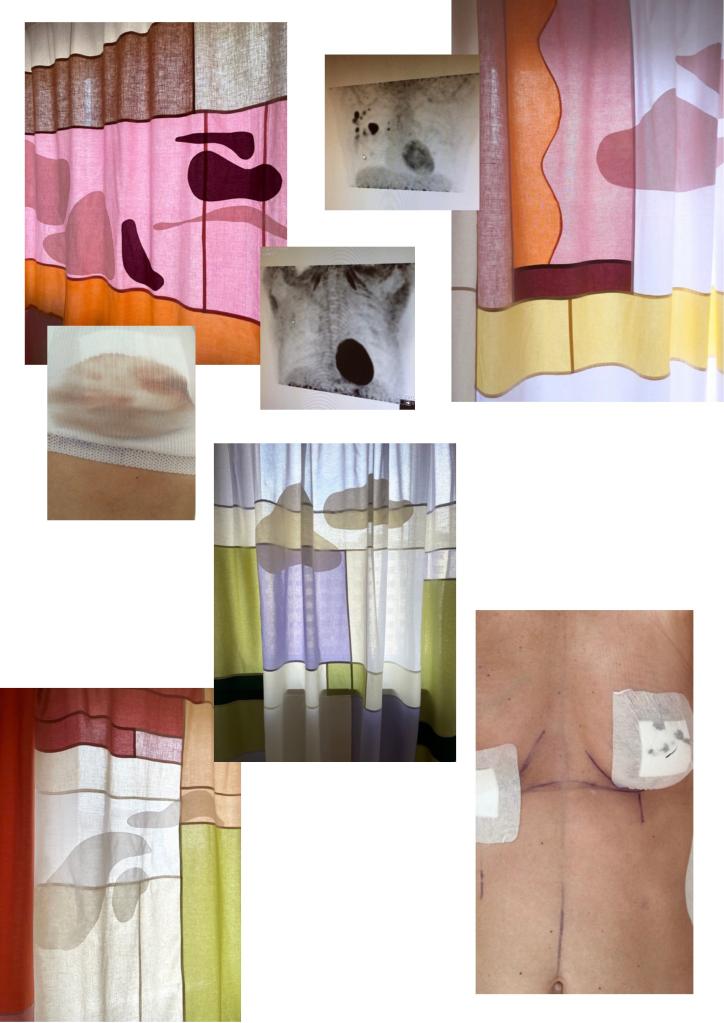


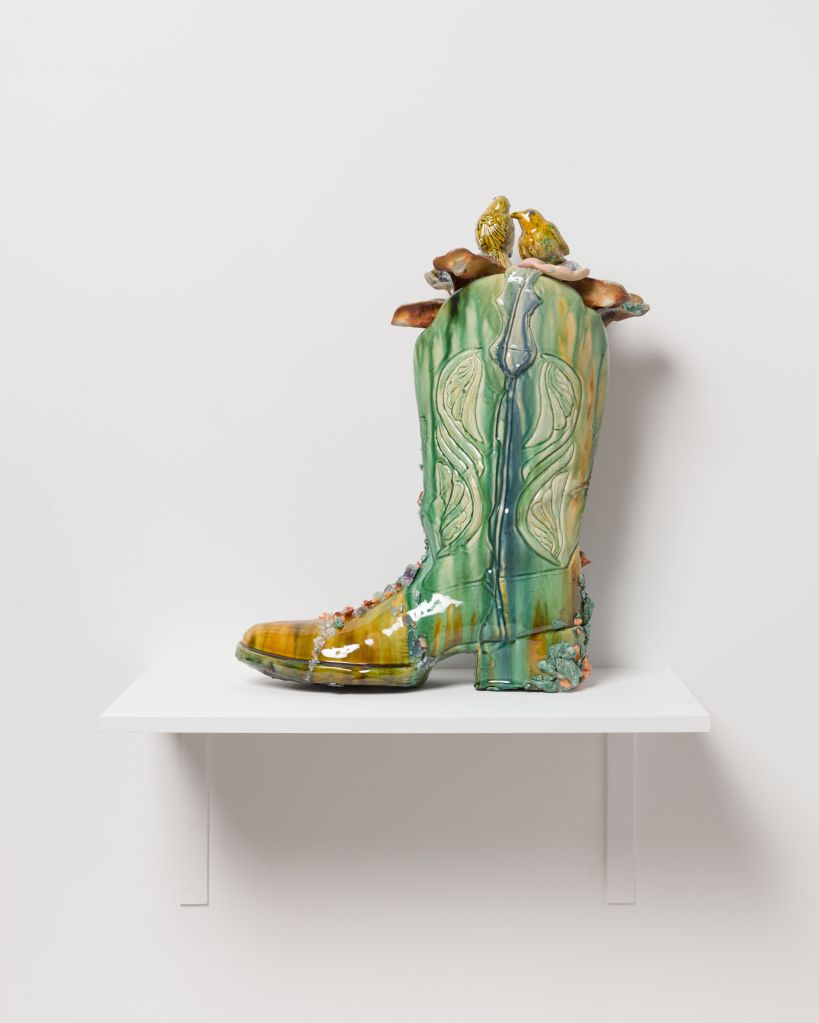


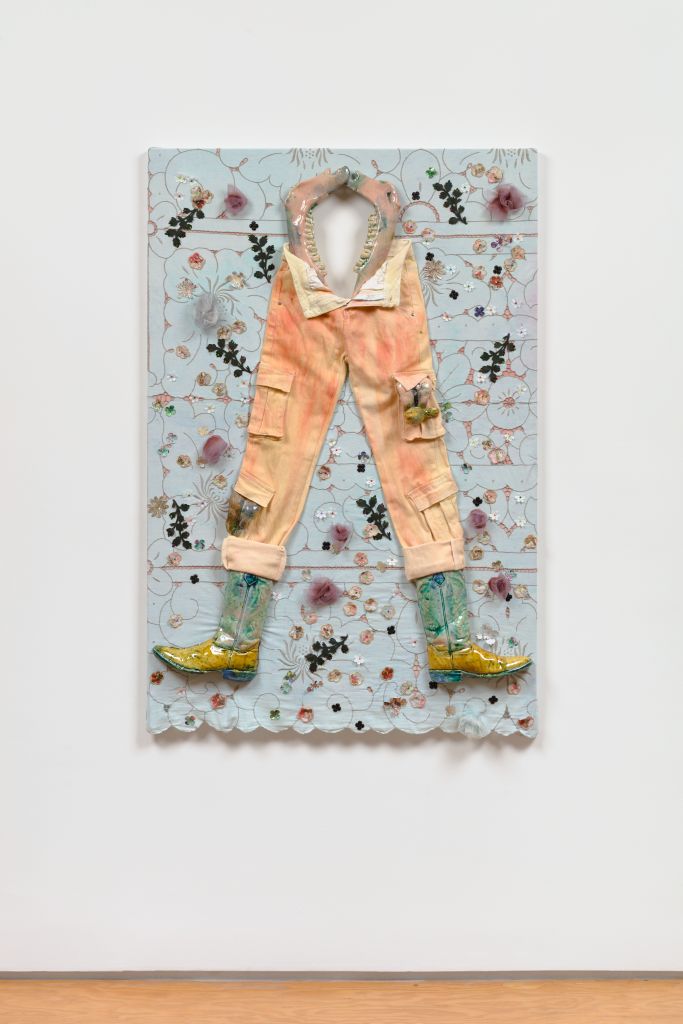


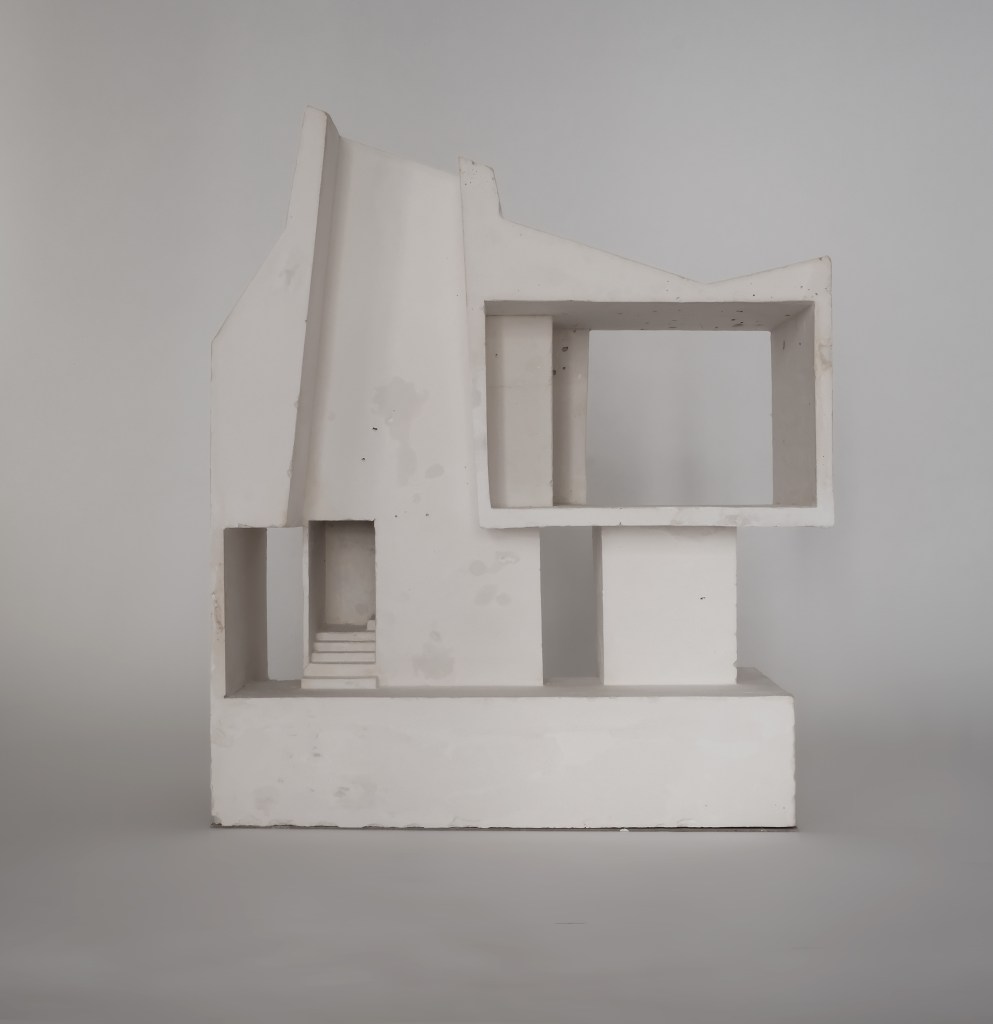




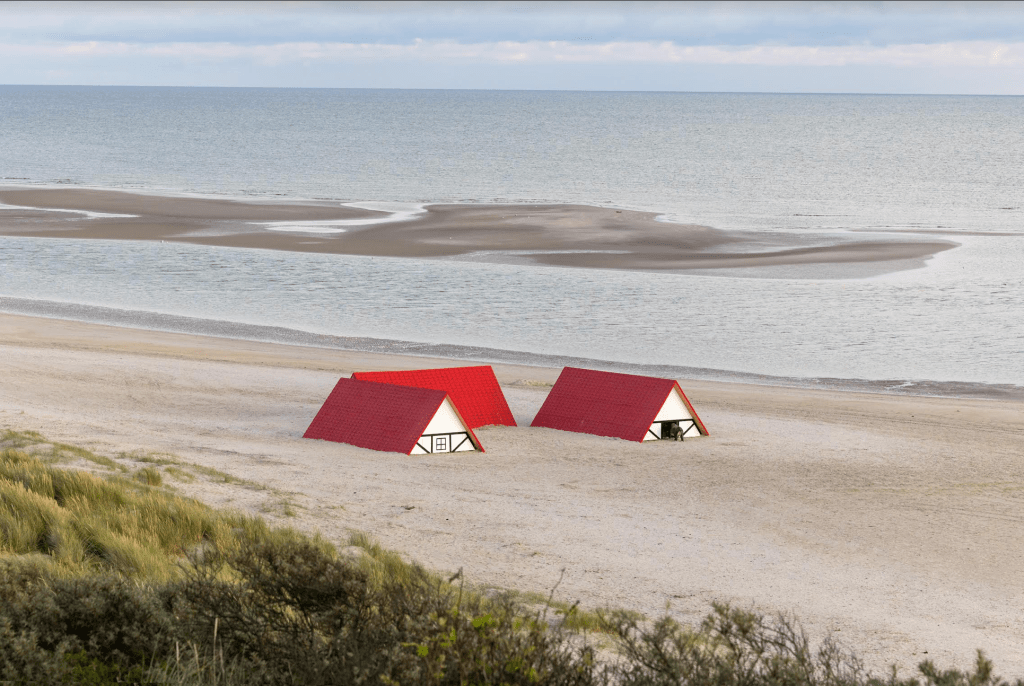
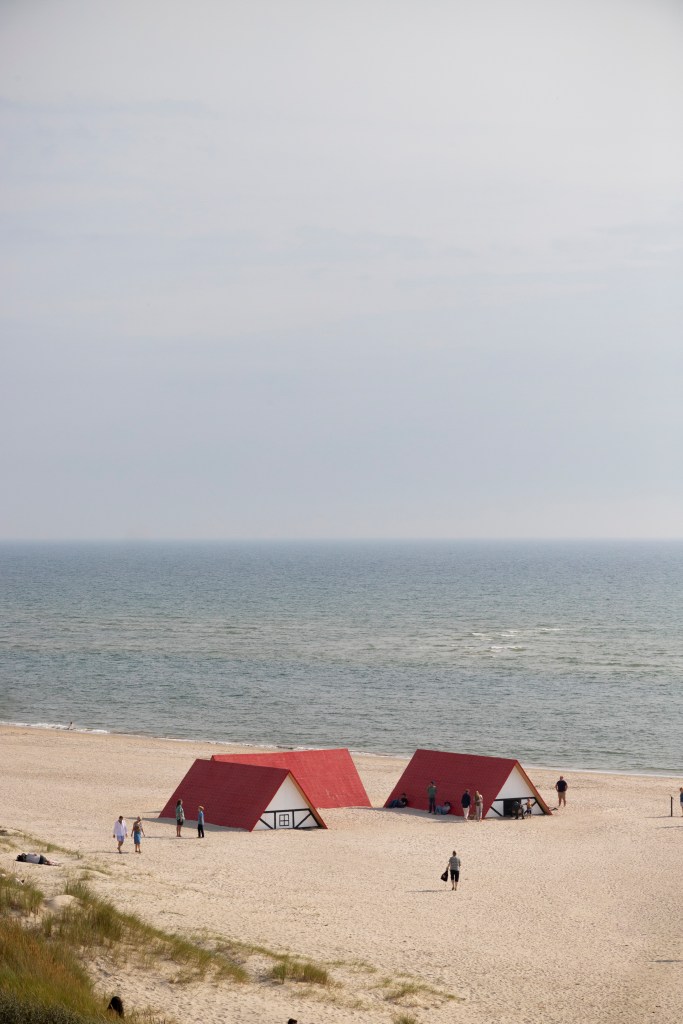
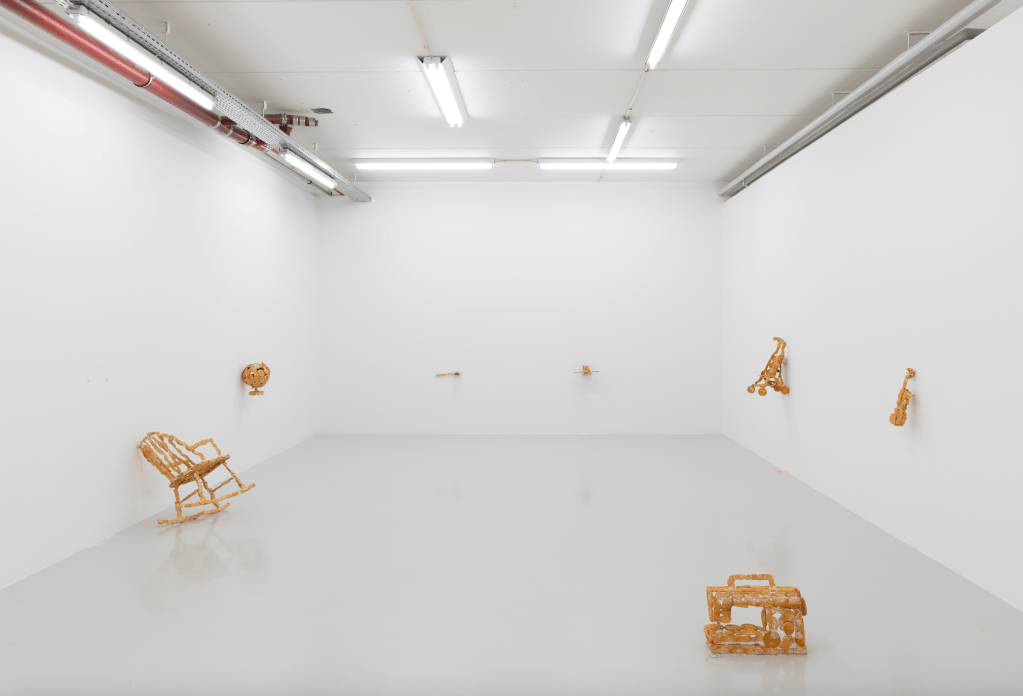
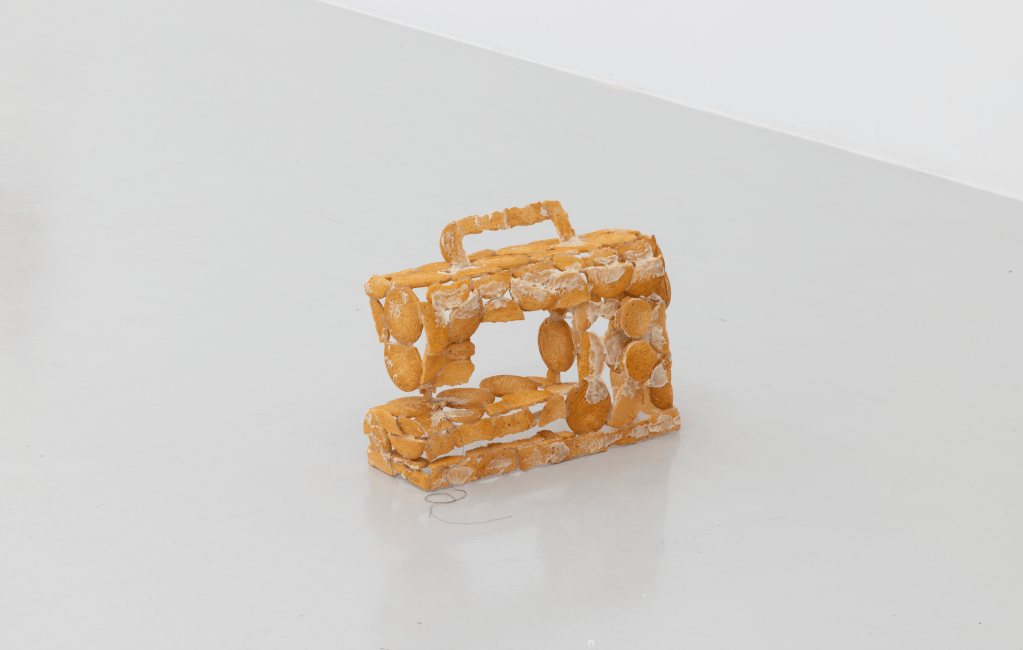

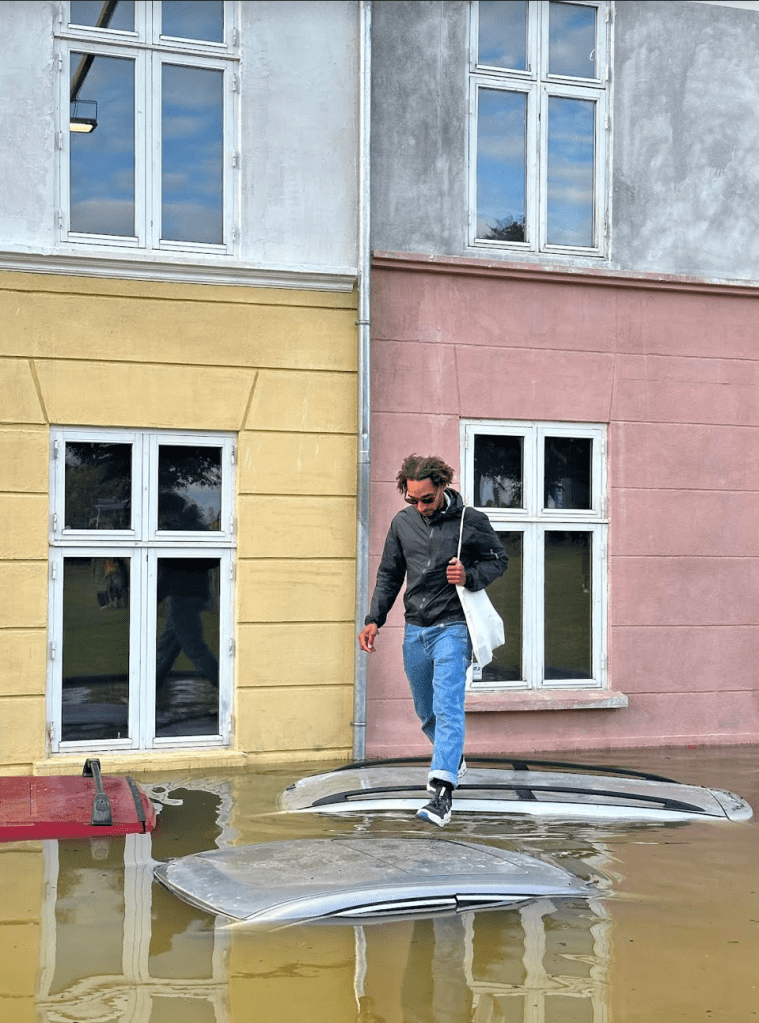
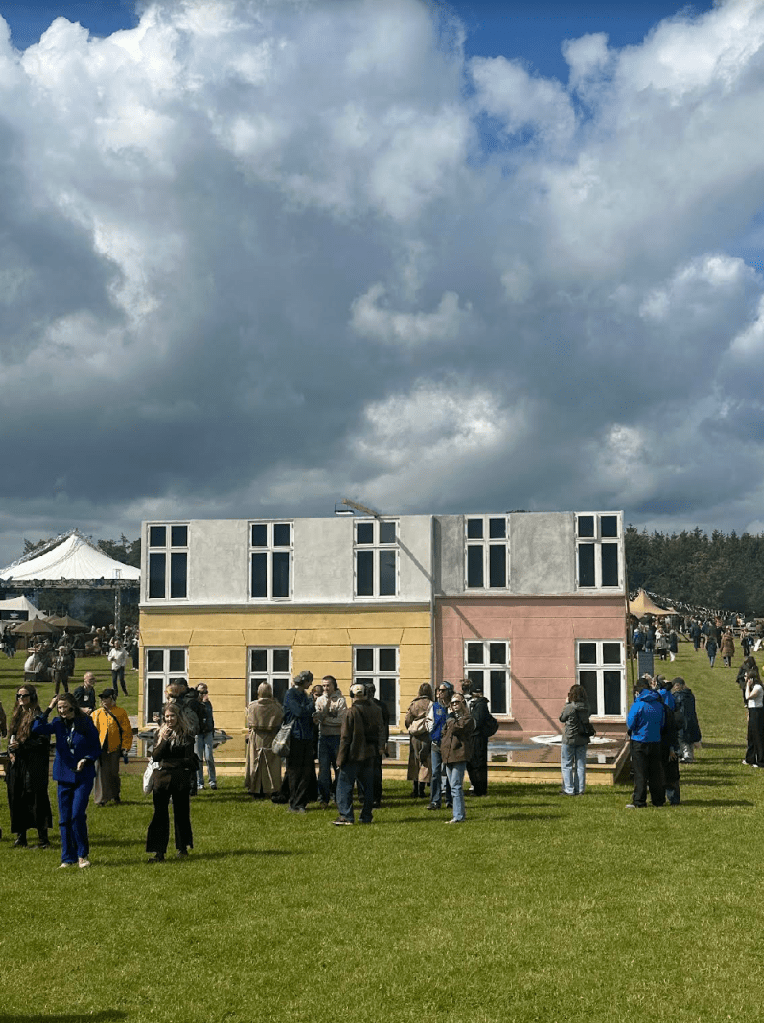
 differensmagazine.com