
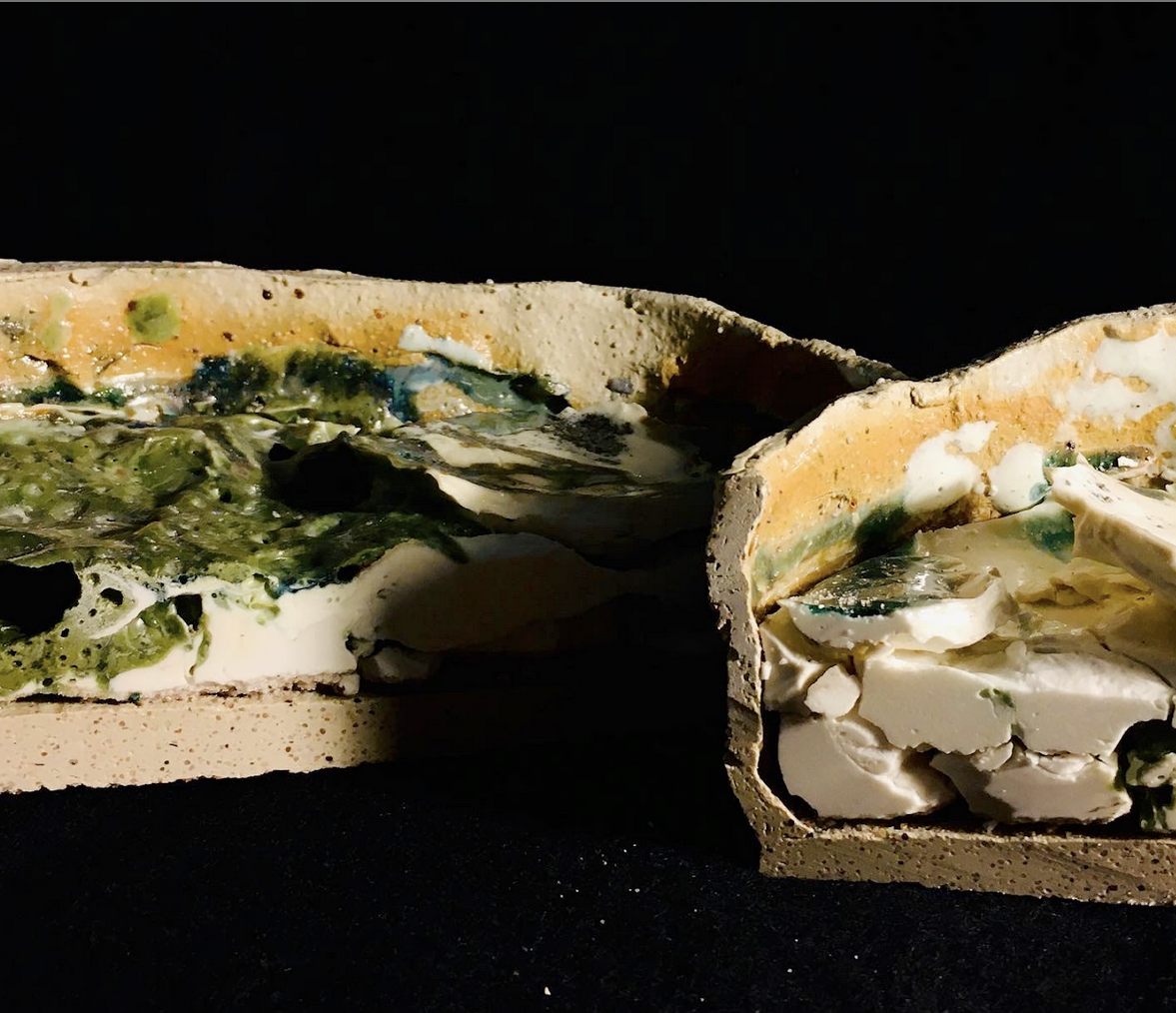
Crust (Ceramics), 2022, Ekta Bagri
#iv. the medium is the message?
#iv. a. medium and mediation
In the fourth issue of Differens Magazine, we investigated the “middle” that takes place between message and messenger or message and recipient, often referred to as medium, media or mediation. This intention resulted in a double issue, in which the first part includes texts exploring what a medium actually is, how it operates and affects the message it delivers – an impact that is demonstrated throughout the issue, while the second part takes a closer look at our own being: the Magazine as a medium.
In the first part, Media theorist and professor Jussi Parikka dwells on geology and the impact of the medium, its own “independent” activity. He proposes an “alternative materialism for the geophysical media age”, one of rare earth minerals and metals, connecting media to geological processes. Nicole Miller then presents her artistic project in which a machine learning program is used to create images of how climate change is visualized in media. Together with interviews conducted on people’s perception of climate change, she shows that media is rarely a passive lens through which you get a more or less exact view of the world.
Like Parikka, Jesper Olsson explores the connection between media/medium and materialism, arguing that our perception of time is always mediated and shaped by media technologies, and their specific materiality. Informed by German media theory, he analyzes the interconnection between time and medium addressed in two poetic works: Johannes Heldén and Håkan Jonsons Evolution (2013, 2014) and Lotta Lotass Fjärrskrift (“Distance Writing”, 2011).
Maria Rogg also explores media technology in terms of agency, turning to the so-called Toronto School to investigate datafication as a transformative perspective of media theory and, further, questioning whether its dualistic nature helps or hinders our understanding of a mediated world. Finally, Klara Hjorth participates with a poetic reflection on the mediator as a personality type, informed partly by the Myers-Briggs Type Indicator test (MBTI). Are Mediators devoid of content? And is that a bad thing? How much can dads decide your personality? And can you strike a pose?
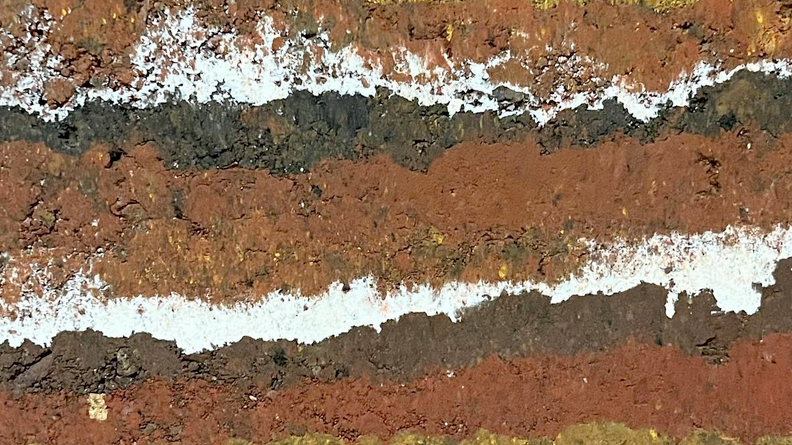
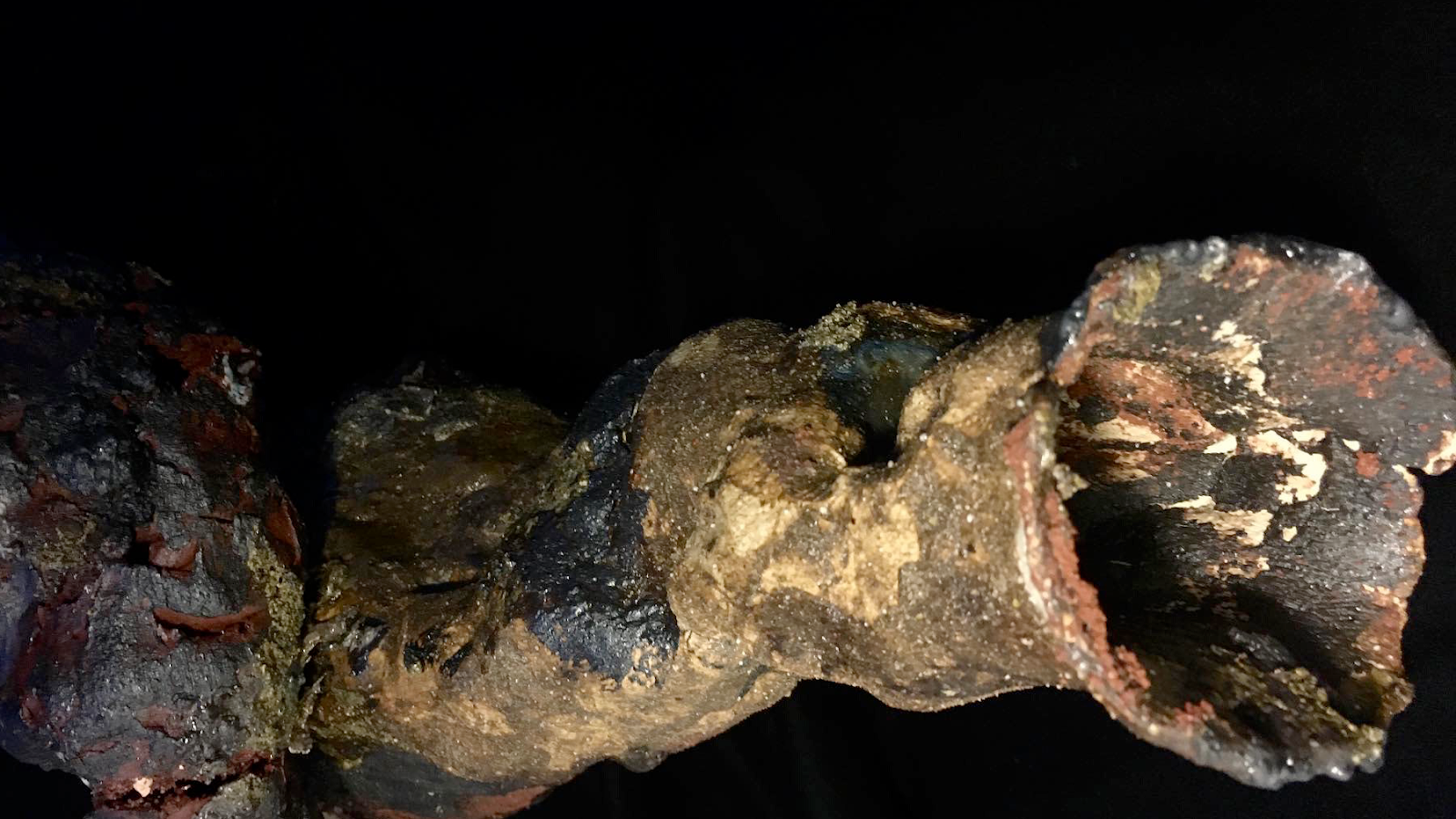
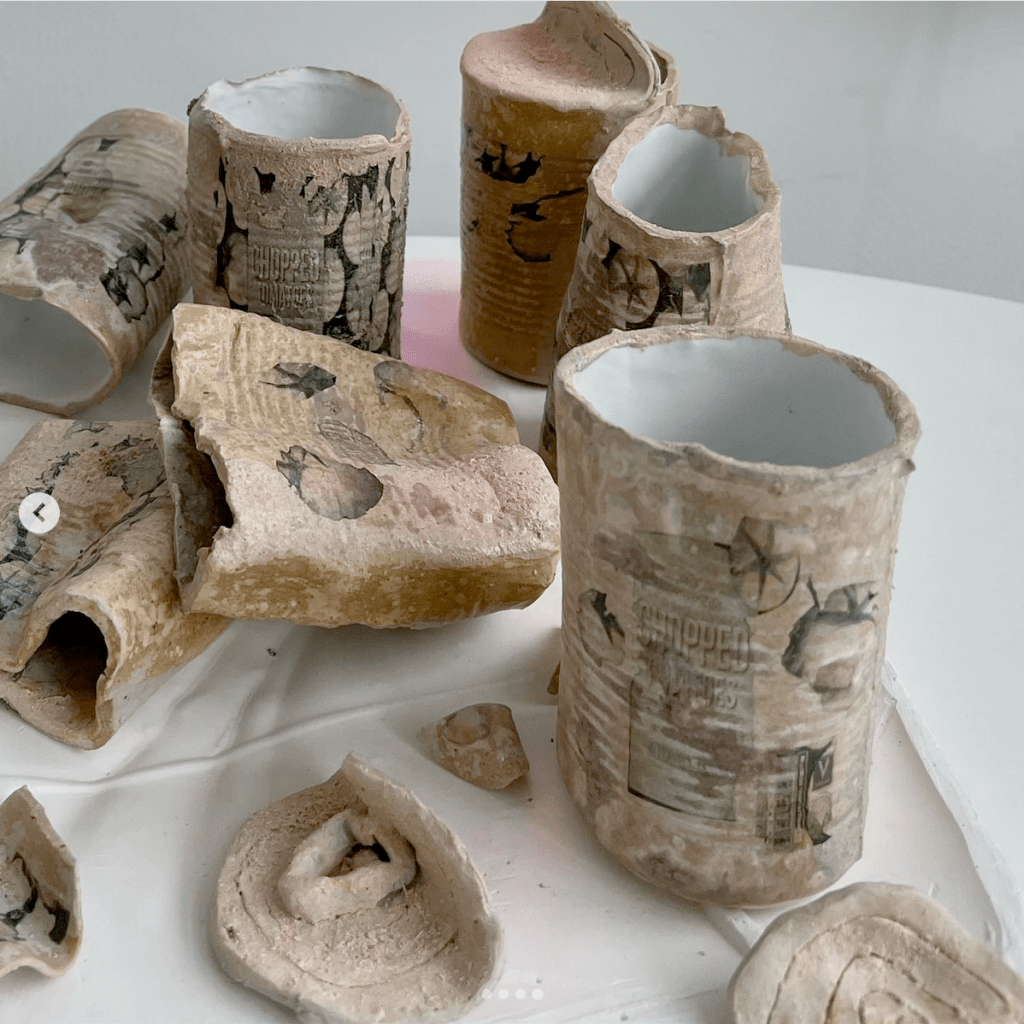
Throughout the issue, works by ceramist and visual artist Ekta Bagri are displayed. Like several aforementioned participants, the relationship between material and medium are explored here, but in this case through clay and not words as medium. She shows how clay is a material with its own principles and aesthetic qualities at the same time as a medium showcasing humans relationship to the earth, how historical and political practices of exploitation and coexistence leave their marks underground, in what usually escapes our gaze.
#iv. b. the message of the magazine
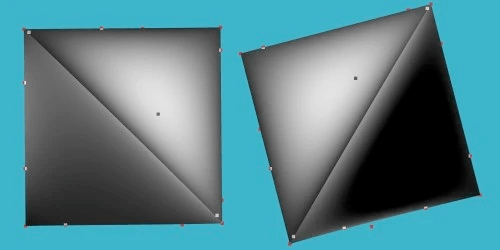
The second part, revolving around the Magazine as a medium, opens with a text written by Søren Andreasen and Lars Bang Larsen, which takes us on a tour among the different meanings and expressions of mediation. Astrid Elander participates with a brief reflection on the post-Internet art movement and on a 2015 issue of e-flux journal. Jonas Thoresson then investigates the cultural role of proletarian media by drawing primarily from an early 20th century Scottish case, thereby entering questions concerning the boundaries and limitations of print media under capitalist market conditions. To finish off the second part of this issue, we introduce to the readers an excerpt from Max Pihlström’s project blog ”femton”, which follows an esotheric road of discoveries regarding computer graphics, mathematical modeling, and triangular mesh.
A DOUBLE ISSUE
winter 23/24
sound
Drown it out, 2022. pbeatgirl
#IV. a. media and mediation
Ekta Bagri: Ceramics and Mediality
Jussi Parikka: An Alternative Media Materialism
Maria Rogg: Heralds of the Ontological Turn
Nicole Miller: The Atmosphere of Climate Change
Jesper Olsson: Times of Literature, Times of the Machine
#IV. b. the message of the magazine
Lars Bang Larsen: The Critical Mass of Mediation
Astrid Elander: Getting over the Internet
Jonas Thoresson: Print Media and Class Conflict
editors
Amanda Winberg
Astrid Elander
Johannes Stenlund
Klara Hjorth
Ale Låke
Agnes Ivarsson
ISSN: 2004-495X
Ceramics and Mediality
”Clay is both a material with its own principles and aesthetic qualities and a medium showcasing human’s relation to earth, exposing historical and political practices of exploitation and coexistence.”
contributon by:
Ekta Bagri
Klara Hjorth
language:
English
An Alternative Media Materialism
”What if there is another level of media materialism that is not so easily dismissed as we would think? What if media materialism is not something that hones in on the machines only? Where do machines come from, what composes technology in its materiality and media after it becomes disused, dysfunctional dead media that refuse to die?”
contributon by:
Jussi Parikka
language:
English
Heralds of the Ontological Turn: Re-reading the Toronto school as The Message of Felt Body Worlds
”By reminding us of our unique, relational bodies situated in this ecology Innis and McLuhan pronounce that media matter existentially and suggest to approach technology through the thick and impure involvement evoked by their texts. By writing otherwise they counteract the dualist categorization and hierarchical classification of differences that media technologies co-constitute.”
contributon by:
Maria Rogg
language:
English
The Atmosphere of Climate Change
”[…] I decided it would be interesting to use neural networks to study an extensive library of climate change media images and then generate images reflective of the collective atmosphere of all of the images.”
contributon by:
Nicole Miller
language:
English
Times of Literature, Times of the Machine: Poetic Media Archaeologies
”With such technical media [film and phonography], events taking place at different points in time (and in different places) could be juxtaposed in an amazing way, the speed of events could be increased or decreased, and time could even be made to go backward —a device heavily exploited by early cinema.”
contributon by:
Jesper Olsson
language:
English
Although they may seem quiet or unassuming, Mediators (INFPs) have vibrant, passionate inner lives
”en pappa kan bestämma vem man är. Det är synd. han såg bara det som speglade honom själv. Alla beskyllningar om att jag är innehållslös stämmer därför. / My commitment to authenticity. Jag har aldrig satt en gräns. Jag flyttar mig på varje vink. / The mediator is a relay or a catalyst that is active at the limit of philosophy.”
contributon by:
Klara Hjorth
language:
Swedish/English
The Critical Mass of Mediation
”Mediation creates facts that reality imitates. The mediating function is evasive, it disarticulates itself because it is a function that does not reflect or problematise itself. When democratic and cultural institutions are under pressure, criteria for evaluating mediation are stressed too. The risk is that these criteria—the concepts we have for freedom, creativity and democratic reason—will withdraw to the non-places of power.”
contributon by:
Lars Bang Larsen
Søren Andreasen
language:
English
Getting Over the Internet
”With its involvement in nearly every aspect of our lives, the internet proves that at least, we cannot separate ourselves from our tools. For most of us, an existence beyond the internet is only a theoretical abstraction, as our bodies start to itch after only a few minutes apart from it. We are what we evolve into in our interactions with the world, through and together with the means we use to interact.”
contributon by:
Astrid Elander
language:
English
Print Media and Class Conflict
”This cursory glance at the dynamics of proletarian print media, whose use-value was understood to lie in the critical education they offered to a collective project of emancipation under difficult conditions, offers an opportunity to reflect on the contemporary conditions for the public use of critical reason.”
contributon by:
Jonas Thoresson
language:
English
Digital Mesh: Ten Fragments from the Project “Femton”, 2017 – 2018.
”In the project of Femton it is precisely the distinguishing power of contour, in all its elusiveness, that has always been key. With an alternative way of constructing contour there arises first and foremost an alternative way of presenting images, as opposed to re-presenting them: imagery as production, not mere acquisition.”
contributon by:
Max Pihlström
language:
English
—
—
For collaborations or contribution with ideas or material, email contribute@differensmagazine.com
For questions concerning the Differens Association, please email tidskriften.differens@gmail.com

Differens Magazine strives to make connections between academic aesthetics and practices within the art world, using contemporary political topics and conflicts to experiment on new ways of thinking together.
ISSN: 2004-495X
© Differens Magazine
Differens Magazine is funded by the Swedish Arts Council, Kulturrådet.
 differensmagazine.com